Forex trading grabs attention by moving over $6.6 trillion every single day, making it the most active financial market on earth. Most people imagine gambling and chaos, with fortunes won or lost in seconds. Yet the biggest surprise is how much forex relies on good old-fashioned discipline and learning, not just wild bets. If you think this is only for pros with complicated strategies, think again.
Table of Contents
- Understanding Forex Trading Basics
- How Forex Trading Works In Practice
- Key Benefits And Risks For All Trader Types
- Tips For Starting Forex Trading Successfully
Quick Summary
| Takeaway | Explanation |
|---|---|
| Forex is a 24-hour market | It operates globally, allowing currency trading at any time from Sunday evening to Friday evening. |
| Learn risk management techniques | Essential strategies include stop loss orders and position sizing to protect your capital. |
| Use demo accounts for practice | Beginners should start with demo accounts to understand trading mechanisms without risking real money. |
| Focus on economic indicators | Analyze factors like GDP and unemployment rates to predict currency movements effectively. |
| Continuous education is crucial | Traders must commit to ongoing learning through courses and market analysis to improve their skills. |
Understanding Forex Trading Basics
Forex trading represents a dynamic global marketplace where currencies are exchanged, creating opportunities for traders to potentially generate profits through strategic financial transactions. This complex yet fascinating world of currency exchange involves multiple participants ranging from individual traders to massive financial institutions.
What Makes Forex Unique
The foreign exchange market distinguishes itself from other financial markets through several key characteristics. Unlike stock markets with centralized exchanges, forex operates as a decentralized global network where currencies are traded 24 hours a day, five days a week. Investopedia reports that the forex market handles an incredible average daily trading volume exceeding $6.6 trillion, making it the largest financial market worldwide.
Traders participate in forex by simultaneously buying one currency while selling another, typically in currency pairs. These pairs represent the relative value between two different monetary systems. For instance, in the EUR/USD pair, a trader speculates on the euro’s performance against the US dollar. The primary goal is to predict and profit from fluctuations in exchange rates.
Key Market Participants
Forex trading involves diverse participants who contribute to the market’s liquidity and complexity. Bank for International Settlements identifies several critical groups driving currency exchanges:
-
Central Banks: These institutions manage national monetary policies and can significantly impact currency values through interest rate adjustments and economic interventions.
-
Commercial Banks: They facilitate international transactions and provide liquidity by continuously trading currencies.
-
Institutional Investors: Hedge funds, pension funds, and investment firms trade currencies as part of their diversification strategies.
-
Retail Traders: Individual traders like you who access the market through online platforms, seeking to capitalize on currency price movements.
Below is a summary table outlining the key characteristics and roles of major forex market participants as discussed above. This helps clarify the differences among central banks, commercial banks, institutional investors, and retail traders:
| Participant | Main Role | Influence on Market |
|---|---|---|
| Central Banks | Manage monetary policy; intervene in markets | Can significantly shift currencies via policy decisions |
| Commercial Banks | Facilitate international transactions; provide liquidity | Main drivers of daily transactions |
| Institutional Investors | Diversify portfolios and seek returns | Large volume trades can impact rates |
| Retail Traders | Individual/speculative trading via online platforms | Provide additional liquidity, less impact individually |
Understanding these market dynamics helps traders recognize the interconnected nature of global financial systems. Forex trading is not just about predicting price changes but comprehending the complex economic factors influencing currency valuations.
Successful forex trading requires continuous learning, risk management, and an ability to interpret global economic indicators. Traders must develop skills in technical analysis, fundamental research, and emotional discipline to navigate this challenging yet potentially rewarding financial landscape.
How Forex Trading Works in Practice
Forex trading transforms complex global financial interactions into practical trading opportunities for individuals and institutions. Understanding the mechanics of how trades are executed requires insight into the platforms, strategies, and technical components that drive currency exchanges.
Trading Platforms and Execution
Modern forex trading relies on sophisticated online platforms that connect traders to global currency markets in real time. Forex.com explains that these platforms provide traders with essential tools like live price quotes, advanced charting capabilities, and instant trade execution. Traders can access these platforms through desktop applications, web browsers, and mobile apps, enabling flexible trading from virtually anywhere in the world.
The actual process of trading involves selecting a currency pair, determining the trade size, and choosing between buying (going long) or selling (going short). Each trade represents a simultaneous transaction where one currency is exchanged for another based on current market rates. Professional traders use specialized software that allows them to execute trades within milliseconds, capitalizing on even minor price fluctuations.
Understanding Currency Pair Dynamics
Currency pairs are the fundamental building blocks of forex trading. Bank of International Settlements notes that these pairs represent the relative value between two different currencies. Major pairs like EUR/USD, USD/JPY, and GBP/USD dominate global trading volumes. Each pair consists of a base currency and a quote currency, with the exchange rate indicating how much of the quote currency is required to purchase one unit of the base currency.
Traders analyze multiple factors to predict currency movements:
- Economic Indicators: Unemployment rates, inflation data, and GDP growth
- Political Stability: Government policies and geopolitical events
- Market Sentiment: Overall trader perception and global economic trends
Risk Management Strategies
Successful forex trading extends far beyond simply predicting currency movements. Effective risk management determines a trader’s long term sustainability. Professional traders implement strategic approaches to protect their capital and minimize potential losses.
Key risk management techniques include:
- Stop Loss Orders: Automatically closing trades at predetermined loss levels
- Position Sizing: Controlling the amount of capital risked in each trade
- Diversification: Spreading investments across multiple currency pairs
- Leverage Control: Carefully managing borrowed trading capital
Traders must develop disciplined approaches that balance potential profits with realistic risk assessment. This requires continuous learning, emotional control, and a comprehensive understanding of global economic systems. While forex trading offers exciting opportunities, it demands serious commitment, strategic thinking, and ongoing education to navigate successfully.
Key Benefits and Risks for All Trader Types
Forex trading presents a complex landscape of potential opportunities and significant challenges for traders across different experience levels. Understanding the nuanced benefits and risks is crucial for making informed trading decisions and protecting financial investments.
Potential Trading Advantages
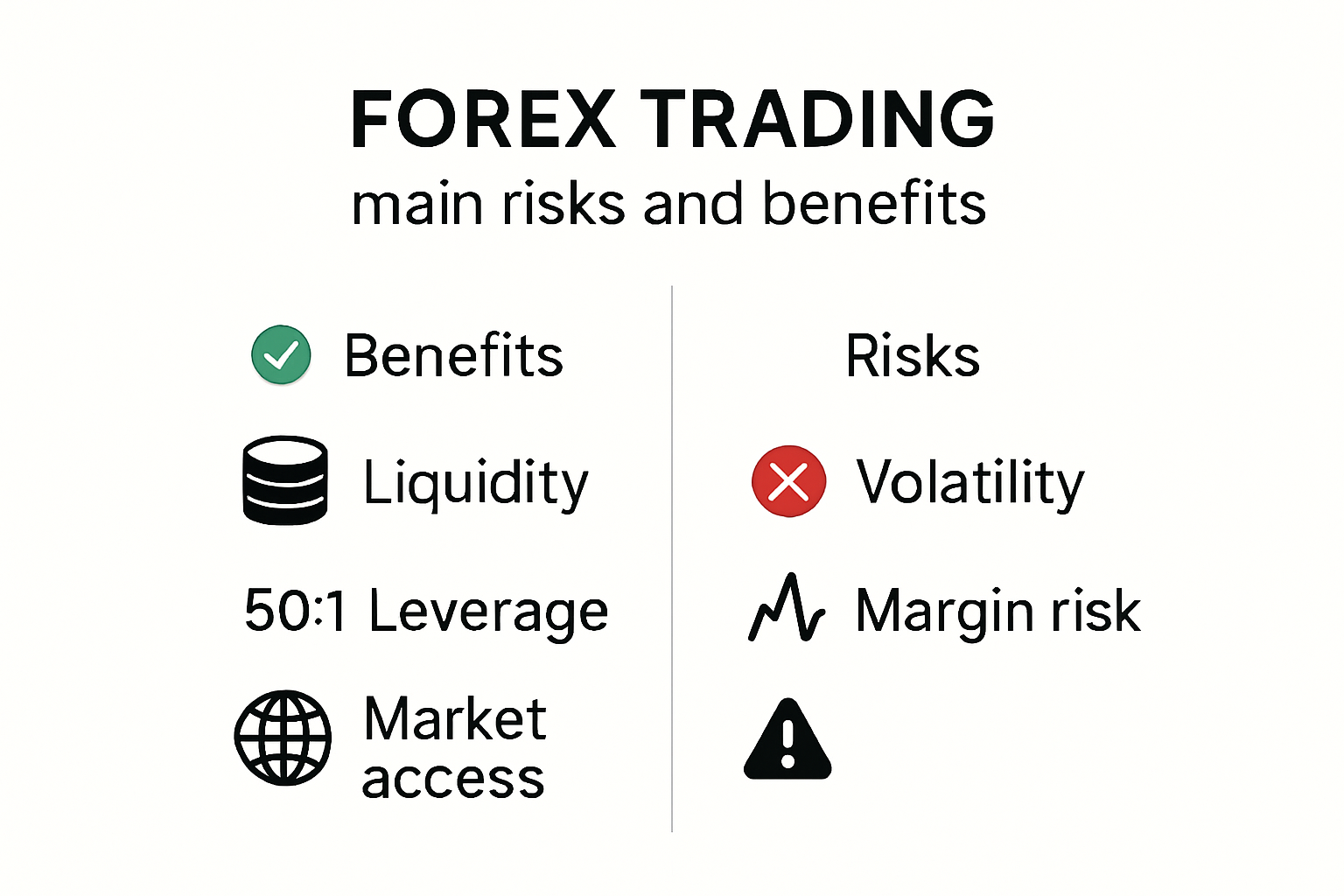
Forex markets offer unique advantages that attract traders from various backgrounds. SEC Investor Resources highlights several key benefits:
- High Liquidity: Currency markets provide exceptional trading flexibility with rapid transaction execution
- Global Accessibility: Traders can participate 24 hours a day across multiple international markets
- Low Entry Barriers: Minimum investment requirements are often lower compared to traditional stock markets
- Potential for Profit in Multiple Market Conditions: Traders can potentially generate returns during both rising and falling market scenarios
The global nature of forex trading means investors can capitalize on economic variations across different countries. Sophisticated traders leverage these international market dynamics to create diverse investment strategies that extend beyond traditional financial instruments.
Critical Risk Considerations
Australian Securities and Investments Commission warns that forex trading involves substantial financial risks. The complex market environment demands comprehensive understanding and disciplined approach:
- High Volatility: Currency exchange rates can fluctuate dramatically within short time periods
- Leverage Risks: Margin trading can amplify potential losses beyond initial investments
- Complex Market Dynamics: Economic, political, and global events rapidly impact currency valuations
- Technical Complexity: Successful trading requires advanced analytical and emotional management skills
Traders must recognize that leverage is a double edged sword. While it can potentially magnify profits, it equally increases potential losses. Professional traders typically recommend risking no more than 1-2% of total trading capital in any single transaction.
Here is a summary table outlining the main advantages and risks of forex trading. This quick reference can help readers compare the most important benefits and critical considerations at a glance:
| Advantage | Description |
|---|---|
| High Liquidity | Enables flexible and rapid trading execution |
| Global Accessibility | 24-hour access to international markets |
| Low Entry Barriers | Lower minimum investment compared to stock markets |
| Profit Potential in Any Market | Opportunities exist in both rising and falling markets |
| Risk | Description |
|---|---|
| High Volatility | Large price swings can lead to rapid losses |
| Leverage Risks | Losses can exceed deposits when using margin |
| Complex Market Dynamics | Economic and political events add unpredictability |
| Technical Complexity | Requires advanced analysis and emotional control |
Strategic Risk Management
Mitigating forex trading risks requires a multifaceted approach. Successful traders implement comprehensive strategies that balance potential rewards with prudent risk control:
- Continuous Education: Regularly update knowledge about global economic trends
- Technical Analysis: Utilize advanced charting and predictive tools
- Emotional Discipline: Develop psychological resilience against market fluctuations
- Diversification: Spread investments across multiple currency pairs
Traders should approach forex as a serious financial endeavor requiring dedicated study, practice, and continuous learning. While opportunities exist, sustainable success demands strategic thinking, rigorous research, and an understanding that losses are an inherent part of the trading journey.
Ultimately, forex trading is not a get rich quick scheme but a sophisticated financial practice requiring commitment, skill, and a realistic perspective on potential outcomes.
Tips for Starting Forex Trading Successfully
Embarking on a forex trading journey requires strategic preparation, continuous learning, and a disciplined approach. New traders must navigate a complex financial landscape with carefully developed skills and realistic expectations.
Building a Strong Foundation

Investopedia recommends starting with a demo account to develop practical trading skills without financial risk. This approach allows beginners to understand market mechanics, test trading strategies, and build confidence before committing real capital.
Education is the cornerstone of successful forex trading. Aspiring traders should invest time in comprehensive learning resources including:
- Online Courses: Structured educational programs covering forex fundamentals
- Trading Books: Comprehensive guides from experienced traders
- Webinars: Interactive learning sessions with market professionals
- Market Analysis Resources: Technical and fundamental analysis platforms
Understanding technical analysis tools becomes crucial. Learning to read price charts, recognize trading patterns, and interpret economic indicators separates successful traders from novices. Practice interpreting candlestick patterns, moving averages, and support resistance levels.
Risk Management Strategies
Effective risk management determines long term trading sustainability. Professional traders emphasize protecting capital as the primary objective. FXCM Trading Education suggests implementing critical risk control techniques:
- Position Sizing: Never risk more than 1-2% of total trading capital in a single trade
- Stop Loss Implementation: Automatically limit potential losses
- Consistent Trading Plan: Develop and strictly follow a predetermined strategy
- Emotional Control: Maintain psychological discipline during market fluctuations
Traders must treat forex as a serious financial endeavor requiring continuous learning and self improvement. Emotional intelligence plays a significant role in navigating market uncertainties.
Technology and Tools
Modern forex trading relies heavily on sophisticated technological resources. Selecting appropriate trading platforms and analytical tools becomes a critical decision for new traders. Key considerations include:
- Platform Reliability: Secure, user friendly trading interfaces
- Real Time Data: Accurate and instantaneous market information
- Mobile Accessibility: Trading capabilities across multiple devices
- Advanced Charting: Comprehensive analytical visualization tools
Beginners should prioritize platforms offering educational resources, demo accounts, and responsive customer support. Many platforms provide integrated learning modules that help traders understand complex market dynamics.
Successful forex trading is not about overnight riches but consistent skill development. Approach the market with patience, continuous learning, and a commitment to understanding global economic systems. Remember that every experienced trader was once a beginner who remained dedicated to improving their craft.
Frequently Asked Questions
What is forex trading?
Forex trading involves exchanging currencies in a global marketplace, aiming to profit from fluctuations in currency prices. It operates 24 hours a day, allowing traders to buy and sell currency pairs.
How do I start trading forex?
To start trading forex, consider opening a demo account to practice without risk. Educate yourself through online courses, trading books, and webinars to build a strong understanding of market dynamics and trading strategies.
What are the key risks involved in forex trading?
Key risks in forex trading include high volatility, leverage risks, and complex market dynamics influenced by economic and political factors. Managing these risks with strategies like stop loss orders and position sizing is crucial for sustainable trading.
Why is risk management important in forex trading?
Risk management is vital in forex trading because it helps protect your capital and minimize potential losses. Employing strategies such as limiting the amount of capital risked per trade and setting stop loss orders can safeguard your investments.
Ready to Trade Smarter? Unlock Your Forex Edge with FrankFX
Struggling to move from demo practice to real profits, or feeling overwhelmed by the pressure to manage risk and analyze the market on your own? The journey from understanding forex basics to making smart trades often leaves traders questioning their strategies, emotional discipline, and access to timely signals. You do not have to figure it out alone.
Join a strong community of active traders at FrankFX and get instant access to proven trading signals, mentorship, and tools designed to help you control risk and read currency trends with confidence. Discover free resources like forex calculators and indicators, or choose a VIP membership for daily live analysis, signals, and automated trading solutions. Take control of your trading outcomes today by visiting FrankFX and see how the right support and real-time strategies can transform your results now.