Trading can look like a quick way to build wealth and yet most traders lose money within their first year. In fact, about 80% of day traders quit within two years. Surprisingly, it’s not a lack of strategy that sinks most accounts. The real reason is a lack of risk management and mastering this skill is what separates surviving traders from those who disappear after one unlucky trade.
Table of Contents
- Why Risk Management In Trading Matters
- Key Strategies For Managing Trading Risks
- Common Mistakes Traders Make With Risk
- Building Your Own Trading Risk Plan
Quick Summary
| Takeaway | Explanation |
|---|---|
| Implement the One-Percent Rule | Limit risk to a maximum of 1% of your portfolio per trade to protect against substantial losses. |
| Utilize Automated Risk Controls | Employ stop-loss and take-profit orders to reduce emotional decision-making and manage risk effectively. |
| Diversify Investments Strategically | Spread investments across various asset classes to minimize impact from any single losing trade. |
| Establish a Personal Risk Plan | Assess your risk tolerance and create quantifiable parameters for your trading to enhance disciplined decision-making. |
| Avoid Emotional Trading Decisions | Recognize the dangers of impulsive trading driven by fear or greed to maintain a rational approach in your strategy. |
Why Risk Management in Trading Matters
Trading without a robust risk management strategy is like navigating a treacherous ocean without a compass. Every trader faces potential financial losses, but those who understand and implement strategic risk control can turn potential disaster into sustainable success.
The Financial Survival Imperative
Financial risk management represents more than a technical requirement. It is the critical defensive mechanism that protects traders from catastrophic losses. According to the Wikipedia entry on financial risk management, effective strategies are essential for protecting economic value by managing exposure to various financial risks.
Traders encounter multiple risk dimensions in their daily activities. Market volatility, unexpected economic shifts, and personal emotional responses can quickly transform potential profits into significant monetary losses. Professional traders recognize that preserving capital is fundamentally more important than generating massive returns.
Understanding Risk Exposure
Research from OpenStax highlights that financial managers must work strategically to decrease the riskiness of financial transactions. For traders, this translates into several critical practices:
- Capital Preservation: Protecting your trading account from substantial drawdowns
- Position Sizing: Limiting individual trade risk to a small percentage of total capital
- Emotional Control: Preventing impulsive decisions driven by fear or greed
The core principle is straightforward. By systematically managing risk, traders create a sustainable approach that allows them to survive market uncertainties and continue trading over the long term.
The Psychological Dimension of Risk Management
Beyond mathematical calculations, risk management involves profound psychological discipline. Successful traders understand that consistent, measured approaches trump sporadic, high-risk gambles. Market risk research demonstrates that potential losses can emerge from multiple variables including price movements and market volatility.
Traders who master risk management develop a strategic mindset. They view each trade as a probabilistic event, not a guaranteed outcome. This perspective allows them to:
- Implement strict stop-loss strategies
- Diversify trading instruments
- Maintain realistic profit expectations
- Continuously learn and adapt their approach
The most sophisticated traders recognize that risk management is not about eliminating risk entirely. Instead, it’s about understanding, measuring, and controlling potential negative outcomes while maintaining the flexibility to capitalize on profitable opportunities.
Effective risk management transforms trading from a speculative activity into a calculated, strategic endeavor. By adopting a disciplined approach, traders can navigate market complexities with confidence, resilience, and a higher probability of long-term success.
Key Strategies for Managing Trading Risks
Successful trading demands more than intuition. It requires a systematic approach to managing potential risks that can erode trading capital and derail financial goals. Understanding and implementing strategic risk management techniques is the difference between sustainable trading and potential financial disaster.
The One-Percent Rule: Protecting Your Capital
Investopedia highlights a critical strategy known as the One-Percent Rule. This fundamental principle advises traders to never risk more than 1% of their total portfolio on a single trade. By limiting potential losses, traders create a protective buffer that prevents catastrophic account drawdowns.
Implementing the One-Percent Rule requires disciplined position sizing. Traders calculate their maximum risk per trade by determining the difference between their entry point and stop-loss level. This approach transforms trading from gambling to a calculated financial strategy, ensuring that no single trade can significantly damage overall portfolio performance.
Automated Risk Control Mechanisms
Foreign exchange risk management research reveals multiple techniques for controlling potential losses. Automated risk control mechanisms play a crucial role in this process. Stop-loss and take-profit orders represent powerful tools that remove emotional decision-making from trading.
Key automated risk control strategies include:
- Stop-Loss Orders: Automatically exit a trade when losses reach a predetermined level
- Take-Profit Orders: Lock in gains by automatically closing positions at target prices
- Trailing Stops: Dynamically adjust stop-loss levels to protect accumulated profits
These mechanisms provide traders with a structured approach to managing risk, ensuring that potential losses are contained while allowing profitable trades to develop.
Diversification and Hedging Techniques
Professional traders understand that risk management extends beyond individual trade protection. Investopedia experts emphasize the importance of diversification and strategic hedging.
Diversification involves spreading investments across different financial instruments, markets, and asset classes. This approach reduces the impact of potential losses in any single trading area. Hedging techniques, such as using options or futures contracts, provide additional layers of protection against market volatility.
Effective traders develop a comprehensive risk management strategy that combines multiple approaches. They continuously analyze their trading performance, understanding their win-loss ratios and average trade outcomes. This data-driven approach allows for constant refinement of risk management techniques.
Ultimately, successful risk management is about creating a sustainable trading approach. By implementing disciplined strategies, using automated tools, and maintaining a comprehensive view of potential risks, traders can transform uncertainty into opportunity. The goal is not to eliminate risk entirely but to manage it intelligently, preserving capital while creating consistent growth potential.
To help you compare and understand the main risk management strategies discussed, here’s a summary table outlining their core features and the benefits they provide to traders:
| Strategy | Core Feature | Key Benefit |
|---|---|---|
| One-Percent Rule | Limits trade risk to 1% of portfolio per trade | Prevents large losses; preserves capital |
| Automated Risk Controls | Use of stop-loss, take-profit, and trailing stop orders | Reduces emotions; locks in profits/losses |
| Diversification & Hedging | Invests across various assets; employs hedging instruments | Reduces risk from single trade or market move |
| Personalized Risk Plan | Customizes rules based on individual risk tolerance | Enhances discipline; fits trader’s profile |
| Emotional Discipline | Follows predefined rules; analytical review | Avoids impulsive mistakes; consistency |
Common Mistakes Traders Make With Risk
Trading involves navigating complex financial landscapes where small mistakes can result in substantial losses. Understanding and recognizing common risk management errors is crucial for developing a sustainable and successful trading approach.
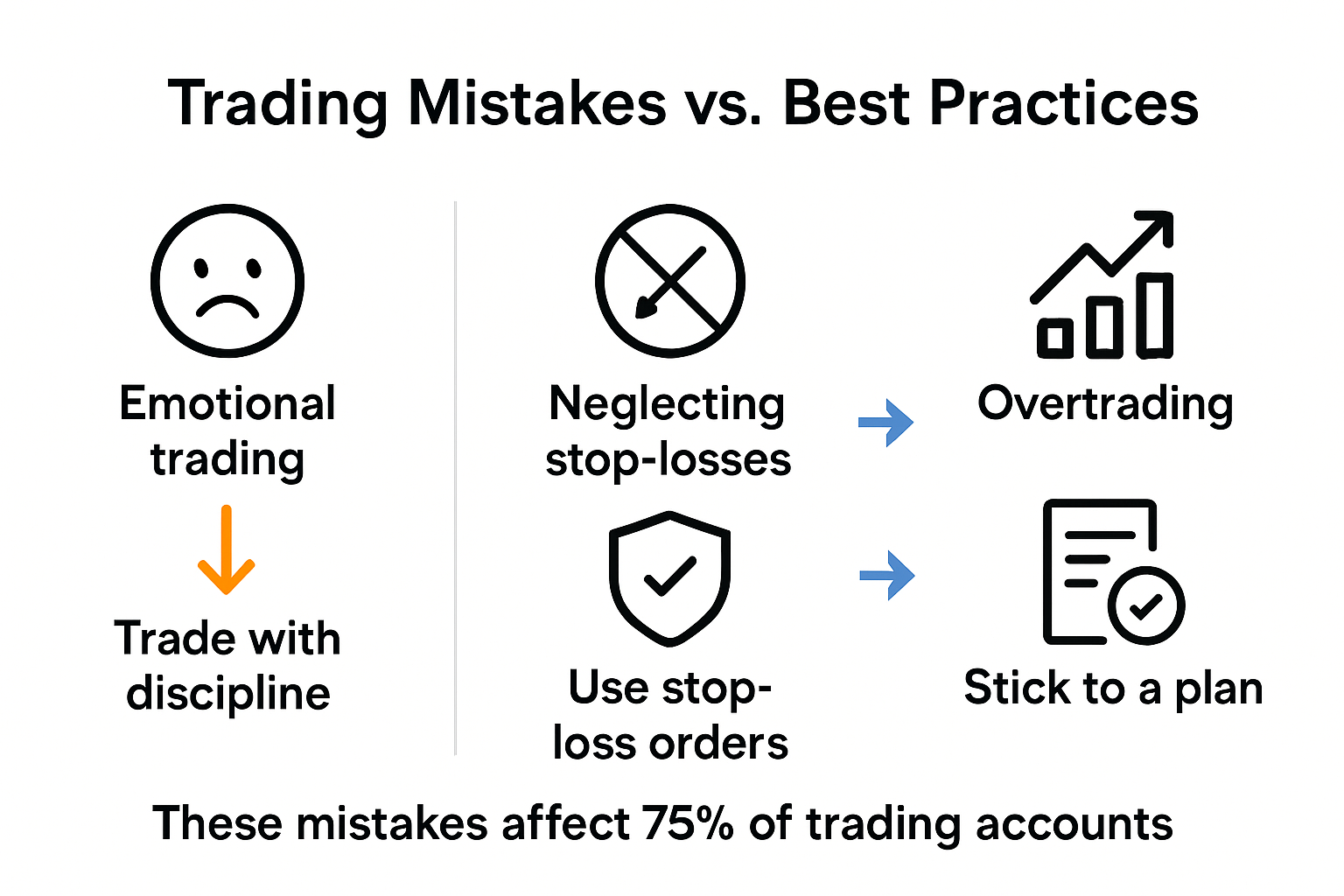
Emotional Decision Making
Charles Schwab emphasizes that emotional trading represents one of the most dangerous pitfalls for traders. Fear, greed, and impulsivity can quickly transform rational strategies into catastrophic financial decisions.
Emotional trading manifests in several destructive patterns. Traders might hold losing positions hoping for a miraculous recovery, or conversely, exit profitable trades prematurely due to panic. These reactions fundamentally undermine carefully constructed risk management strategies.
Successful traders develop emotional discipline by:
- Creating predefined trading rules
- Practicing consistent strategy execution
- Maintaining a detached, analytical perspective
- Regularly reviewing and reflecting on trading performance
Neglecting Stop-Loss Strategies
Yahoo Finance highlights the critical mistake of not implementing stop-loss orders. Without these protective mechanisms, traders expose themselves to potentially unlimited financial risk, especially during volatile market conditions.
Stop-loss orders serve as an automatic risk management tool. They predetermined exit points protect traders from substantial losses by closing positions when market movements reach a specific threshold. Traders who consistently ignore these protective strategies essentially gamble with their investment capital.
Key considerations for effective stop-loss implementation include:
- Setting stop-loss levels based on technical analysis
- Adjusting stop-loss points as trades move into profitable territory
- Understanding market volatility and potential price fluctuations
Overtrading and Loss Recovery Attempts
Trading psychology research reveals that overtrading represents another significant risk management failure. Traders often attempt to recover losses by increasing trade frequency, which paradoxically leads to more substantial financial damage.
Overtrading occurs when emotional impulses override strategic thinking. Traders might:
- Execute trades without proper analysis
- Increase position sizes to recoup previous losses
- Trade beyond their predetermined risk tolerance
- Ignore established trading plans
The psychological drive to recover losses quickly can transform rational trading into a high-risk gambling scenario. Professional traders recognize that consistent, disciplined approaches yield better long-term results than desperate recovery attempts.
Mitigating these common mistakes requires self-awareness, structured trading plans, and continuous education. By understanding potential pitfalls, traders can develop more robust risk management strategies that protect their capital and create sustainable trading success.
Building Your Own Trading Risk Plan
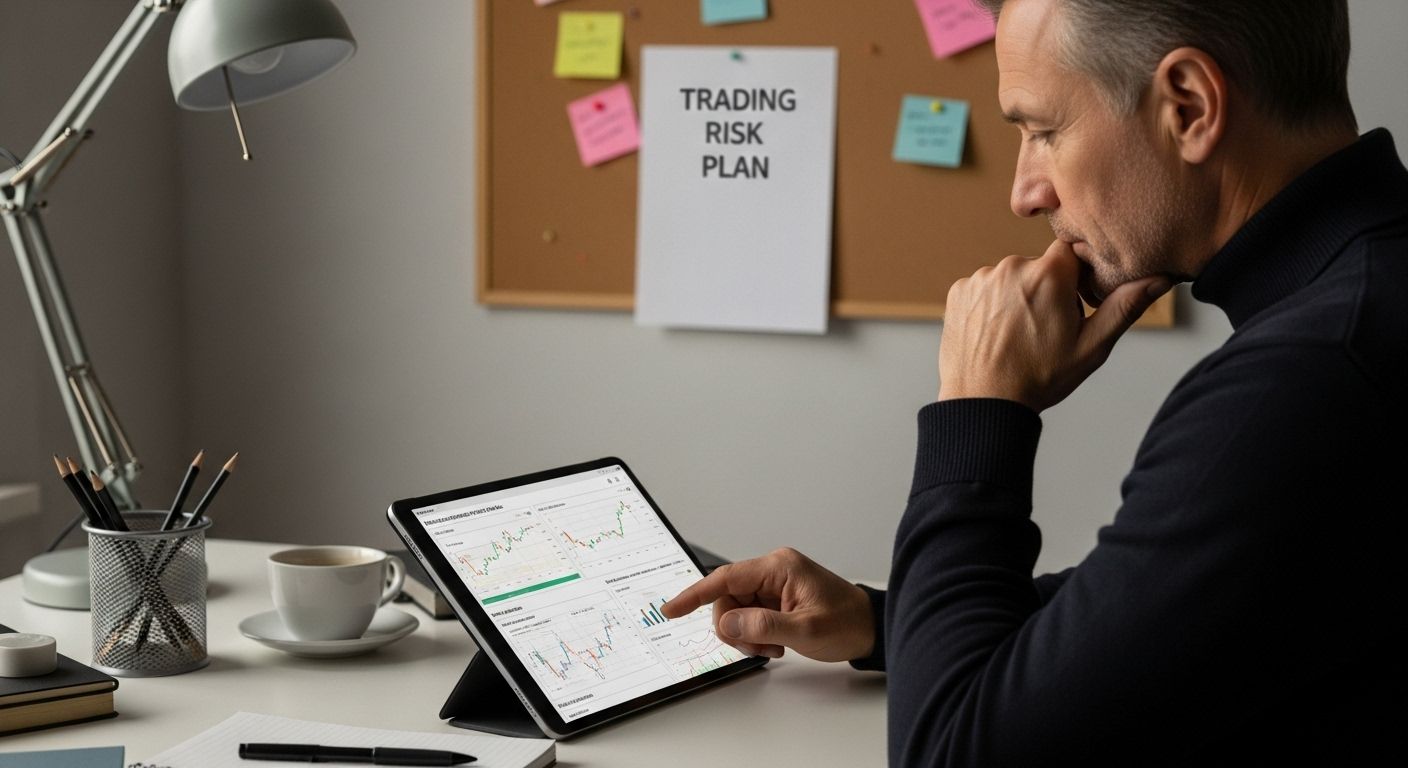
Developing a personalized trading risk plan is not a luxury. It is an essential survival strategy for traders seeking sustainable financial success. A comprehensive risk management blueprint transforms trading from a speculative activity into a structured, strategic approach.
Assessing Personal Risk Tolerance
CME Group emphasizes the critical first step of understanding individual risk tolerance. This process involves deep self-reflection and honest assessment of personal financial and psychological boundaries.
Risk tolerance assessment includes examining:
- Financial capacity to absorb potential losses
- Emotional resilience during market volatility
- Personal financial goals and investment timelines
- Comfort level with different investment instruments
Traders might categorize their risk tolerance as conservative, moderate, or aggressive. For instance, with a $10,000 account and moderate risk tolerance, a trader might decide to risk approximately 3% per trade, which translates to $300 maximum potential loss.
Developing Quantifiable Risk Parameters
Investopedia highlights the importance of establishing clear, measurable risk management techniques. This involves creating a systematic approach to trade selection, position sizing, and loss mitigation.
Key quantifiable risk parameters include:
- Maximum Loss Per Trade: Typically 1-2% of total trading capital
- Portfolio Diversification Percentage: Spreading investments across different asset classes
- Stop-Loss and Take-Profit Levels: Predefined exit points for each trade
- Expected Return Calculations: Analyzing potential profit versus potential loss
By transforming abstract risk concepts into concrete numerical guidelines, traders create a rational framework that reduces emotional decision-making.
Scenario Planning and Continuous Adaptation
USDA Risk Management Agency recommends comprehensive scenario planning as a critical risk management strategy. This approach involves anticipating potential market conditions and preparing strategic responses in advance.
Effective scenario planning requires traders to:
- Analyze historical market data
- Consider economic, political, and social factors
- Develop contingency plans for different market environments
- Regularly review and update risk management strategies
Successful traders understand that a risk management plan is not a static document. It is a living strategy that evolves with market conditions, personal growth, and changing financial objectives.
Below is a checklist table summarizing the key steps and considerations for building your own trading risk plan, as highlighted in the article:
| Step/Consideration | Description | Included in My Plan? |
|---|---|---|
| Assess Personal Risk Tolerance | Know your financial/emotional risk boundaries | |
| Determine Maximum Loss Per Trade | Set limit (usually 1-2% of capital/trade) | |
| Define Portfolio Diversification | Specify allocation across asset classes | |
| Set Stop-Loss & Take-Profit Parameters | Establish exit points for each trade | |
| Plan Scenario Responses | Prepare for different market outcomes | |
| Review & Update Risk Plan Regularly | Continually refine as markets and goals change |
Building a robust trading risk plan demands discipline, self-awareness, and continuous learning. By creating a personalized, data-driven approach to risk management, traders can transform uncertainty into a calculated pathway toward financial success.
Frequently Asked Questions
What is risk management in trading?
Risk management in trading refers to the strategies and techniques that traders use to minimize potential losses while maximizing profits. It involves assessing risk levels, setting limits on losses, and employing tools like stop-loss orders to protect capital.
Why is the One-Percent Rule important for traders?
The One-Percent Rule suggests that traders should never risk more than 1% of their total portfolio on a single trade. This strategy helps to safeguard against large losses and allows traders to survive market fluctuations without significant financial damage.
How can emotional decision-making impact trading?
Emotional decision-making can lead traders to make impulsive trades based on fear or greed, often resulting in significant financial losses. Establishing predefined trading rules and maintaining a disciplined approach are crucial for minimizing emotional influences in trading.
What key strategies can I use for effective risk management?
Key strategies for effective risk management include implementing the One-Percent Rule, using automated risk controls like stop-loss and take-profit orders, diversifying investments across asset classes, and developing a personalized risk plan that aligns with one’s individual risk tolerance.
Transform Your Risk Management With FrankFX Solutions
After learning the keys to successful risk management and the dangers of emotional trading, you may be looking for ways to put these strategies into action. Many traders struggle to stick to the One-Percent Rule, control losses with real discipline, or find reliable signals in volatile markets. If you want to move beyond theory and adopt proven, structured methods for safeguarding your capital, there are real tools and expert insights available right now.

Take your trading from uncertain to confident. Join the FrankFX community and gain access to live trading sessions, daily signals, educational resources, and automated risk management tools. Explore our VIP memberships or try our free trading calculators and indicators to build your own risk plan. Do not leave your success to chance. Start improving your risk management today with FrankFX and see the difference a professional approach can make.