Swing trading continues to attract traders with the promise of turning short bursts of price movement into real profits. Some traders make the most of this by holding positions just a few days and others for several weeks. Yet only a small percentage actually keep profits steady over time. Why? Studies show most beginning swing traders struggle because they skip proper strategy development or risk just 2% per trade, exposing themselves to unnecessary loss. The biggest surprise is not just about catching the right wave but about mastering timing and discipline. What happens when you flip the script and build your playbook for every type of market instead of chasing every new trade?
Table of Contents
- Understanding Swing Trading And Its Key Concepts
- Proven Swing Trading Strategies Explained Simply
- Adapting Strategies For Forex, Crypto, And Indices
- Risk Management Tips For Consistent Profits
Quick Summary
| Takeaway | Explanation |
|---|---|
| Develop a structured trading strategy | A clear plan helps identify entry and exit points based on technical analysis. |
| Implement effective risk management | Protect your portfolio by limiting risk per trade and adjusting position sizes based on market conditions. |
| Adapt strategies for different markets | Recognize unique characteristics of Forex, Crypto, and Indices and tailor your approach accordingly. |
| Utilize trend following and breakout techniques | These fundamental strategies can capture significant price movements in various market conditions. |
| Continuously refine your approach | Stay adaptable by learning from market behaviors and adjusting strategies for consistent performance. |
Understanding Swing Trading and Its Key Concepts
Swing trading represents a dynamic approach to financial markets that bridges the gap between day trading and long-term investing. Unlike day traders who execute multiple trades within a single trading session, swing traders capitalize on price movements that typically occur over days or weeks. This strategy requires a nuanced understanding of market trends, technical analysis, and strategic timing.
The Fundamental Mechanics of Swing Trading
At its core, swing trading involves capturing a portion of a potential price movement within a broader trend. Traders aim to identify opportunities where securities are likely to move significantly in a specific direction, then enter and exit positions to maximize potential gains. According to a research study published in the Journal of Financial and Quantitative Analysis, institutional swing trades can play a critical role in market efficiency and corporate performance management.
Key characteristics that distinguish swing trading include:
- Timeframe Flexibility: Positions are typically held from two days to several weeks
- Technical Analysis Dependence: Heavy reliance on chart patterns, trend lines, and momentum indicators
- Risk Management: Calculated approach to potential gains and losses
Advanced Strategic Considerations
Successful swing trading goes beyond simple trend following. Emerging research in reinforcement learning applied to trading systems suggests sophisticated traders are increasingly utilizing advanced computational frameworks to develop more precise trading strategies. These approaches integrate complex algorithmic models with traditional technical analysis to identify potential market opportunities.
Traders must develop a robust framework that includes:
- Comprehensive market trend analysis
- Precise entry and exit point identification
- Rigorous risk management protocols
- Continuous strategy refinement
The primary objective is not just capturing individual trade profits but maintaining consistent performance across multiple market conditions. This requires a disciplined approach that balances technical skills, psychological resilience, and adaptive strategic thinking.
While swing trading offers significant potential, it demands a sophisticated understanding of market dynamics. Successful practitioners combine technical expertise, disciplined risk management, and the ability to make rapid yet calculated decisions in rapidly changing market environments. Traders must remain adaptable, continuously learning and adjusting their strategies to match evolving market conditions.
Proven Swing Trading Strategies Explained Simply
Swing trading strategies provide traders with systematic approaches to capture market movements and generate consistent returns. Unlike complex trading methodologies, effective swing trading strategies focus on clear, actionable principles that can be applied across different financial markets.
Trend Following Strategy
The trend following strategy represents a foundational approach in swing trading. This method involves identifying and trading in the direction of established market momentum. Research from the Journal of Financial and Quantitative Analysis suggests that institutional traders successfully leverage similar momentum-based techniques to enhance market performance.
Key components of trend following include:
- Identifying Market Direction: Using moving averages and trend lines to determine overall market movement
- Entry Point Selection: Entering trades when price confirms the existing trend
- Stop Loss Placement: Implementing protective measures to limit potential losses
Breakout Trading Approach
Advanced research in trading systems indicates that breakout strategies can be particularly effective for swing traders. A breakout occurs when a security’s price moves outside a defined support or resistance level with increased volume. This strategy capitalizes on significant price movements that suggest potential continued momentum.
Breakout trading involves:
- Identifying key support and resistance levels
- Waiting for a confirmed price movement beyond these levels
- Entering trades with clear stop loss and take profit parameters
Algorithmic Optimization Techniques
Cutting-edge research on trading dynamics explores how traders can optimize their strategies using advanced computational techniques. Modern swing traders increasingly incorporate algorithmic approaches to refine their trading methods, allowing for more precise entry and exit points.
Effective swing trading requires a multifaceted approach that combines:
- Technical analysis skills
- Risk management principles
- Psychological discipline
- Continuous learning and adaptation
Traders must recognize that no single strategy guarantees success. The most effective approach involves developing a personalized strategy that aligns with individual risk tolerance, market understanding, and trading goals. Successful swing trading demands consistent practice, thorough market research, and the ability to adapt to changing market conditions.
While these strategies provide a solid framework, traders should always conduct thorough research, practice with simulated trading accounts, and continuously refine their approach based on real-world performance and market dynamics.
Adapting Strategies for Forex, Crypto, and Indices
Successful swing trading requires adaptable strategies that can navigate the unique characteristics of different financial markets. While core trading principles remain consistent, each market type demands specialized approaches to maximize potential returns and manage risks effectively.
Forex Market Swing Trading Techniques
Forex markets present unique opportunities for swing traders due to their high liquidity and constant global activity. Advanced research on algorithmic trading demonstrates that traders can develop systematic approaches to capitalize on currency pair movements. Key considerations for forex swing trading include understanding currency correlations, monitoring economic indicators, and implementing precise technical analysis techniques.
Effective forex swing trading strategies involve:
- Technical Pattern Recognition: Identifying reliable chart patterns specific to currency markets
- Economic Event Analysis: Tracking global economic events that impact currency valuations
- Volatility Management: Adapting position sizes based on currency pair volatility
Cryptocurrency Market Dynamic Strategies
Research utilizing Dynamic Mode Decomposition reveals sophisticated methods for analyzing complex cryptocurrency market dynamics. Unlike traditional markets, crypto markets demonstrate extreme volatility and require more adaptive trading approaches. Swing traders must develop strategies that account for rapid price fluctuations and unique market sentiment drivers.
Cryptocurrency swing trading demands:
- Enhanced risk management protocols
- Real-time sentiment analysis
- Rapid decision-making capabilities
- Advanced technical analysis techniques
Index Market Swing Trading Approach
High-frequency trading research provides insights into developing robust strategies for index markets. Index swing trading focuses on broader market trends, requiring traders to understand sector-wide movements and macroeconomic influences. Successful index swing traders combine technical analysis with comprehensive market understanding.
Key strategies for index swing trading include:
- Monitoring sector-specific performance indicators
- Utilizing broader market trend analysis
- Implementing multi-timeframe technical analysis
Traders must recognize that each market type requires a nuanced approach. While foundational swing trading principles remain consistent, successful adaptation involves continuous learning, technological integration, and a deep understanding of market-specific dynamics.
To help readers quickly compare how swing trading strategies adapt to various markets, the table below outlines the key features and focus areas for Forex, Cryptocurrency, and Index market swing trading.
| Market Type | Key Characteristics | Swing Trading Focus |
|---|---|---|
| Forex | High liquidity, 24/5 global activity | Pattern recognition, economic event analysis, |
| volatility management | ||
| Cryptocurrency | Extreme volatility, rapid changes | Enhanced risk management, real-time sentiment, |
| rapid decision-making | ||
| Indices | Reflects broader market trends | Sector performance monitoring, multi-timeframe |
| analysis, macroeconomic influences |
The most effective swing traders develop a flexible methodology that can be dynamically adjusted across different market types. This requires a combination of technical skills, computational tools, and a comprehensive understanding of market behaviors. Continuous education, real-time market analysis, and a willingness to refine strategies are crucial for long-term success in swing trading across forex, crypto, and index markets.
Risk Management Tips for Consistent Profits
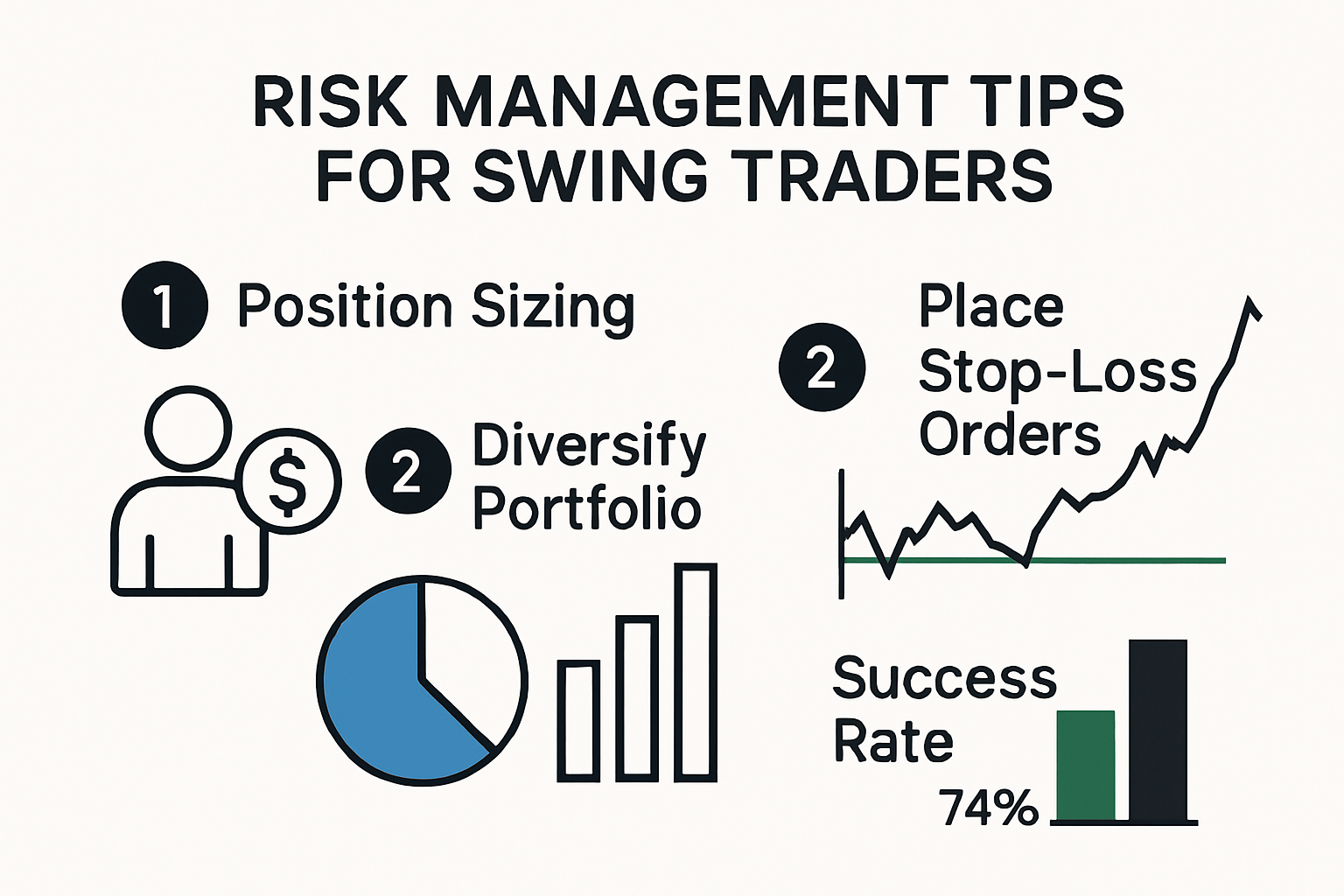
Risk management is the cornerstone of sustainable swing trading, serving as the critical foundation that separates successful traders from those who experience significant financial losses. Understanding and implementing robust risk management strategies can transform trading from a speculative activity to a disciplined, systematic approach to market engagement.
Position Sizing and Portfolio Protection
Research on drawdown-modulated feedback control strategies reveals sophisticated methods for maintaining consistent trading performance. Effective position sizing involves carefully allocating capital to ensure no single trade can substantially damage overall portfolio value. This approach requires traders to develop a systematic method of determining appropriate trade sizes based on account balance, risk tolerance, and market volatility.
Key principles of position sizing include:
- Risk Per Trade Limitation: Restricting individual trade risk to 1-2% of total account capital
- Correlation Awareness: Understanding how different positions interact within the portfolio
- Dynamic Capital Allocation: Adjusting position sizes based on market conditions and portfolio performance
Advanced Risk Mitigation Techniques
Emerging research in ensemble reinforcement learning demonstrates innovative approaches to managing trading risks. Sophisticated traders increasingly utilize advanced computational models to optimize risk-return trade-offs. These techniques go beyond traditional stop-loss methods, incorporating complex algorithms that can dynamically adjust trading strategies in real-time.
Comprehensive risk mitigation involves:
- Implementing precise stop-loss and take-profit mechanisms
- Developing multi-layered risk assessment protocols
- Continuously monitoring and adjusting trading parameters
- Creating contingency plans for unexpected market movements
Portfolio Optimization Strategies
Cutting-edge research on adaptive risk management highlights the importance of a holistic approach to trading risk. Successful traders view risk management not as a restrictive mechanism, but as a strategic tool for consistent performance. This involves creating a robust framework that balances potential returns with comprehensive risk control.
Essential risk optimization strategies include:
- Diversifying across multiple markets and trading instruments
- Developing a consistent trading methodology
- Maintaining emotional discipline during market fluctuations
- Regularly reviewing and refining trading performance

Traders must recognize that risk management is an ongoing process of learning and adaptation. No single strategy guarantees success, but a disciplined approach that combines technical expertise, psychological resilience, and continuous improvement can significantly enhance trading performance.
Ultimately, consistent profits arise from a combination of strategic risk management, thorough market analysis, and the ability to make rational decisions under pressure. Successful swing traders view risk not as something to be eliminated, but as a calculated element to be carefully managed and leveraged for potential gains.
The following table summarizes essential risk management techniques to help swing traders maintain consistent profits and protect their portfolios.
| Technique | Description |
|---|---|
| Position Sizing | Limiting risk to 1-2% per trade and adjusting trade size |
| Correlation Awareness | Understanding interactions among different portfolio assets |
| Dynamic Capital Allocation | Changing position sizes based on market and portfolio status |
| Stop-Loss & Take-Profit Levels | Pre-setting exits to manage downside and lock in profits |
| Portfolio Diversification | Spreading trades across markets/instruments for stability |
| Continuous Performance Review | Regularly analyzing and adjusting trading strategies |
Frequently Asked Questions
What is swing trading and how does it differ from day trading?
Swing trading is a trading strategy where positions are held for several days to weeks to capitalize on price moves. Unlike day trading, where trades are executed within a single day, swing trading focuses on medium-term trends.
What are some effective swing trading strategies?
Effective swing trading strategies include trend following, breakout trading, and algorithmic optimization techniques. These strategies help traders identify entry and exit points based on market momentum and price movements.
How can I manage risk while swing trading?
Risk management in swing trading involves limiting individual trade risk to 1-2% of your total account capital, using stop-loss orders, and diversifying your portfolio to mitigate potential losses.
How should I adapt my swing trading strategy for different markets?
Adapting your swing trading strategy for different markets, such as Forex, Cryptocurrency, or Indices, involves understanding the unique characteristics of each market, including volatility, liquidity, and economic factors, then tailoring your approach accordingly.
Ready to Level Up Your Swing Trading Results?
You have just learned why so many traders struggle to keep swing trading profits consistent. The main challenges—uncertain entry points, unclear risk management, and the difficulty of adapting strategies for forex, crypto, or indices—hold most traders back. But what if you could turn complex theory into clear action, with guidance and tools that match your real goals?

FrankFX is designed for traders who want reliable education and results. Get full access to live trading sessions, daily signals, advanced strategy classes, and forex calculators that make every trade more precise. You can also join a supportive community and learn how our automated tools help you stay disciplined. Visit FrankFX to explore VIP memberships and discover free signals and calculators that put proven swing trading strategies in your hands today. Take the next step to trade smarter and grow your confidence right now.