Most traders worry about picking between scalping and swing trading as if it is a simple matter of speed or patience. Yet the difference goes way deeper than just holding trades for seconds or days. Get this. Scalpers can see success rates as high as 70 percent, but swing traders often take home bigger profits per trade—sometimes up to 10 percent. That single detail flips everything you thought you knew about which strategy really pays off.
Table of Contents
- Understanding Scalping And Swing Trading Styles
- Key Differences: Timeframes, Risks, And Rewards
- Pros And Cons For Forex, Crypto, And Indices
- How To Choose The Right Trading Approach
Quick Summary
| Takeaway | Explanation |
|---|---|
| Understand your trading style | Determine whether scalping or swing trading aligns with your skills and risk tolerance. |
| Evaluate time commitments | Scalping requires intense focus and rapid trades, while swing trading allows for longer analysis periods. |
| Know the risks involved | Scalping involves quick gains but higher stress, whereas swing trading offers better risk management and analysis time. |
| Analyze market dynamics | Different markets—forex, crypto, indices—have unique characteristics that affect strategy success. |
| Prioritize continuous education | Mastering trading strategies necessitates ongoing learning and adapting to market changes. |
Understanding Scalping and Swing Trading Styles
Trading strategies form the backbone of successful market participation, with scalping and swing trading representing two distinctly different approaches to capturing market opportunities. Each method demands unique skills, psychological preparation, and technical understanding.
The Fundamental Differences in Trading Approaches
Scalping and swing trading represent opposite ends of the trading spectrum in terms of time investment and strategy execution. According to Investopedia, scalping involves executing numerous trades within extremely short time frames, often lasting seconds to minutes, with the primary goal of capturing minimal price movements.
In contrast, swing trading focuses on capturing larger price movements over extended periods, typically ranging from several days to weeks. Traders utilizing this approach aim to identify and capitalize on price trends and potential market momentum shifts. The core distinction lies in the trade duration and profit target strategy.
To help clarify the core differences between scalping and swing trading, the following table compares their main characteristics, requirements, and typical outcomes.
| Feature | Scalping | Swing Trading |
|---|---|---|
| Typical Trade Duration | Seconds to minutes | Days to weeks |
| Trade Frequency | Hundreds of trades daily | Few trades per week |
| Profit per Trade | 0.2% to 0.5% | 2% to 10% |
| Success Rate | 50%–70% | 30%–50% |
| Stress Level | High | Moderate |
| Technical Requirements | High-speed tools, real-time data | Analysis software, trend indicators |
| Psychological Demands | Rapid decisions, focus, discipline | Patience, trend analysis, risk mgmt. |
| Transaction Costs | High due to volume | Lower due to fewer trades |
Technical and Psychological Requirements
Traders must understand the unique psychological and technical demands of each strategy. A comprehensive TradingView analysis reveals fascinating insights into trader performance. The study suggests scalpers experience success rates between 50-70% due to high trade frequency, while swing traders typically achieve 30-50% success rates with potentially more substantial returns.
Scalping requires:
- Rapid Decision Making: Traders must execute trades within seconds
- High Concentration: Constant market monitoring is essential
- Advanced Technical Analysis: Quick pattern recognition skills
Swing trading demands:
- Strategic Patience: Holding positions for multiple days or weeks
- Trend Analysis: Identifying longer-term market movements
- Risk Management: Broader stop-loss and profit-taking strategies
Advanced Algorithmic Perspectives
Interestingly, recent technological advancements are transforming these trading approaches. A groundbreaking study exploring cooperative multi-agent reinforcement learning demonstrates how advanced algorithms can now mimic and potentially optimize scalping strategies. By leveraging sophisticated order book analysis and settlement data processing, these computational models represent the cutting edge of trading strategy development.
Ultimately, choosing between scalping and swing trading depends on individual trader characteristics, risk tolerance, available time, and technological resources. Successful traders often develop a nuanced understanding of both approaches, allowing flexibility in their market engagement strategies.
Key Differences: Timeframes, Risks, and Rewards
Trading strategies are not one-size-fits-all, and the distinctions between scalping and swing trading extend far beyond mere time commitment. Understanding the nuanced differences in timeframes, risks, and potential rewards becomes crucial for traders seeking to optimize their market approach.
Time Investment and Market Engagement
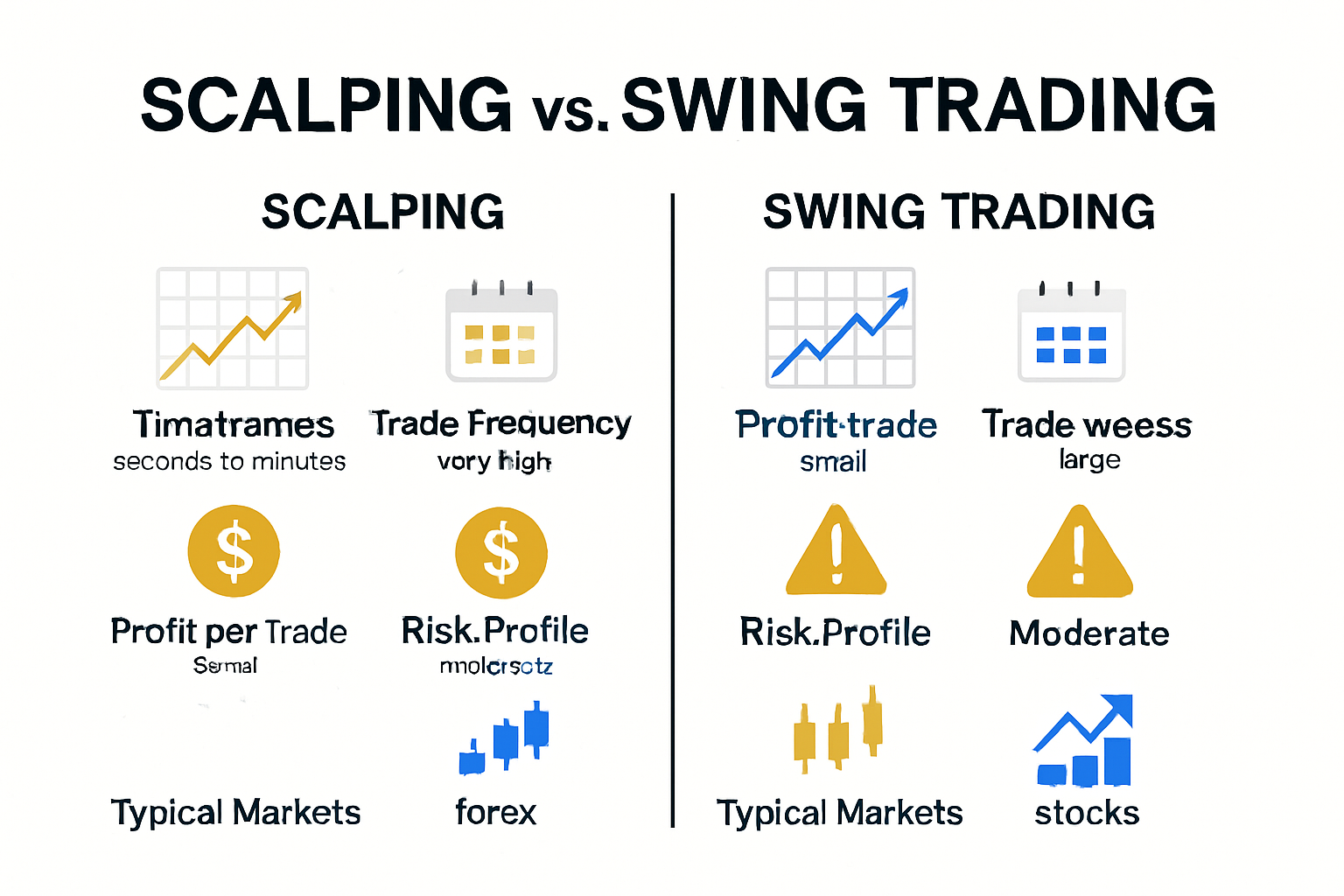
Traders must carefully evaluate the time requirements for each strategy. According to Investopedia, scalping demands an intense, almost surgical approach to trading. Traders execute hundreds of trades daily, holding positions for mere seconds to minutes. In stark contrast, Wikipedia describes swing trading as a more measured strategy, with traders holding positions from one to several days, capturing price movements across broader market trends.
Key Time Characteristics:
- Scalping: Seconds to minutes per trade
- Swing Trading: Days to weeks per trade
- Trade Frequency: Scalping (hundreds of trades daily), Swing Trading (few trades per week)
Risk Management and Psychological Demands
Risk exposure differs dramatically between these trading approaches. Trading research highlights that scalping requires exceptional discipline and rapid decision-making, with traders facing increased stress due to the high-frequency nature of trades. Each transaction carries potential for both quick gains and rapid losses, demanding split-second analytical skills and emotional control.
Swing trading offers a more measured risk profile. Traders have more time to analyze market conditions, set strategic stop-losses, and make calculated decisions. This approach allows for:
- Deeper Market Analysis: More time to evaluate trend indicators
- Reduced Emotional Pressure: Less intense moment-to-moment decision-making
- Comprehensive Risk Mitigation: Ability to adjust positions with less immediate time constraints
Potential Returns and Performance Metrics
The financial outcomes of these strategies reveal fascinating insights. While scalping might generate numerous small profits, swing trading potentially offers more substantial returns with fewer transactions. Traders must consider:
- Scalping Profit Potential: Small, frequent gains (often 0.2% to 0.5% per trade)
- Swing Trading Profit Potential: Larger gains per trade (potentially 2% to 10%)
- Transaction Costs: Scalping incurs significantly higher broker fees due to trade volume
Successful traders recognize that neither approach guarantees consistent profits. The optimal strategy depends on individual skill sets, market understanding, and personal risk tolerance. Some traders even develop hybrid approaches, combining elements of both scalping and swing trading to create a personalized trading methodology.
Ultimately, mastering these strategies requires continuous learning, disciplined practice, and a deep understanding of market dynamics. Whether you choose the rapid-fire approach of scalping or the more strategic swing trading, success hinges on continuous education, emotional discipline, and adaptive market analysis.
Pros and Cons for Forex, Crypto, and Indices
Each trading market presents unique characteristics that significantly impact the effectiveness of scalping and swing trading strategies. Understanding these nuanced differences becomes crucial for traders seeking to optimize their approach across forex, cryptocurrency, and index markets.
Forex Market Dynamics
According to Investopedia, forex markets offer distinct advantages and challenges for both scalping and swing trading strategies. The forex market’s high liquidity and 24-hour trading cycle make it particularly attractive for traders.
Scalping in Forex:
- Pros: Extremely tight spreads, high liquidity, constant market movement
- Cons: Requires rapid execution, high transaction costs, significant psychological pressure
Swing Trading in Forex:
- Pros: More relaxed trading approach, ability to capitalize on longer-term currency trends
- Cons: Susceptibility to geopolitical events, overnight risk, slower profit generation
Cryptocurrency Market Volatility
Wikipedia’s research highlights the unique challenges of trading cryptocurrencies. The extreme volatility of crypto markets creates both extraordinary opportunities and substantial risks for scalpers and swing traders.
Cryptocurrency trading strategies differ dramatically:
- Scalping: Potential for rapid profits during high-volatility periods
- Swing Trading: Ability to ride longer market trends and major price movements
Key Considerations:
- Extreme price fluctuations
- 24/7 market availability
- Lower liquidity compared to traditional markets
- Higher potential for market manipulation
Index Market Approach
Index markets provide a more structured environment for both scalping and swing trading. These markets represent broader economic trends, offering more predictable movement patterns compared to individual stocks or cryptocurrencies.
Scalping in Index Markets:
- Pros: More stable underlying assets
- Cons: Smaller price movements, reduced volatility
Swing Trading in Index Markets:
- Pros: Lower transaction costs, alignment with broader economic trends
- Cons: Slower price movements, less frequent trading opportunities
Traders must recognize that no single strategy guarantees consistent success. The optimal approach depends on:
The table below summarizes the pros and cons of scalping and swing trading in different markets, helping you evaluate how each strategy fares in forex, crypto, and indices.
| Market | Scalping: Pros | Scalping: Cons | Swing Trading: Pros | Swing Trading: Cons |
|---|---|---|---|---|
| Forex | Tight spreads, high liquidity | High costs, rapid execution | Trend leverage, relaxed pace | Overnight risk, slow profits |
| Cryptocurrency | Quick profits in volatility | Extreme price swings, low liquidity | Ride major trends | High manipulation risk |
| Indices | Stability, predictable assets | Small price moves, less volatility | Low costs, broad trend capture | Slower moves, fewer opportunities |
- Individual risk tolerance
- Available time for market monitoring
- Technical analysis skills
- Emotional discipline
- Understanding of specific market characteristics
Successful traders often develop a flexible approach, adapting their strategy to specific market conditions and personal strengths. By understanding the unique pros and cons of scalping and swing trading across different markets, traders can create more robust and adaptive trading methodologies.

How to Choose the Right Trading Approach
Selecting the most suitable trading approach requires careful self-assessment and a comprehensive understanding of personal capabilities, market conditions, and individual trading goals. Traders must navigate a complex decision-making process that goes beyond simple strategy selection.
Personal Skill Assessment and Psychological Readiness
Investopedia emphasizes the critical importance of matching trading strategies to individual psychological profiles. Scalping demands exceptional mental resilience, requiring traders to make rapid decisions under intense pressure. Traders considering this approach must honestly evaluate their:
- Emotional Control: Ability to remain calm during rapid market movements
- Concentration Levels: Capacity to maintain focus for extended periods
- Stress Management: Tolerance for high-pressure trading environments
Swing trading offers a more measured approach, allowing traders more time to analyze market conditions and make deliberate decisions. This strategy suits individuals who prefer:
- Strategic Thinking: Ability to analyze broader market trends
- Patience: Comfort with holding positions for days or weeks
- Less Immediate Stress: Reduced moment-to-moment market pressure
Technical Requirements and Resource Allocation
Advanced research on trading strategies reveals the increasing complexity of modern trading approaches. Traders must consider their technological capabilities and available resources:
Scalping Requirements:
- High-speed internet connection
- Advanced trading platform with real-time data
- Sophisticated technical analysis tools
- Powerful computer setup
- Minimal transaction cost environment
Swing Trading Requirements:
- Reliable market analysis software
- Access to comprehensive market research
- More flexible technological infrastructure
- Ability to conduct in-depth trend analysis
Performance and Long-Term Strategy Alignment
Research examining technical trading strategies highlights the importance of aligning trading approaches with long-term financial objectives. Traders should consider:
- Financial Goals: Short-term income generation vs. long-term wealth building
- Risk Tolerance: Capacity to absorb potential losses
- Time Commitment: Available hours for market monitoring
- Capital Availability: Minimum investment requirements
Successful traders recognize that no single strategy guarantees consistent profits. The optimal approach involves:
- Continuous learning
- Regular strategy evaluation
- Willingness to adapt to changing market conditions
- Developing a personalized trading methodology
Ultimately, choosing between scalping and swing trading is a deeply personal decision. Traders must conduct thorough self-assessment, understand their psychological strengths and limitations, and remain committed to ongoing education and skill development. The most successful approach combines strategic selection, continuous learning, and adaptive market engagement.
Frequently Asked Questions
What is the primary difference between scalping and swing trading?
Scalping involves executing numerous trades within very short time frames, often lasting seconds to minutes, aiming to capture minimal price movements. In contrast, swing trading focuses on longer price movements, holding positions for days to weeks to capitalize on market trends.
What are the psychological requirements for scalping and swing trading?
Scalping requires high concentration, rapid decision-making, and emotional control due to the fast-paced nature of trades. Swing trading, on the other hand, demands strategic patience and the ability to analyze broader market trends without immediate pressure.
Which trading approach offers higher potential returns: scalping or swing trading?
Swing trading typically offers larger profits per trade, potentially ranging from 2% to 10%, whereas scalping focuses on smaller, frequent profits, usually around 0.2% to 0.5% per trade. Therefore, swing trading can result in higher overall returns despite fewer trades.
How can I choose the best trading strategy for myself?
To choose the best trading strategy, assess your personal skills, psychological readiness, time commitment, and risk tolerance. Consider whether you prefer making quick trades with high intensity (scalping) or a more measured, analytical approach (swing trading) that allows for longer holding periods.
Turn Trading Insights Into Real Results With FrankFX
Torn between scalping and swing trading but still struggling to find which method aligns with your skills, risk tolerance, and daily routine? The article above explains how choosing the right strategy depends not only on technical ability, but also on psychological readiness, trade frequency, and in-depth market analysis. Many traders get stuck at this stage, feeling overwhelmed by the pressure to make fast decisions or commit to longer-term holding periods without clear guidance or support.

Get the solutions you need right now. Experience the difference with hands-on mentorship, live trading sessions, daily signals, and advanced analysis classes found at FrankFX. Benefit from free trading tools and join a community that empowers you to confidently apply scalping or swing trading concepts to real markets. Visit our main site and start your free journey, or discover practical tools like our forex calculators and automated robots to streamline your strategy today. Make today the day you upgrade your trading routine with expert support and actionable insights.