Every time you enter a trade, you are taking on risk that can impact your financial future in ways you might not expect. Most people think the real danger comes from volatile markets or sudden news events. Yet the real risk often hides in plain sight as over 90 percent of traders who fail do so because they underestimate their actual risk exposure. Understanding where your money is truly vulnerable could change how you trade forever.
Table of Contents
- What Is Risk Exposure In Trading?
- Why Managing Risk Exposure Is Crucial For Traders
- How Risk Exposure Affects Market Performance
- Key Concepts In Measuring And Managing Risk Exposure
- Real-World Applications Of Risk Exposure Management
Quick Summary
| Takeaway | Explanation |
|---|---|
| Understand risk exposure dynamics | Risk exposure is not static; it fluctuates based on market conditions and investor strategies. |
| Calculate risk effectively | Employ methods like Value at Risk and drawdown analysis to quantify potential financial losses. |
| Manage risk strategically | Implement adaptive strategies such as portfolio diversification and strict stop-loss limits to protect capital. |
| Monitor market changes continuously | Regular assessment of market conditions is crucial for effective risk management and informed trading decisions. |
| Recognize psychological factors | Emotional control and discipline are essential in managing both trading risks and personal investment strategies. |
What is Risk Exposure in Trading?
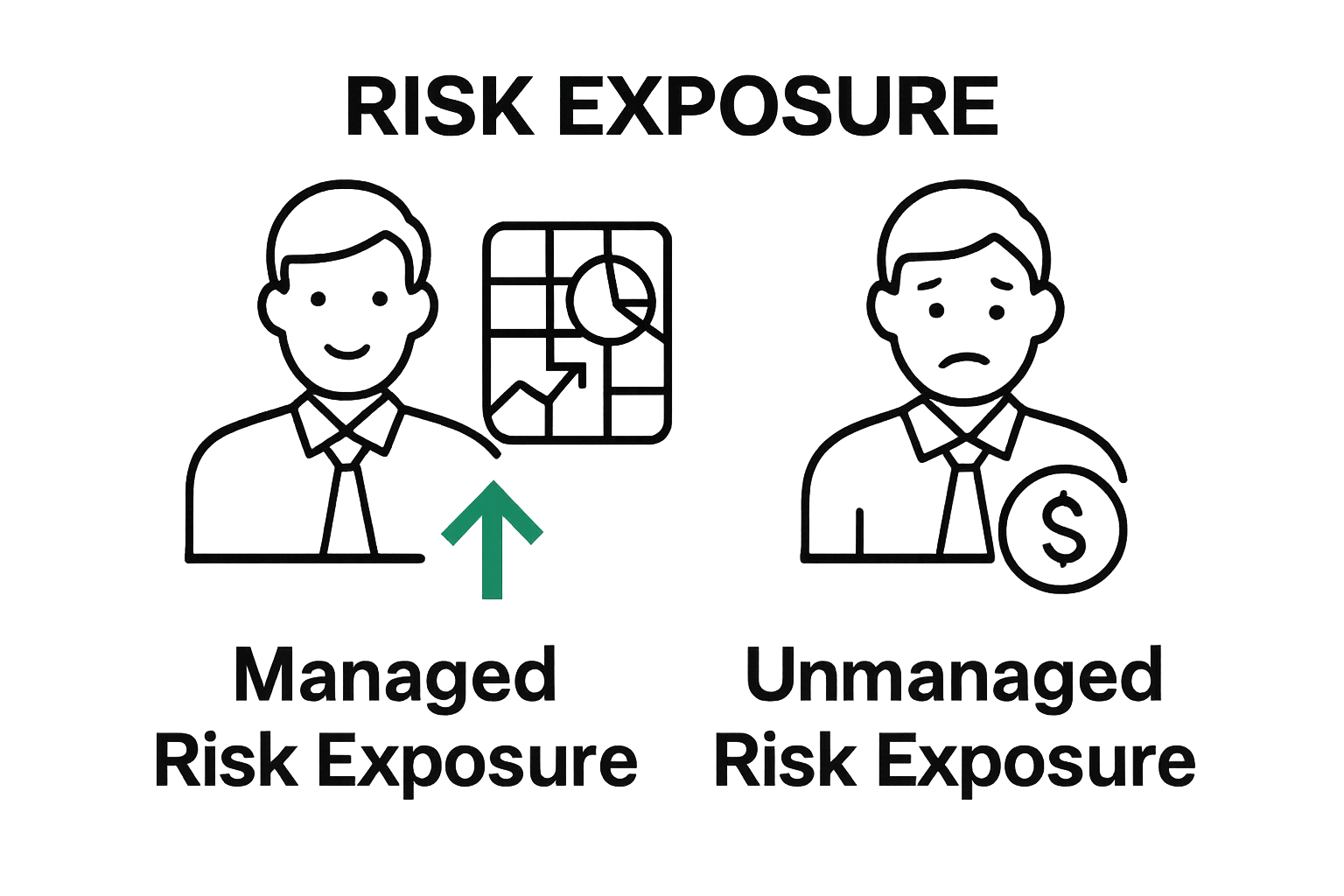
Risk exposure represents the potential financial vulnerability traders encounter when engaging in market transactions. At its core, risk exposure measures the extent to which trading activities could result in monetary losses based on market fluctuations, economic conditions, and individual investment strategies.
Understanding the Fundamentals of Risk Exposure
In trading, risk exposure is not a single, static concept but a dynamic assessment of potential financial threats. Traders must recognize that every investment carries inherent risks that can dramatically impact portfolio performance. Read more about risk management strategies to develop a comprehensive understanding.
Key elements that contribute to risk exposure include:
- Market volatility and unpredictable price movements
- Leverage and margin trading conditions
- Economic events and geopolitical uncertainties
- Individual trading instrument characteristics
Calculating and Assessing Risk Exposure
Professional traders employ multiple techniques to quantify and manage risk exposure. They typically analyze potential losses by examining historical price data, calculating potential drawdowns, and establishing predetermined risk tolerance levels. According to CME Group, understanding risk exposure involves comprehensive evaluation of multiple financial parameters.
Traders assess risk exposure through sophisticated methods like:
- Value at Risk (VaR) calculations
- Maximum drawdown analysis
- Correlation between different trading instruments
- Stress testing investment portfolios
Successful risk management requires continuous monitoring and adaptive strategies that respond to changing market conditions. By developing a nuanced understanding of risk exposure, traders can protect their capital and optimize potential returns.
The table below summarizes key quantitative techniques used to measure risk exposure in trading, along with brief descriptions and examples of each method.
| Method | Description | Example Application |
|---|---|---|
| Value at Risk (VaR) | Estimates potential loss over a specific time frame | Forecasting maximum expected portfolio loss in a week |
| Maximum Drawdown | Measures the largest peak-to-trough decline | Assessing the worst historical portfolio loss |
| Stress Testing | Simulates extreme market scenarios to gauge risk | Evaluating performance during economic crises |
| Correlation Analysis | Assesses relationships between trading instruments | Determining risk impact across asset classes |
| Standard Deviation of Returns | Quantifies volatility in an asset or portfolio | Comparing relative risk between assets |
Why Managing Risk Exposure is Crucial for Traders
Managing risk exposure is the fundamental cornerstone of sustainable trading success. Without strategic risk management, traders expose themselves to potentially catastrophic financial losses that can rapidly deplete investment capital and terminate trading careers.
The Financial Survival Imperative
Traders operate in an inherently unpredictable environment where market conditions can shift dramatically within moments. Explore advanced risk management strategies to protect your trading portfolio effectively. According to Bank for International Settlements, understanding and mitigating risk exposure is not just a recommendation but a critical survival mechanism in financial markets.
Key reasons why managing risk exposure is essential include:
- Preventing substantial financial losses
- Maintaining consistent portfolio performance
- Protecting long term investment capital
- Ensuring psychological trading stability
Psychological and Strategic Dimensions of Risk Management
Risk management transcends mere numerical calculations. It represents a comprehensive approach that combines financial strategy with psychological discipline. Successful traders recognize that emotional control and systematic risk assessment are equally important in managing potential market vulnerabilities.
Professional traders protect themselves through:
- Implementing strict stop loss parameters
- Diversifying investment portfolios
- Limiting position sizes relative to total capital
- Continuously monitoring market volatility
Effective risk exposure management transforms trading from a high stakes gamble into a calculated, strategic pursuit. By developing robust risk mitigation techniques, traders can create sustainable performance models that balance potential rewards with comprehensive protective measures.
This table highlights major psychological and strategic techniques for managing risk exposure, combining both behavioral and tactical aspects important for trader resilience.
| Technique | Purpose | Example Action |
|---|---|---|
| Strict Stop-Loss Parameters | Limit potential loss on each trade | Setting automatic exit points |
| Portfolio Diversification | Reduce risk by spreading investments | Allocating across asset classes |
| Position Sizing Limits | Control exposure relative to total capital | Capping trade size to 2% of account |
| Continuous Market Monitoring | Adapt to evolving risks and opportunities | Regular portfolio risk reviews |
| Emotional Control | Maintain discipline and avoid impulsive decisions | Sticking to trading plans |
How Risk Exposure Affects Market Performance
Risk exposure plays a critical role in determining overall market dynamics, influencing everything from individual trading strategies to broader economic stability. Understanding these intricate relationships helps traders and investors navigate complex financial landscapes more effectively.
Market Volatility and Risk Transmission
Market performance is fundamentally interconnected with risk exposure mechanisms. Learn about common volatility trading terminologies to better comprehend these complex interactions. According to CFA Institute, risk exposure acts as a transmission mechanism that can amplify or dampen market movements.
Key factors demonstrating risk exposure impact include:
- Systemic risk propagation across different market segments
- Investor sentiment and market confidence levels
- Speed and magnitude of price adjustments
- Correlation between different financial instruments
Psychological and Structural Market Implications
Risk exposure fundamentally shapes market behavior by influencing trader psychology and institutional investment strategies. Heightened risk perception can trigger rapid market corrections, while low perceived risk might encourage speculative trading.
Complex interactions between risk exposure and market performance manifest through:
- Institutional investor risk allocation strategies
- Market liquidity and trading volume fluctuations
- Pricing mechanisms for financial derivatives
- Collective investor risk tolerance
Traders and financial professionals must continuously monitor and adapt to these dynamic risk exposure landscapes. By understanding how risk exposure influences market performance, investors can develop more sophisticated and resilient trading approaches that anticipate potential market shifts and protect their financial interests.
Key Concepts in Measuring and Managing Risk Exposure
Measuring and managing risk exposure requires sophisticated analytical techniques and comprehensive strategic frameworks. Traders must develop a nuanced understanding of multiple methodological approaches to effectively protect their investments and optimize portfolio performance.
Quantitative Risk Assessment Methods
Learn more about essential risk management strategies to enhance your trading approach. According to the CFA Institute, quantitative risk assessment involves multiple sophisticated analytical techniques designed to evaluate potential financial vulnerabilities.
Critical quantitative risk measurement techniques include:
- Value at Risk (VaR) calculations
- Sensitivity analysis and stress testing
- Correlation coefficient measurements
- Maximum drawdown estimations
- Standard deviation of returns
Qualitative and Structural Risk Management Frameworks
Effective risk exposure management transcends numerical calculations. Comprehensive risk management requires integrating quantitative metrics with qualitative strategic insights that consider broader market dynamics and potential systemic risks.
Key qualitative risk management components encompass:
- Continuous market environment monitoring
- Understanding institutional trading behaviors
- Evaluating geopolitical and economic uncertainties
- Developing adaptive risk mitigation strategies
Traders who master both quantitative and qualitative risk management techniques can create robust frameworks that anticipate potential market disruptions. By combining analytical precision with strategic flexibility, investors can develop more resilient and sophisticated risk management approaches that protect capital while maintaining potential for growth.
Real-World Applications of Risk Exposure Management
Risk exposure management extends far beyond theoretical concepts, transforming into critical practical strategies that protect financial investments across diverse trading environments. Professional traders and financial institutions implement sophisticated risk management techniques to navigate complex market landscapes effectively.
Institutional Trading Risk Mitigation
Explore comprehensive risk management strategies to understand practical implementation techniques. According to the Federal Reserve, real-world risk management requires comprehensive approaches that integrate advanced analytical tools with strategic decision making.
Key institutional risk management applications include:
- Portfolio diversification across multiple asset classes
- Implementing automated risk monitoring systems
- Establishing predetermined loss threshold limits
- Creating dynamic hedging strategies
- Developing comprehensive risk reporting mechanisms
Adaptive Risk Management Techniques
Successful risk management demands continuous adaptation to evolving market conditions. Traders must develop flexible frameworks that can quickly respond to unexpected market shifts and potential systemic risks.
Practical risk exposure management strategies encompass:
- Real time portfolio risk assessment
- Scenario based stress testing
- Continuous trader skill development
- Advanced algorithmic risk calculation models
Modern risk exposure management represents a sophisticated blend of technological innovation, statistical analysis, and strategic foresight. By integrating quantitative metrics with adaptive frameworks, traders can create robust systems that protect investments while maintaining potential for strategic growth and performance optimization.

Take Control of Your Trading Risk Now
Struggling with unpredictable losses and high volatility in your trades? The article highlighted how understanding and managing risk exposure can be the critical difference between protecting your capital and facing unwanted drawdowns. Every trader knows the fear of a sudden market shift undermining even the most careful strategies. But you do not have to face these challenges alone.

Discover how FrankFX empowers you to turn risk management theory into actionable steps. Join our community for daily trading signals, expert mentorship, and live webinars focused specifically on reducing risk exposure and managing market unpredictability. Experienced traders and beginners alike leverage our free forex calculators and trading robots to make informed decisions every day. Take your next step toward safer, more consistent trading. Visit FrankFX now and transform your approach to risk before your next trade.
Frequently Asked Questions
What is risk exposure in trading?
Risk exposure refers to the potential financial vulnerability that traders face when engaging in market transactions. It measures the extent to which trading activities could lead to monetary losses due to market fluctuations, economic conditions, and investment strategies.
How do you calculate risk exposure in trading?
Traders calculate risk exposure using techniques such as Value at Risk (VaR) calculations, maximum drawdown analysis, and stress testing investment portfolios. These methods help assess potential losses based on historical data and predetermined risk tolerance levels.
Why is managing risk exposure important for traders?
Managing risk exposure is crucial for sustainable trading success. It helps prevent substantial financial losses, maintain consistent portfolio performance, protect long-term capital, and ensure psychological stability while trading in unpredictable market environments.
What are some effective strategies for managing risk exposure?
Effective strategies include implementing strict stop-loss parameters, diversifying investment portfolios, limiting position sizes relative to total capital, and continuously monitoring market volatility to adapt to changing conditions.
Recommended
- Risk Management in Trading
- Deriv Micro Account
- Top Swing Trading Strategies for All Market Types 2025
- Common Volatility Trading Terminologies
- blog
- Master Building an Investment Portfolio for Profits