Leverage lets traders control positions far bigger than their own bankroll. Some brokers let you open trades worth up to 100 times your actual deposit, so $500 becomes $50,000 in buying power. That sounds like a golden ticket. Most people think this kind of power is reserved for the Wall Street elite, but everyday traders dive in too. The catch? One wrong move and that same leverage can wipe you out just as fast.
Table of Contents
- What Is Leverage And How Does It Function In Trading?
- The Importance Of Leverage In Forex And Crypto Markets
- How Leverage Can Amplify Gains And Losses
- Understanding Margin Requirements And Risk Management With Leverage
- Real-World Examples Of Leverage In Trading Scenarios
Quick Summary
| Takeaway | Explanation |
|---|---|
| Leverage amplifies potential returns and risks. | Higher leverage ratios can lead to significant gains but also substantial losses. Understand the trade-off before engaging. |
| Margin requirements are crucial for managing trades. | Traders must maintain a certain balance to keep positions open, preventing forced closures due to insufficient funds. |
| Use conservative leverage ratios for safety. | Professional traders recommend leveraging between 1:10 and 1:30 to effectively balance risk and reward in trading. |
| Implement strict risk management strategies. | Utilizing stop-loss orders and limiting exposure are key practices to mitigate losses while trading with leverage. |
| Market volatility influences leverage dynamics. | Understanding how market conditions may affect margins and leverage is essential for effective trading strategies! |
What Is Leverage and How Does It Function in Trading?
Leverage represents a powerful financial strategy that allows traders to control larger market positions using a smaller amount of personal capital. By borrowing funds from a broker, traders can amplify potential returns while simultaneously increasing potential risks.
Understanding the Fundamental Concept
At its core, leverage is a method of trading that enables investors to gain greater market exposure without committing the full value of an investment upfront. Think of leverage like a financial multiplier that magnifies both potential profits and potential losses. For example, a 1:100 leverage ratio means that for every $1 a trader invests, they can control $100 in the market.
Key Characteristics of Leverage:
- Allows traders to open larger positions than their account balance
- Provides opportunity to generate higher returns with less initial capital
- Increases potential risk proportionally with potential reward
How Leverage Mechanics Work in Trading
Traders utilize leverage through margin trading, where brokers essentially lend capital to traders based on their account balance. According to Cornell Law School, leverage involves using borrowed money to increase potential investment returns. In practical trading scenarios, this means a trader with $1,000 and 1:50 leverage could potentially control a $50,000 trading position.
The mechanism works by requiring traders to maintain a minimum margin requirement, which represents the percentage of the total trade value that must be kept in the trading account. If the market moves against the trader’s position, they may receive a margin call requiring additional funds to maintain the leveraged position.
Risk and Reward Dynamics
While leverage offers exciting opportunities, it simultaneously presents significant risks. Traders must understand that amplified potential gains come with equally amplified potential losses. A small market movement can result in substantial financial outcomes when trading with high leverage ratios. Successful traders approach leverage with careful risk management strategies, including setting strict stop-loss orders and maintaining disciplined position sizing.
Professional traders often recommend using leverage conservatively, typically between 1:10 and 1:30 ratios, to balance potential returns with manageable risk exposure.
The Importance of Leverage in Forex and Crypto Markets
Leverage plays a transformative role in forex and cryptocurrency trading, offering traders unprecedented opportunities to maximize potential returns while simultaneously introducing complex risk management challenges. By understanding how leverage functions across these dynamic markets, traders can make more informed and strategic investment decisions.
Leverage Dynamics in Forex Trading
In forex markets, leverage allows traders to control significantly larger positions than their actual account balance. A trader with $1,000 and a 1:50 leverage ratio can potentially manage a $50,000 trading position. This amplification mechanism enables traders to capitalize on even minor currency price fluctuations, creating opportunities for substantial profits. Synthetic index traders often utilize similar leverage strategies to maximize their market exposure.
Critical Forex Leverage Considerations:
- Enables trading of large currency positions with minimal capital
- Allows speculation on global currency market movements
- Provides flexibility in managing international trading strategies
Cryptocurrency Market Leverage Mechanics
Cryptocurrency markets present unique leverage opportunities characterized by higher volatility and less regulatory oversight compared to traditional forex markets. According to Bank for International Settlements research, cryptocurrency leverage ratios can range between 1.4 to 1.9, creating significant potential for both gains and losses.
Crypto traders typically access leverage through margin trading platforms and derivative contracts like futures and perpetual swaps. These instruments allow traders to open positions much larger than their initial investment, with some platforms offering leverage ratios up to 100:1.
Risk Management and Strategic Considerations
Successful leverage trading requires sophisticated risk management techniques. Experienced traders understand that while leverage can amplify profits, it simultaneously increases potential losses. Implementing strict risk control strategies such as stop-loss orders, position sizing, and continuous market analysis becomes crucial.
Professional traders typically recommend maintaining conservative leverage ratios between 1:10 and 1:30, ensuring a balanced approach that protects capital while allowing meaningful market participation.
The following table compares key characteristics and risk factors of leverage in Forex and cryptocurrency markets as discussed in the article.
| Market Type | Common Leverage Ratios | Volatility Level | Regulatory Oversight | Risk Management Needed |
|---|---|---|---|---|
| Forex | Up to 1:50 | Moderate | High | Very High |
| Cryptocurrency | 1.4 to 1.9 (typical), up to 1:100 on some platforms | Very High | Lower than Forex | Extremely High |
| Indices (Synthetic, Volatility) | Up to 1:50 (varies) | High | Moderate | High |
| Understanding leverage is not just about maximizing potential returns but also about protecting one’s investment from catastrophic market movements. |
How Leverage Can Amplify Gains and Losses
Leverage represents a double-edged financial instrument that can dramatically transform trading outcomes, creating scenarios where small market movements can result in substantial financial consequences. Understanding how leverage simultaneously creates opportunities and risks is critical for traders seeking to navigate complex financial markets effectively.
The Mechanics of Amplification
Leverage functions like a financial multiplier, where gains and losses are proportionally increased based on the leverage ratio.
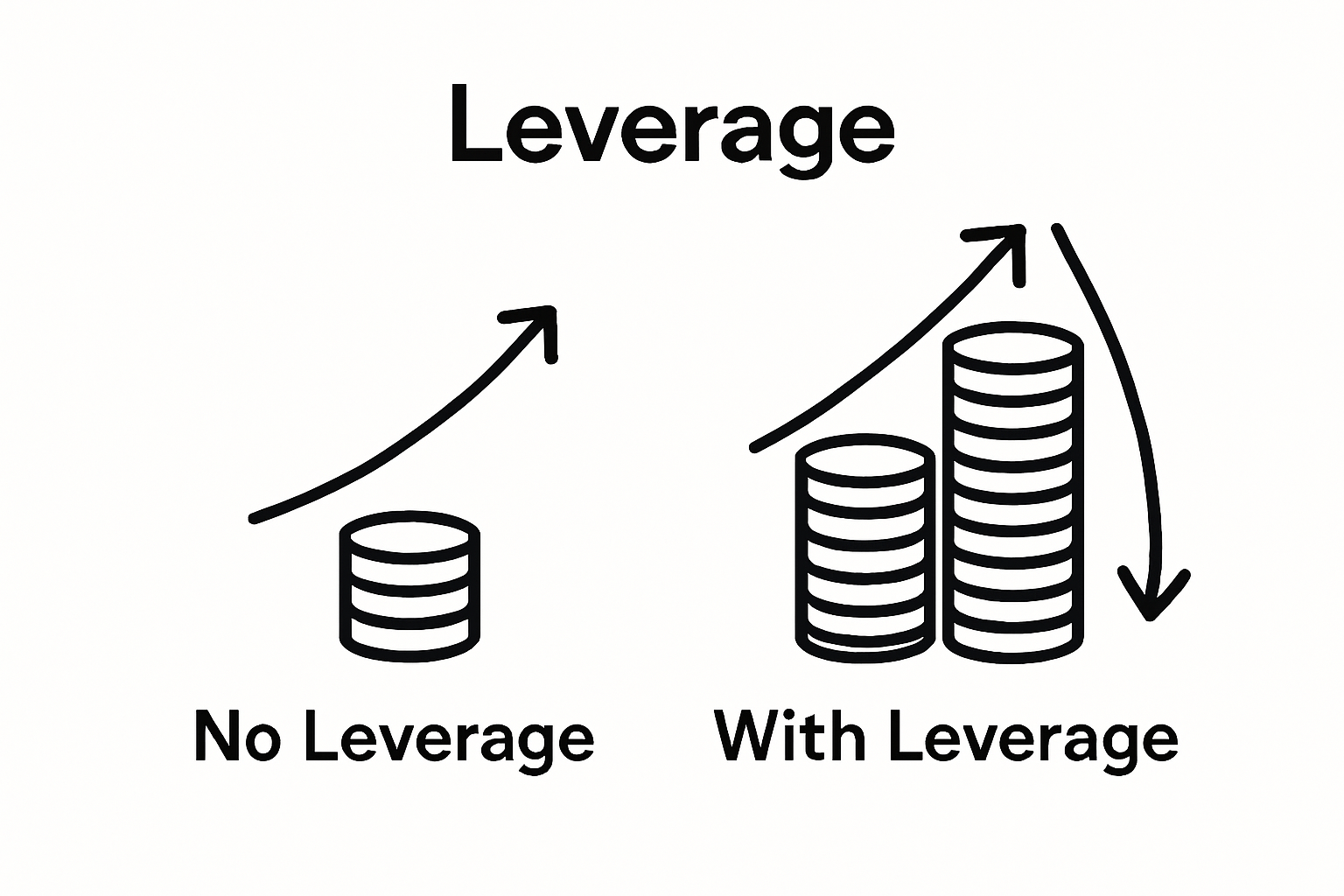 For instance, with a 1:50 leverage, a 1% market movement translates into a 50% change in the trader’s position value. This mathematical relationship means traders can experience exponential financial outcomes from minimal market fluctuations.
Key Amplification Characteristics:
- Small market movements create significant portfolio impact
- Potential for rapid capital growth or substantial losses
- Requires precise risk management strategies
Gain Scenarios and Potential Rewards
In favorable market conditions, leverage can transform modest investments into remarkable returns. A trader investing $1,000 with 1:50 leverage could potentially generate profits equivalent to a $50,000 investment. According to OECD research, understanding these leverage dynamics is crucial for managing potential financial volatility.
Successful leveraged trading requires deep market understanding, technical analysis skills, and an ability to predict short-term price movements with reasonable accuracy. Boom and crash strategy traders often utilize these amplification mechanics to maximize their trading potential.
Loss Mitigation and Risk Management
The same amplification mechanism that creates potential gains can quickly transform into catastrophic losses. A 2% adverse market movement with 1:50 leverage could potentially wipe out an entire trading account. Professional traders mitigate these risks through strategic approaches like implementing strict stop-loss orders, maintaining conservative leverage ratios, and continuously monitoring market conditions.
Experienced traders recommend never risking more than 1-2% of total account value on a single trade when using leverage. This disciplined approach ensures that even multiple consecutive losing trades will not completely deplete trading capital, providing a critical safety net in volatile market environments.
Understanding Margin Requirements and Risk Management with Leverage
Margin requirements represent a critical mechanism in leveraged trading that helps protect both traders and brokers from excessive financial risk. By establishing precise rules about the minimum capital needed to maintain trading positions, margin requirements serve as a fundamental risk management tool in financial markets.
The Fundamentals of Margin Trading
Margin trading involves using borrowed funds from a broker to open larger trading positions than an investor’s actual account balance would normally permit. The margin requirement represents the minimum percentage of the total trade value that must be maintained in the trading account to keep the position open. For instance, a 5% margin requirement means a trader must keep $5 available for every $100 of the total trading position.
Essential Margin Trading Principles:
- Determines the maximum leverage a trader can utilize
- Protects brokers from potential trader defaults
- Helps control systemic financial risk
Calculating and Managing Margin Levels
Brokers calculate margin requirements based on multiple factors including market volatility, asset type, and overall trading risk. According to research on margin trading dynamics, these requirements can dynamically adjust to market conditions, providing a flexible risk management framework.
Volatility index traders must pay special attention to margin requirements, as rapidly changing market conditions can quickly impact their trading positions. When a trader’s account falls below the minimum margin requirement, a margin call is triggered, requiring the trader to deposit additional funds or close out existing positions.
Risk Mitigation Strategies
Successful leverage traders implement comprehensive risk management techniques to navigate margin requirements effectively. This involves continuously monitoring account equity, maintaining sufficient buffer capital, and understanding the specific margin rules of their trading platform.
Professional traders typically recommend keeping account equity well above the minimum margin requirement, often maintaining 2-3 times the required margin as a safety buffer. This approach provides flexibility during market fluctuations and reduces the likelihood of forced position closures.
By understanding and respecting margin requirements, traders can use leverage as a powerful tool for potential financial growth while maintaining a disciplined and strategic approach to risk management.
Here is a concise table outlining different leverage-related terms and their definitions to clarify the key concepts referenced throughout the article.
| Term | Definition |
|---|---|
| Leverage | The ability to control a larger market position with a smaller amount of personal capital by borrowing funds. |
| Margin Requirement | The minimum percentage of trade value that must be maintained in the account to keep a leveraged position open. |
| Margin Call | A broker alert requiring a trader to deposit more funds or close positions due to the account falling below minimum margin. |
| Stop-Loss Order | A preset order to automatically sell or close a position at a certain price to limit potential losses. |
| Leverage Ratio | The ratio expressing how much capital can be controlled per unit of own funds (e.g., 1:50, 1:100). |
Real-World Examples of Leverage in Trading Scenarios
Leverage transforms theoretical financial concepts into practical trading strategies, demonstrating how strategic borrowing can create remarkable investment opportunities across different markets. By examining concrete scenarios, traders can better understand the intricate dynamics of leveraged trading.
Forex Trading Leverage Scenario
Consider a forex trader with $1,000 in their trading account using a 1:50 leverage ratio. If the EUR/USD currency pair moves 2% in the trader’s predicted direction, the potential profit could be significantly amplified. With standard leverage, a 2% market movement would translate to a 100% return on the trader’s initial investment, turning the $1,000 into $2,000.
Key Forex Leverage Characteristics:
- Enables trading large currency positions with minimal capital
- Amplifies potential profits from small market movements
- Requires precise market prediction skills
Cryptocurrency Market Leverage Example
Cryptocurrency markets present even more dramatic leverage scenarios. According to Stanford Graduate School of Business research, leverage can create significant market dynamics. A bitcoin trader with $500 and 1:100 leverage could potentially control a $50,000 position. If bitcoin increases 5% during the trading period, the trader could realize a $2,500 profit instead of a modest $25 return without leverage.
Boom and crash strategy traders frequently utilize these leverage mechanics in volatile cryptocurrency markets, capitalizing on rapid price fluctuations.
Risk Management in Practical Leverage Scenarios
While leverage offers extraordinary potential, it simultaneously introduces substantial risks. A real-world example illustrates this dual nature: imagine a trader miscalculating a market movement. That same 5% unfavorable price change could instantly eliminate the entire trading account, demonstrating why rigorous risk management is crucial.
Professional traders mitigate these risks by implementing strict strategies such as:
- Setting precise stop-loss orders
- Limiting leverage to conservative ratios
- Continuously monitoring market conditions
- Maintaining substantial account buffer capital
By studying these practical scenarios, traders can develop a nuanced understanding of leverage as a powerful yet potentially dangerous financial instrument that demands respect, knowledge, and disciplined implementation.
Trade Smarter with Powerful Leverage Tools and Expert Guidance
Struggling to master the fine balance between amplified gains and increased risks in leverage trading? If you have ever wondered how to use leverage to your advantage without risking your entire account, you are not alone. The concepts of margin, position sizing, and effective risk management in trading can be overwhelming. At FrankFX, we empower you to go beyond the basics and transform your understanding into practical trading success.
Why navigate these complex markets alone? Join our FrankFX community and unlock access to premium mentorship, real-time signals, free calculators, and a full library of expert resources tailored for both forex and index traders. Take the next step toward confident trading by exploring our automated tools and daily analysis or visit our VIP mentorship program to start learning from proven professionals now. Success in leveraged trading starts with the right support—act today for a smarter edge.
Frequently Asked Questions
What is leverage in trading?
Leverage in trading allows investors to control larger market positions with a smaller amount of capital by borrowing funds from a broker, magnifying both potential profits and risks.
How does leverage affect my trading risks and rewards?
Leverage amplifies both gains and losses; a small market movement can result in significant financial outcomes, making precise risk management essential when trading with leverage.
What are margin requirements in leveraged trading?
Margin requirements are the minimum percentage of the trade value that must be maintained in the trading account to keep a leveraged position open, serving as a risk management tool for traders and brokers.
What are recommended leverage ratios for safe trading practices?
Professional traders often recommend conservative leverage ratios between 1:10 and 1:30 to balance the potential for returns with manageable risk exposure.
Recommended
- FRANKFX TRADING ACADEMY | TRADING
- FRANKFX TRADING ACADEMY | TRADING
- FRANKFX TRADING ACADEMY | TRADING
- FRANKFX TRADING ACADEMY | TRADING