Traders are always searching for a strategy that actually works in unpredictable markets. Fundamental analysis dives deep into financials, while technical analysis focuses on price charts. But the real surprise is that research shows combining both methods can significantly improve predictive accuracy and trading results. Most people think they need to pick a side, but top investors are now using both approaches together for a sharper edge.
Table of Contents
- What Is Fundamental Analysis And Its Key Concepts?
- What Is Technical Analysis And Its Core Principles?
- Why Fundamental And Technical Analysis Matter In Trading
- How Fundamental And Technical Analysis Interact
- Choosing Between Fundamental And Technical Analysis For Trading
Quick Summary
| Takeaway | Explanation |
|---|---|
| Fundamental Analysis Assesses Intrinsic Value | It determines if assets are undervalued, overvalued, or fairly valued through comprehensive economic and financial evaluations. |
| Technical Analysis Focuses on Price Trends | It analyzes past price movements and trading volume to predict future market behavior, guiding shorter-term trading decisions. |
| Integrating Both Methods Enhances Strategies | Combining fundamental and technical analysis provides a more holistic view, leveraging long-term value with short-term market sentiment. |
| Select Analysis Based on Trading Goals | Choosing between fundamental and technical analysis depends on individual investment styles, time horizons, and risk management strategies. |
| Flexibility in Approach Increases Success | Successful traders adapt and utilize both analytical methods to create robust strategies for varying market conditions. |
What is Fundamental Analysis and Its Key Concepts?
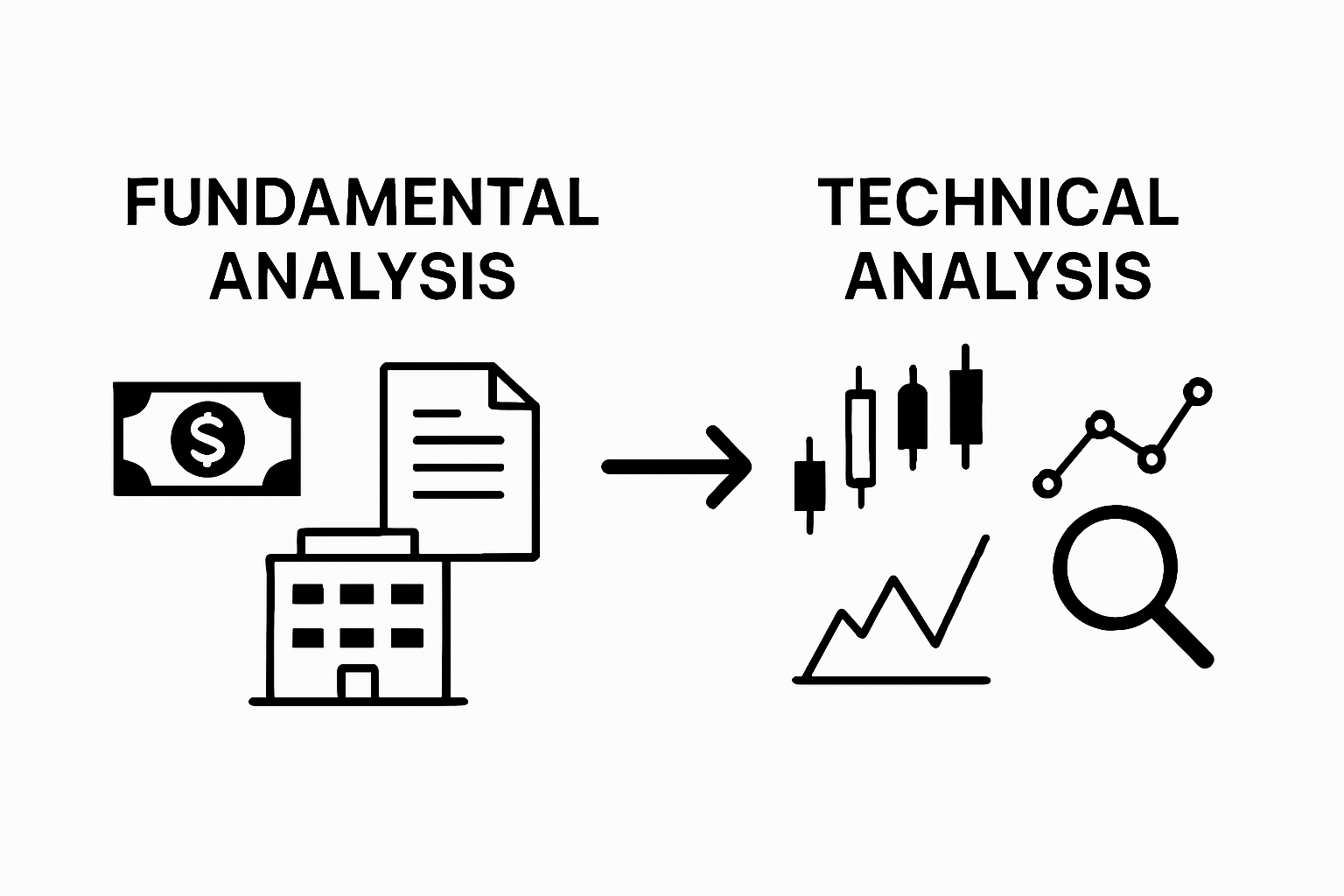
Fundamental analysis represents a comprehensive investment research methodology that evaluates a financial instrument’s intrinsic value by examining underlying economic, financial, and qualitative factors. Unlike technical analysis which focuses on price movements, fundamental analysis seeks to understand the core drivers determining an asset’s true worth.
Core Principles of Fundamental Analysis
At its foundation, fundamental analysis assesses an asset’s potential by investigating multiple interconnected elements. For traders and investors, this means diving deep into economic indicators, company financials, industry dynamics, and broader market conditions that could influence an investment’s performance.
The primary goal is to determine whether an asset is undervalued, fairly valued, or overvalued based on extensive research. This approach requires examining several critical components:
- Economic indicators like GDP growth
- Company financial statements
- Management quality and corporate governance
- Industry competitive landscape
- Macroeconomic trends and geopolitical factors
Practical Application in Trading
Traders utilizing fundamental analysis typically conduct thorough investigations before making investment decisions. According to research from the Warren Institute, this method involves systematically analyzing multiple data points to construct a comprehensive understanding of an asset’s potential.
In practice, fundamental analysis might involve studying a company’s annual reports, evaluating management strategies, understanding revenue streams, assessing debt levels, and considering broader economic trends that could impact future performance. For forex traders, this might mean examining national economic policies, interest rates, employment statistics, and political stability.
The key distinction is that fundamental analysis looks beyond short-term price fluctuations, focusing instead on long-term value creation and sustainable growth potential.
To clarify the major differences and purposes of fundamental analysis and technical analysis, the following table summarizes their core principles and practical focuses for easier comparison.
| Aspect | Fundamental Analysis | Technical Analysis |
|---|---|---|
| Main Focus | Intrinsic value of assets | Price trends and patterns |
| Key Drivers | Economic, financial, and qualitative factors | Historical prices, charts, and trading volume |
| Typical Time Horizon | Long-term | Short-term to medium-term |
| Data Sources | Financial reports, economic indicators, qualitative data | Price charts, technical indicators, trading volumes |
| Primary Goal | Assess undervaluation or overvaluation | Predict future market behavior through patterns |
| Typical Users | Investors and analysts focused on fundamentals | Traders seeking to exploit market timing and sentiment |
| Strengths | Evaluates asset value and sustainability | Identifies entry/exit points and short-term trends |
What is Technical Analysis and Its Core Principles?
Technical analysis is a trading discipline that evaluates investments by analyzing statistical trends, price movements, and trading volumes to predict future market behavior. Unlike fundamental analysis, which examines underlying economic factors, technical analysis concentrates exclusively on the price action and trading patterns of financial instruments.
Foundational Assumptions of Technical Analysis
Technical analysis operates on several key philosophical principles that distinguish it from other investment research methods. Traders who use this approach believe that historical price movements and market psychology can provide meaningful insights into potential future market trends.
The core assumptions underlying technical analysis include:
- Market prices reflect all available information
- Price movements follow identifiable patterns
- Historical trading behaviors tend to repeat
- Trader psychology significantly influences market movements
- Statistical trends can predict potential future price directions
Practical Tools and Methodologies
According to research from the Corporate Finance Institute, technical analysts employ various sophisticated tools to interpret market data. These include chart patterns, momentum indicators, trend lines, moving averages, and oscillators that help traders understand potential market movements.
Technical traders typically use multiple timeframes and analytical tools to confirm their hypotheses. They might examine daily, weekly, and monthly charts to understand short-term fluctuations and long-term trends simultaneously. By combining different indicators like relative strength index (RSI), moving average convergence divergence (MACD), and Bollinger Bands, traders attempt to create a comprehensive view of potential market directions.
The primary objective of technical analysis is not to predict exact price points but to identify probability-based scenarios that help traders make more informed decisions. While no method guarantees perfect predictions, technical analysis provides a structured approach to understanding market dynamics, trader sentiment, and potential future price movements.
Why Fundamental and Technical Analysis Matter in Trading
Fundamental and technical analysis are complementary approaches that provide traders with comprehensive insights into market dynamics, investment potential, and strategic decision-making. By integrating these methodologies, traders can develop more robust and nuanced trading strategies that account for both long-term value and short-term market movements.
Synergistic Investment Strategies
Each analysis method offers unique perspectives that, when combined, create a more holistic understanding of financial instruments.

Key benefits of integrating both approaches include:
- Comprehensive market evaluation
- Risk mitigation through multi-dimensional assessment
- Enhanced decision-making capabilities
- Better understanding of market psychology
- More precise entry and exit point identification
Empirical Evidence of Combined Approaches
According to research published in the Jurnal Manajemen Maranatha, integrating fundamental and technical analysis models can significantly improve predictive accuracy. This approach allows traders to leverage both quantitative financial metrics and historical price patterns, creating a more sophisticated investment strategy.
Traders can explore advanced trading techniques on our volatility index trading forum to further understand these complex analytical methods. By understanding how fundamental factors interact with market sentiment, investors can develop more nuanced strategies that balance long-term potential with short-term market opportunities.
The ultimate goal is not to choose between fundamental or technical analysis, but to recognize how these approaches complement each other. Successful traders view these methods as interconnected tools that, when used together, provide a more comprehensive view of market dynamics, potential risks, and investment opportunities.
How Fundamental and Technical Analysis Interact
Fundamental and technical analysis are not competing methodologies but complementary approaches that provide traders with multifaceted insights into market behavior. Their interaction creates a more comprehensive framework for understanding investment opportunities, blending quantitative evaluation with market sentiment analysis.
Information Integration Mechanisms
Traders leverage fundamental and technical analysis by using each method to validate and refine their investment strategies. Fundamental analysis establishes the baseline value of an asset, while technical analysis helps determine optimal entry and exit points based on market psychology and price movements.
Key interaction points between these analytical approaches include:
- Using fundamental insights to confirm technical signals
- Identifying potential market inefficiencies
- Timing investments based on both intrinsic value and market trends
- Assessing risk through multiple analytical perspectives
- Developing more nuanced trading strategies
Strategic Application in Trading
According to research from academic finance studies, institutional investors increasingly recognize the value of integrating fundamental and technical analysis. For instance, a trader might use fundamental analysis to select promising assets and then apply technical analysis to determine precise market entry and exit points.
Traders interested in advanced trading techniques can explore our synthetic indices trading forum to understand practical implementation strategies. The interplay between these analytical methods allows traders to develop a more holistic approach that accounts for both long-term value potential and short-term market dynamics.
Ultimately, the interaction between fundamental and technical analysis transforms individual analytical tools into a powerful, integrated investment strategy. By understanding how these approaches complement each other, traders can make more informed decisions that balance rigorous financial assessment with real-time market insights.
Choosing Between Fundamental and Technical Analysis for Trading
Choosing between fundamental and technical analysis depends on a trader’s investment goals, risk tolerance, trading style, and market understanding. While both methods offer valuable insights, they serve different purposes and are most effective when applied strategically to specific trading scenarios.
Determining the Right Analytical Approach
Traders must consider multiple factors when selecting an analytical method. The choice is not about which approach is superior, but about matching the right strategy to specific investment objectives. Fundamental analysis suits investors seeking long-term value, while technical analysis benefits traders focused on short-term market movements.
Critical considerations for selecting an analytical approach include:
- Investment time horizon
- Personal trading experience
- Market volatility
- Available research resources
- Individual risk management strategies
Strategic Selection Criteria
According to research from the Investment Science Institute, different market conditions and investment goals require tailored analytical approaches. Fundamental analysis proves more effective for:
- Long-term investment strategies
- Evaluating company financial health
- Understanding economic trend impacts
- Assessing intrinsic asset value
Technical analysis, conversely, excels in:
-
Short-term trading opportunities
-
Identifying market sentiment shifts
-
Timing precise market entry and exit points
-
Analyzing price momentum
Traders looking to enhance their analytical skills can explore our boom and crash strategy forum to develop more nuanced trading techniques.
Successful traders often adopt a hybrid approach, leveraging strengths from both fundamental and technical analysis.
This table highlights scenarios where each analysis method is most effective, helping traders choose the right approach based on their specific needs and market conditions.
| Analytical Approach | Best Used For | Example Applications |
|---|---|---|
| Fundamental Analysis | Long-term investments, evaluating value | Assessing company health, analyzing economic trends |
| Technical Analysis | Short-term trading, market timing | Identifying sentiment shifts, precise entry/exit point timing |
| Combined Approach | Balanced strategies, maximizing both strengths | Using fundamentals for selection, technicals for execution |
Unlock Real Trading Confidence By Bridging Analysis With Action
Are you struggling to turn your knowledge of fundamental and technical analysis into profitable trades? It is tough when the markets move fast and you are left guessing whether to trust the indicators or the economy. Many traders find themselves caught between conflicting signals, unable to make decisions with confidence. The need for clear, actionable guidance and a solid trading strategy has never been stronger. At FrankFX, we recognize that frustration and help you transform uncertainty into strength by offering a suite of comprehensive tools, signals, and mentorship that put your research into practice.

Now is the perfect time to apply your understanding with real-world trading support. Join our thriving FrankFX community where you get access to daily signals, advanced analysis, and exclusive mentorship tailored for both forex and index traders. Take advantage of our free resources and automated trading solutions designed to enhance your strategies from the fundamentals up. Do not wait for another missed opportunity. Visit FrankFX today and see how our advanced tools can help you sharpen your edge. Experience the full potential of your analysis by tapping into our live sessions, free indicators, and trading robots. Start your journey to more decisive and confident trading now.
Frequently Asked Questions
What is fundamental analysis?
Fundamental analysis is a comprehensive investment research methodology that evaluates an asset’s intrinsic value by examining economic, financial, and qualitative factors.
How does technical analysis differ from fundamental analysis?
Technical analysis focuses solely on price movements and trading patterns, while fundamental analysis examines underlying economic factors to determine an asset’s true worth.
Can I combine fundamental and technical analysis in my trading strategy?
Yes, integrating both fundamental and technical analysis can provide a more holistic understanding of market dynamics, allowing for better decision-making and risk management.
When is it better to use fundamental analysis?
Fundamental analysis is typically more effective for long-term investment strategies, helping investors evaluate a company’s financial health and understand economic impacts on asset value.
Recommended
- FRANKFX TRADING ACADEMY | TRADING
- FRANKFX TRADING ACADEMY | TRADING
- FRANKFX TRADING ACADEMY | TRADING
- FRANKFX TRADING ACADEMY | TRADING