Gap trading catches people’s attention for a good reason. Out of all trading patterns, gap moves create some of the fastest price swings you’ll ever see. But what’s wild is that crypto markets show even more frequent and dramatic gaps than stocks or forex. Most traders get drawn in by the chart patterns, but the top performers know it’s the hidden patterns behind these gaps and the way you manage risk that truly separate wins from wipeouts.
Table of Contents
- Understanding Gap Trading And Market Types
- Popular Gap Trading Strategies Explained
- How To Identify And Manage Trading Gaps
- Tips For Success In Different Markets
Quick Summary
| Takeaway | Explanation |
|---|---|
| Understand gap types and market dynamics | Recognize the different gap types to better anticipate market movements and trading opportunities. |
| Apply specific trading strategies | Use strategies like fade the gap, breakaway gap, and trend continuation to capitalize on price gaps effectively. |
| Implement robust risk management | Protect against losses by setting clear stop-loss orders and position sizes for every gap trade. |
| Analyze volume for gap validity | High trading volume confirms the reliability of gaps, influencing potential follow-through on price movements. |
| Adapt strategies to market conditions | Flexibility in trading strategies is essential for success in varying market types like forex, stocks, and cryptocurrencies. |
Understanding Gap Trading and Market Types
Gap trading represents a nuanced strategy that requires traders to understand the intricate dynamics of different market types and price movements. A gap occurs when a financial instrument’s price suddenly jumps or drops between trading sessions, creating a clear visual space on a price chart where no trading activity happened.
Types of Market Gaps
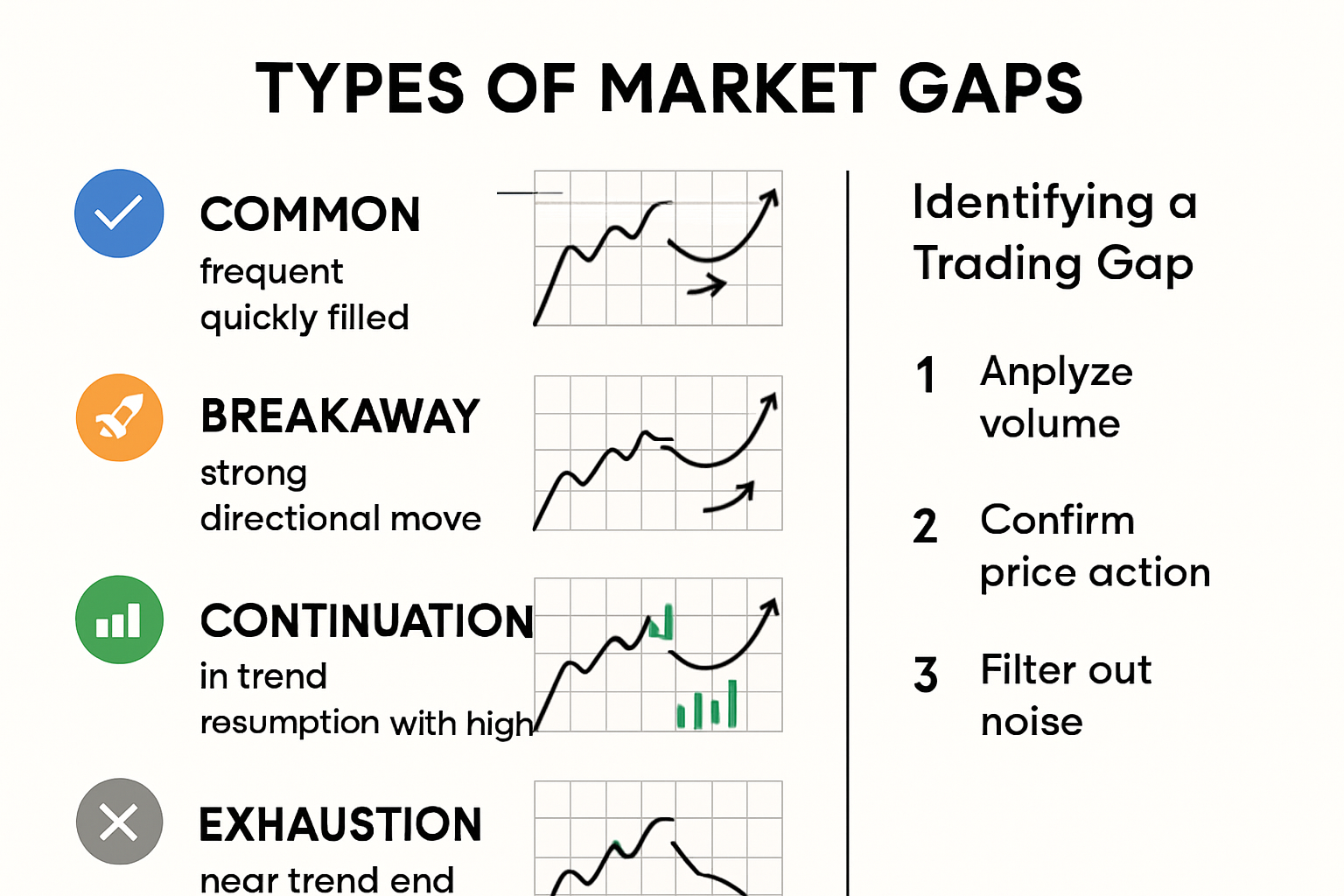
Traders encounter several distinct gap categories that signal different market psychology and potential trading opportunities. Opening gaps happen when the market starts trading significantly higher or lower than the previous day’s closing price. These gaps can emerge from overnight news, earnings reports, or significant market sentiment shifts. Investopedia classifies four primary gap types: common, breakaway, continuation, and exhaustion gaps.
To help you quickly compare the main gap types and their market significance, the following table summarizes the key characteristics and implications of each gap mentioned in the article.
| Gap Type | Description | Typical Market Signal/Implication |
|---|---|---|
| Common Gap | Small, frequent gaps with little significance | Usually filled quickly; not reliable for trading |
| Breakaway Gap | Large gap breaking support/resistance with high volume | Signals new trend or major directional movement |
| Continuation Gap | Gaps mid-trend during strong price movement | Confirms current trend momentum |
| Exhaustion Gap | Final gap near the end of a trend | Often signals trend reversal or slowdown |
| Opening Gap | Market opens higher/lower than previous close | Driven by news, earnings, or sentiment shifts |
Breakaway gaps represent powerful market signals indicating potential trend reversals or new directional movements. They typically occur when price breaks through a significant support or resistance level with substantial volume. Continuation gaps suggest an existing trend’s strength, showing momentum remains consistent during market movement. FinancialTrading.com notes these gaps often appear midway through a strong trend, confirming the current price direction.
Gap Trading Mechanics
Successful gap trading strategies require traders to analyze multiple factors beyond simple price movement. Volume plays a critical role in determining a gap’s reliability and potential follow-through. High-volume gaps generally represent more significant market conviction compared to low-volume price jumps.
Traders must also consider the underlying market context. Different markets like forex, stocks, and cryptocurrencies exhibit unique gap characteristics. Forex markets, operating 24 hours, experience fewer traditional gaps compared to stock markets with defined trading sessions. Cryptocurrency markets, known for higher volatility, can present more frequent and dramatic gap opportunities.
Risk management becomes paramount when implementing gap trading techniques. Traders should establish clear entry and exit rules, utilizing stop-loss orders and position sizing strategies to protect against unexpected market reversals. Understanding the probability and potential outcomes of different gap types allows traders to make more informed decisions and develop robust trading approaches.
Gap trading isn’t a guaranteed profit mechanism but a strategic approach requiring continuous learning, market analysis, and disciplined execution. Successful traders combine technical analysis, market sentiment evaluation, and risk management to transform gap trading from a simple chart pattern into a comprehensive trading strategy.
Popular Gap Trading Strategies Explained
Gap trading strategies offer traders multiple approaches to capitalize on price discontinuities across financial markets. Understanding these strategies requires a comprehensive analysis of market behavior, technical indicators, and risk management techniques.
Fade the Gap Strategy
The fade the gap strategy represents a counterintuitive approach where traders intentionally trade against the initial gap movement. StockCharts.com explains this method involves identifying overextended price movements and anticipating a potential reversal. Traders look for specific conditions such as low trading volume, lack of fundamental support, or excessive market momentum to execute this strategy.
Successful fade trading requires precise timing and robust risk management. Traders typically set tight stop-loss orders to protect against potential continued price movement. The strategy works best in markets with predictable behavioral patterns and when traders can quickly assess the gap’s underlying causes.
Breakaway Gap Trading Approach
Investopedia highlights the breakaway gap strategy as a more aggressive trading technique focused on capturing significant trend initiation moments. This approach targets gaps that signal the beginning of a new market trend, typically occurring after periods of consolidation or major market events.
Key elements of breakaway gap trading include:
- Confirming volume Substantial trading volume validates the gap’s significance
- Technical confirmation Multiple technical indicators supporting the trend
- Fundamental analysis Understanding the underlying market drivers
Traders implementing this strategy seek to enter positions early in a potential trend, maximizing profit potential while managing downside risk through precise entry and exit points.
Trend Continuation Gap Strategy
The trend continuation gap strategy focuses on gaps that emerge during established market trends. These gaps represent momentary price accelerations that confirm the existing market direction. Traders utilizing this approach look for specific gap characteristics that suggest the current trend will persist.
Critical considerations include analyzing the gap’s position within the broader market context, evaluating supporting technical indicators, and understanding the gap’s relationship to recent price action. Successful implementation requires traders to distinguish between genuine trend continuation signals and potential false breakouts.
Risk management remains paramount in gap trading strategies. Traders must develop disciplined approaches that incorporate:
- Precise position sizing
- Strategic stop-loss placement
- Comprehensive market analysis
- Continuous strategy refinement
While gap trading strategies offer potential opportunities, they are not foolproof. Successful traders combine technical analysis, market understanding, and psychological discipline to transform these strategies from simple chart patterns into robust trading approaches.
How to Identify and Manage Trading Gaps
Identifying and managing trading gaps requires a systematic approach that combines technical analysis, market understanding, and disciplined risk management. Traders must develop a comprehensive skill set to effectively recognize and capitalize on gap trading opportunities across different financial markets.
Identifying Gap Characteristics
Technical Analysis of Financial Markets emphasizes the importance of distinguishing between different gap types. Traders should look for specific visual and technical indicators that signal a meaningful gap. Volume analysis plays a crucial role in confirming gap significance. High-volume gaps typically represent more substantial market movements compared to low-volume price jumps.
Key characteristics to identify include:
- Gap size Measuring the price difference between trading sessions
- Market context Understanding the surrounding price action and trend
- Trading volume Evaluating the strength of the price movement
Traders must develop a keen eye for distinguishing between common market noise and genuinely significant gaps that present actionable trading opportunities.
Risk Management Strategies
Research from Market Analysis Experts highlights the critical importance of robust risk management in gap trading. Successful traders implement multiple layers of protection to mitigate potential losses. This involves setting precise stop-loss orders, carefully sizing positions, and maintaining a disciplined approach to trade execution.
Effective risk management techniques include:
- Position sizing Limiting exposure to any single trade
- Stop-loss placement Protecting against unexpected market reversals
- Diversification Spreading risk across multiple trading opportunities
Traders should never risk more than a small percentage of their trading capital on a single gap trade. The goal is to survive and continue trading, not to make a single massive bet.
Advanced Gap Trading Techniques
Advanced traders develop sophisticated approaches to gap trading that go beyond basic pattern recognition. This involves integrating multiple analysis techniques, including fundamental analysis, technical indicators, and market sentiment evaluation. Wikipedia’s Gap Trading Overview suggests that successful gap trading requires a holistic understanding of market dynamics.
Advanced techniques include:
- Combining multiple technical indicators
- Analyzing pre-market and after-hours trading activity
- Considering macroeconomic factors that might influence price movements
Traders must remain adaptable, continuously learning and refining their approach. Each market and financial instrument presents unique gap trading characteristics that require careful study and nuanced interpretation.
Mastering gap trading is a complex journey that demands patience, discipline, and continuous learning. Successful traders approach gaps as opportunities for strategic market entry, not guaranteed profit mechanisms. They combine technical skill, market understanding, and psychological discipline to transform gap trading from a simple chart pattern into a sophisticated trading strategy.
Tips for Success in Different Markets
Successful gap trading requires a nuanced approach that adapts to the unique characteristics of different financial markets. Traders must develop flexible strategies that account for the specific dynamics of forex, stock, cryptocurrency, and other trading environments.
Market-Specific Gap Trading Strategies
Walk Forward Optimization Research suggests that traders should develop adaptive strategies that can withstand varying market conditions. Each market presents unique challenges and opportunities for gap trading.
Forex markets, operating 24 hours a day, experience different gap dynamics compared to stock markets. Cryptocurrency markets demonstrate higher volatility, creating more frequent and dramatic gap opportunities. Stock markets typically show more predictable gap patterns, especially around earnings reports and significant economic events.
Key market-specific considerations include:
- Forex Minimal overnight gaps due to continuous trading
- Stocks More pronounced gaps during market open
- Cryptocurrency Extreme price volatility and frequent gaps
The table below compares how gap trading characteristics and strategies differ across major financial markets, helping you select the right approach for each environment.
| Market Type | Gap Frequency & Size | Typical Gap Causes | Strategic Consideration |
|---|---|---|---|
| Forex | Rare, usually small | Major news/events, weekends | Fewer opportunities; require fast action |
| Stocks | Frequent, can be large at open | Earnings, news, overnight sentiment | Best for fade and breakaway strategies |
| Cryptocurrency | Frequent, often very large/volatile | High volatility, market structure | Use strong risk management, high potential |
Advanced Performance Optimization
Statistical Arbitrage Research highlights the importance of dynamic modeling and parameter adaptation in trading strategies. Successful traders implement sophisticated techniques to improve their gap trading performance across different markets.
Performance optimization strategies include:
- Continuous backtesting Regularly evaluating strategy effectiveness
- Parameter adjustment Adapting to changing market conditions
- Risk management Implementing robust protective measures
Traders must develop a systematic approach to strategy refinement. This involves collecting detailed performance data, analyzing trading results, and making incremental improvements to their gap trading techniques.
Cross-Market Trading Techniques
Advanced traders develop skills that allow them to identify and exploit gap trading opportunities across multiple markets. This requires a comprehensive understanding of different market mechanics, technical indicators, and trading instruments.
Cross-market trading techniques involve:
- Comparing gap characteristics across different financial instruments
- Understanding correlations between markets
- Developing flexible trading algorithms
Successful cross-market gap trading demands exceptional analytical skills and the ability to quickly adapt to changing market conditions. Traders must maintain a holistic view of market dynamics, integrating technical analysis, fundamental research, and real-time market sentiment.

Ultimately, success in gap trading comes from a combination of technical skill, disciplined risk management, and continuous learning. Traders who approach gap trading as a sophisticated, adaptive strategy are more likely to achieve consistent performance across different markets. The key is to remain flexible, analytical, and committed to ongoing strategy refinement.
Frequently Asked Questions
What are the different types of gaps in trading?
There are several types of gaps in trading, including common gaps, breakaway gaps, continuation gaps, exhaustion gaps, and opening gaps. Each type signals different market conditions and opportunities.
How can I manage risk while gap trading?
To manage risk in gap trading, establish clear entry and exit rules, utilize stop-loss orders, determine appropriate position sizes, and avoid risking more than a small percentage of your trading capital on any single trade.
What is the fade the gap strategy?
The fade the gap strategy involves trading against the initial gap movement. Traders look for overextended price movements and anticipate a reversal, relying on specific conditions like low trading volume and lack of fundamental support.
How does gap trading differ across financial markets?
Gap trading characteristics vary by market type. For instance, forex markets typically show fewer gaps than stock markets, while cryptocurrency markets often experience more frequent and volatile gaps due to high volatility. Each market requires tailored strategies to capitalize on gaps.
Supercharge Your Gap Trading With FrankFX Expert Tools and Signals
Are you struggling to consistently identify high-probability gaps or frustrated by sudden reversals that wipe out your profits? The article you just read highlights how fast-moving gap opportunities and risk management are critical to your trading results. If you want to reliably execute advanced strategies like fade the gap, breakaway gaps, or manage trend continuations, you deserve access to more than just static charts and theory. You need live trading signals, mentorship, and robust automation that fits the demanding pace of forex and crypto gaps.

Stop relying on luck or incomplete tools when reacting to price gaps. Gain an edge by joining a thriving community where you receive daily signals, exclusive analysis, and direct guidance from expert traders. Start your transformation today at FrankFX, and unlock free resources, automated indicators, and live session access. Your next step is simple: visit FrankFX trading solutions right now to put professional gap strategies into action and see why so many traders trust us to accelerate their growth.