Automated trading is shaking up the way people make money in financial markets. Professional traders warn against investing more than 2-5 percent of your total trading capital in any one automated strategy. Most folks picture a trading robot as a money-printing machine, racking up profits while you sleep. But the real power comes from a careful blend of testing, constant tweaking, and clear strategy that most traders overlook. Ready to see what actually drives long-term success in the world of trading bots?
Table of Contents
- Step 1: Define Your Trading Goals And Strategy
- Step 2: Select And Set Up Your Trading Platform
- Step 3: Choose Or Develop Trading Algorithms
- Step 4: Test Your Automated Trading System
- Step 5: Monitor And Adjust Your Trading Automation
Quick Summary
| Key Point | Explanation |
|---|---|
| 1. Define Clear Trading Goals | Establish specific objectives to guide your automated trading strategy effectively and maintain consistency. |
| 2. Choose a Suitable Trading Platform | Select a platform that supports automation and aligns with your trading needs for better performance. |
| 3. Develop or Acquire Algorithms | Create or source algorithms that match your strategy for optimal execution in complex market conditions. |
| 4. Conduct Thorough Testing | Implement historical and forward testing to validate your system and protect your investment prior to live trading. |
| 5. Monitor and Adjust Systems Regularly | Continuously track performance metrics and adapt your trading algorithm to changing market dynamics for sustained success. |
Step 1: Define Your Trading Goals and Strategy
Successful automated trading begins with crystal clear goals and a well-defined strategy. Your trading objectives are the compass that will guide every subsequent decision in building an automated system. Without precise goals, you risk creating a trading robot that lacks direction and consistency.
Here is a step overview table outlining the main phases of automating your trading, including the focus of each step and its role in the overall process.
| Step | Focus Area | Purpose/Outcome |
|---|---|---|
| 1. Define Goals & Strategy | Objective Setting | Shape foundation for trading system |
| 2. Select & Set Up Platform | Platform Evaluation & Setup | Provide robust environment for automation |
| 3. Choose/Develop Algorithms | Strategy Development | Ensure executable logic for trade actions |
| 4. Test Trading System | Validation & Risk Assessment | Confirm reliability before going live |
| 5. Monitor & Adjust Automation | Oversight & Optimization | Maintain performance and manage risk |
Start by thoroughly assessing your personal financial landscape. Are you seeking supplemental income, long-term wealth accumulation, or rapid short-term gains? Each objective demands a different approach to automated trading. For forex and crypto markets, your strategy must account for unique volatility characteristics. Professional traders recommend allocating no more than 2-5% of your total investment capital to any single automated trading strategy to manage risk effectively.
Crafting Your Trading Blueprint
Develop a comprehensive strategy that includes specific parameters like entry and exit points, risk tolerance, and preferred trading instruments. Your automated system needs precise rules that can be translated into programmable logic.
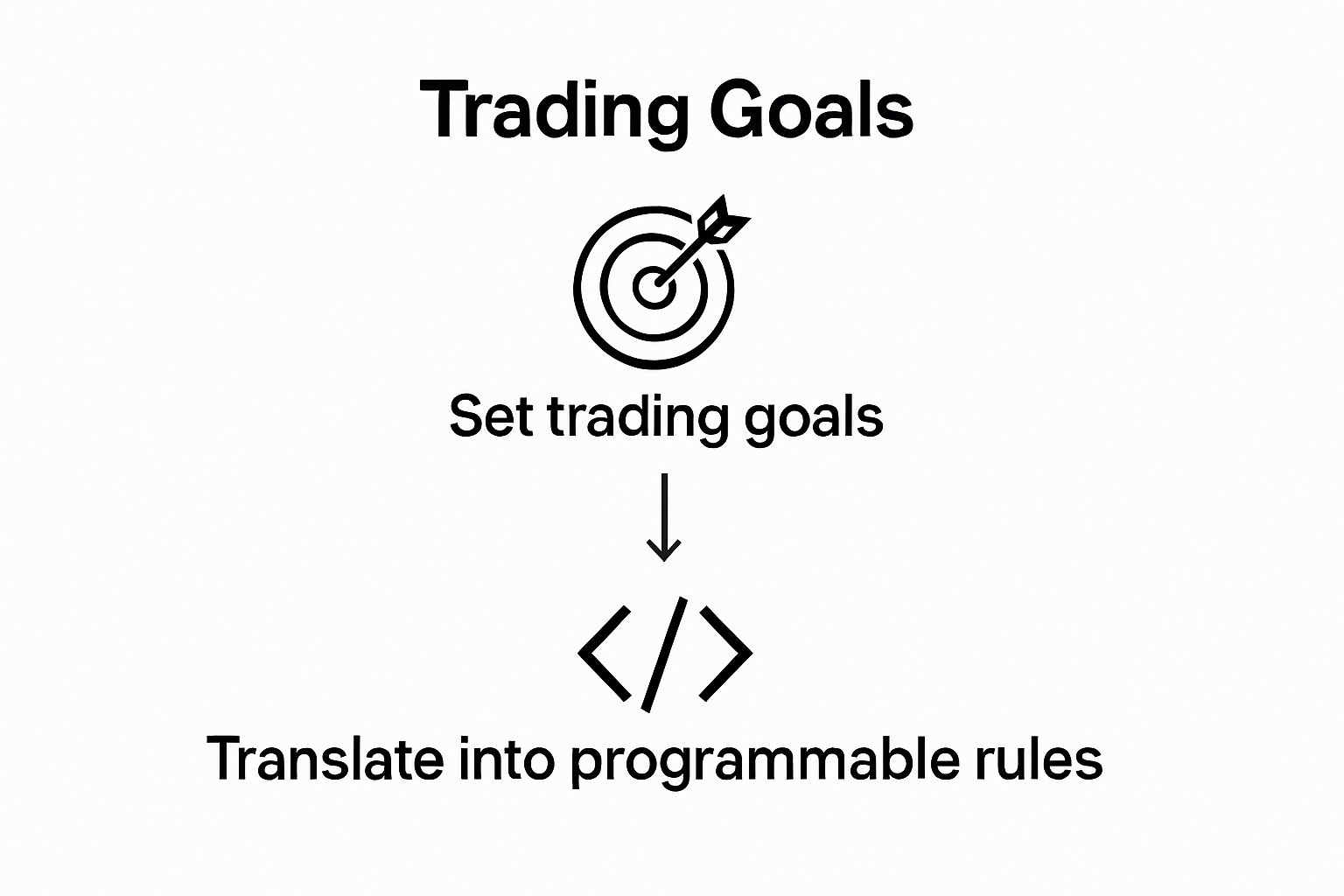 This means defining exact conditions for trade execution – such as moving average crossovers, relative strength indicators, or specific price action patterns.
Consider your risk management framework critically. Will you implement hard stop-loss limits? What percentage of your trading capital are you willing to risk per trade? These questions transform abstract goals into concrete trading algorithms. Learn more about advanced trading strategies in our Volatility Index forum to refine your approach.
Successful automated trading requires brutal honesty about your risk appetite and investment goals. A well-defined strategy acts as your trading system’s genetic code – determining its behavior, adaptability, and potential for sustainable profitability. Take time to research, backtest, and validate your approach before committing real capital to an automated trading solution.
Step 2: Select and Set Up Your Trading Platform
Choosing the right trading platform is a critical foundation for successful automated trading. Your platform serves as the operational headquarters where strategies transform from conceptual blueprints into executable trading algorithms.
Not all platforms are created equal, and selecting one that matches your specific trading goals can dramatically impact your potential returns.
Begin by evaluating platforms that support comprehensive automation features across forex and cryptocurrency markets. Look for platforms offering robust API connectivity, advanced charting tools, and seamless integration with popular programming languages like Python or MQL4/5. MetaTrader 4 and 5, TradingView, and specialized crypto platforms like Boom and Crash trading strategies provide excellent starting points for traders seeking reliable automation solutions.
Platform Configuration and Technical Setup
Once you’ve selected a platform, focus on creating a secure and efficient trading environment. Configure your platform’s settings to align precisely with the trading strategy developed in your previous step. This involves setting up risk management parameters, defining trade size limitations, and establishing connection protocols with your preferred brokers or exchanges. Professional traders recommend implementing multiple layers of authentication and using dedicated trading computers to minimize system vulnerabilities.
Pay close attention to your platform’s backtesting capabilities. A superior trading platform will allow you to simulate your strategy using historical market data, providing crucial insights into potential performance before risking real capital. Most advanced platforms offer comprehensive reporting features that help you analyze strategy effectiveness, track performance metrics, and identify potential optimization opportunities. Remember that successful automated trading requires continuous monitoring and periodic strategy refinement based on real-world performance data.
Step 3: Choose or Develop Trading Algorithms
Trading algorithms represent the intelligence behind your automated trading system, translating your strategic vision into executable code. The right algorithm can transform market complexity into predictable trading opportunities. Traders have multiple pathways to acquire these sophisticated trading tools: developing custom algorithms, purchasing pre-built solutions, or adapting existing open-source strategies.
Below is a summary table comparing different methods for acquiring a trading algorithm, helping you select the approach that best matches your needs and skill level.
| Method | Required Skills | Customization Level | Key Considerations |
|---|---|---|---|
| Develop Custom Algorithm | Programming | High | Full control over logic and features |
| Purchase Pre-built Solution | None | Low | Quick deployment, limited customization |
| Adapt Open-source Strategy | Basic Programming | Medium | Modify existing code, moderate control |
| Use Trend-following Algorithm | None/Basic Coding | Medium | Good for beginners in momentum markets |
| Use Mean Reversion/Arbitrage | Advanced Programming | High | Suitable for complex market conditions |
For traders with programming skills, creating a proprietary algorithm offers maximum customization. Python and MQL4/5 remain the most popular languages for developing trading algorithms, providing robust libraries and frameworks specifically designed for financial modeling. Beginners might start with trend-following algorithms that identify and trade along established market momentum, while advanced traders can explore more complex strategies like mean reversion or statistical arbitrage.
Navigating Algorithm Selection and Refinement
Carefully evaluate potential algorithms against your predefined trading goals and risk tolerance. Professional traders recommend extensive backtesting across multiple market conditions, ensuring your algorithm performs consistently under varying scenarios. Consider algorithms that demonstrate adaptability across forex and cryptocurrency markets, as these assets exhibit unique volatility characteristics. Explore advanced trading techniques in our synthetic indices forum to gain deeper insights into algorithmic strategy development.
When selecting or developing an algorithm, prioritize several critical performance metrics. Look for strategies with proven historical performance, low maximum drawdown, consistent returns, and clear risk management protocols. Machine learning techniques like reinforcement learning and neural networks are increasingly popular, offering dynamic adaptation to changing market conditions. However, these advanced approaches require significant technical expertise and computational resources. Ultimately, successful algorithmic trading demands a balance between mathematical precision, market understanding, and continuous refinement of your trading approach.
Step 4: Test Your Automated Trading System
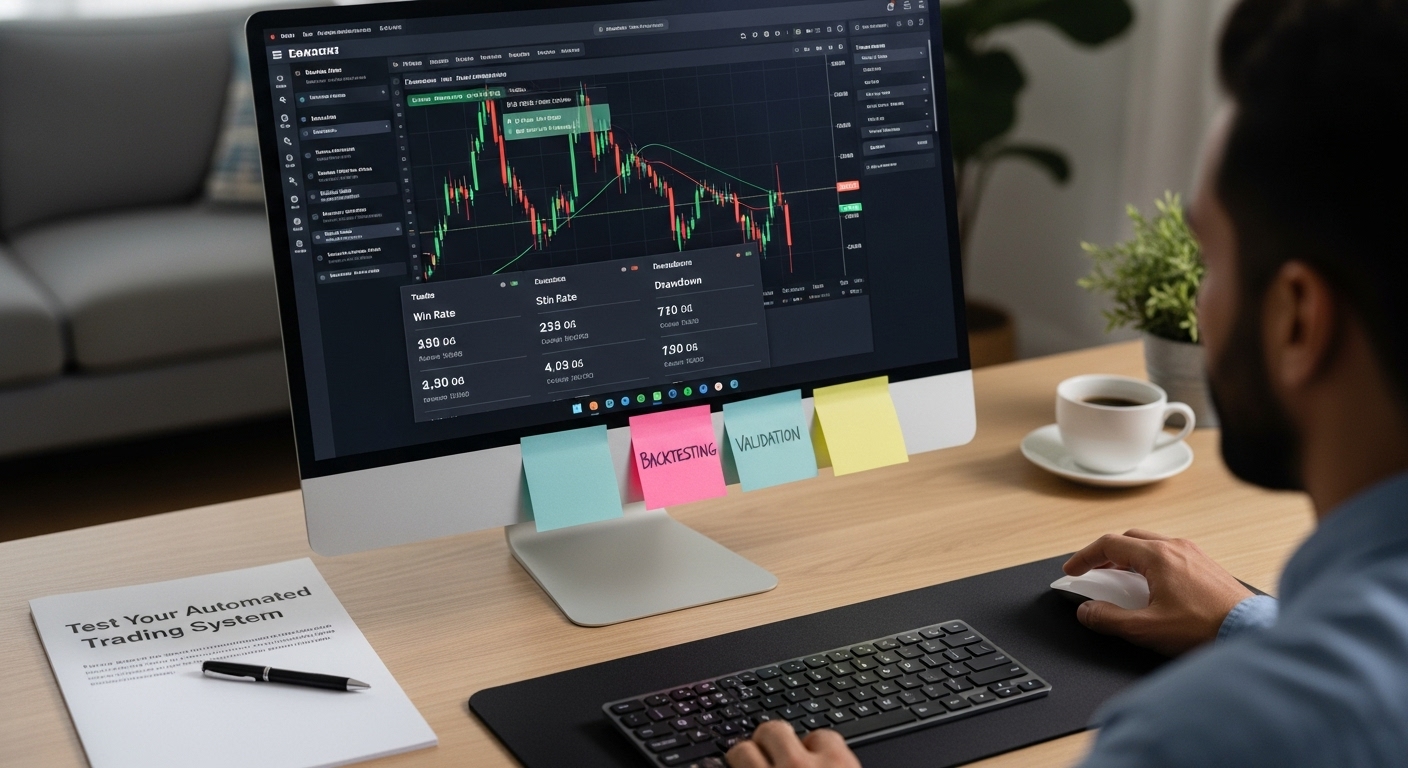
Testing your automated trading system represents a critical checkpoint between theoretical strategy and real-world performance. This phase is not just a recommendation – it’s an absolute necessity for protecting your investment capital. Comprehensive testing allows you to identify potential weaknesses, validate your algorithm’s robustness, and build confidence before committing actual funds.
Begin with historical backtesting using comprehensive market data spanning different market conditions. Your goal is to simulate how your trading algorithm would have performed across various market scenarios – including volatile periods, trending markets, and sideways movements. Most professional trading platforms offer built-in backtesting tools that enable traders to run strategies against historical price data, generating detailed performance reports that reveal critical insights about potential strategy effectiveness.
Systematic Validation and Risk Assessment
Progress from historical backtesting to forward testing, which involves running your algorithm in a simulated live trading environment with real-time market data but without risking actual capital. Professional traders recommend a minimum of 3-6 months of forward testing before considering live deployment. During this phase, carefully monitor key performance metrics such as win rate, average profit per trade, maximum drawdown, and risk-adjusted return calculations. Learn advanced testing techniques in our synthetic indices forum to refine your approach.
As you validate your system, implement strict risk management parameters. Configure maximum loss thresholds that automatically halt trading if predetermined risk levels are exceeded. This approach protects your capital from unexpected algorithmic behavior and ensures a disciplined approach to automated trading. Remember that no trading system is perfect – continuous monitoring, periodic revalidation, and willingness to adapt are essential for long-term success in the dynamic world of algorithmic trading.
Step 5: Monitor and Adjust Your Trading Automation
Successful automated trading is not a set-it-and-forget-it endeavor. Continuous monitoring and strategic adjustment are the lifeblood of a robust trading system. Your algorithm operates in dynamic markets that constantly shift, requiring vigilant oversight and proactive refinement to maintain performance and manage risk effectively.
Establish a comprehensive monitoring framework that tracks key performance indicators in real-time. This includes tracking metrics like win rate, average trade duration, maximum drawdown, and return on investment. Professional traders recommend creating daily and weekly performance dashboards that provide immediate visual insights into your trading system’s behavior. Pay special attention to sudden changes in trading patterns, unexpected losses, or significant deviations from historical performance benchmarks that might signal the need for immediate intervention.
Strategic Adaptation and Performance Optimization
Market conditions evolve rapidly, and your automated trading system must adapt accordingly. Implement a quarterly review process where you systematically analyze your algorithm’s performance across different market environments. This involves conducting deep-dive assessments of trade execution, identifying persistent weaknesses, and making incremental algorithm adjustments. Explore advanced trading techniques in our synthetic indices forum to gain deeper insights into market adaptation strategies.
Risk management remains paramount during this monitoring phase. Configure automated circuit breakers that can pause or halt trading if predefined risk thresholds are exceeded. These protective mechanisms prevent catastrophic losses during unexpected market turbulence. Remember that successful automated trading is not about achieving perfect performance, but about creating a resilient system that can consistently navigate market complexity while preserving capital. Embrace a mindset of continuous learning, where each trade and market cycle provides valuable data for refining your trading approach.
Ready to Transform Your Trading Results with Automation?
Are you struggling to turn your trading strategies into profitable automated systems, or feeling uncertain about backtesting and algorithm selection? Every trader faces the pressure of choosing the right platform, risk management methods, and reliable tools to navigate volatile forex and crypto markets. At FrankFX, we understand these challenges and are committed to guiding you every step of the way. From goal setting and strategy creation to real-world testing and performance monitoring, our resources align seamlessly with the essential topics you just learned in “How to Automate Trading: Boost Your Forex and Crypto Gains.”
Stop letting uncertainty keep you from maximizing your gains. With our comprehensive online trading education, real-time signals, and powerful automated trading robots, you can automate your trades confidently and with less stress. Our VIP memberships open doors to mentorship, daily live trading, and personalized support. Explore free tools, advanced strategies, and join a thriving trader community right now. The next step? Visit FrankFX and discover how you can start trading smarter, not harder, today.
Frequently Asked Questions
What are the first steps to automate trading in forex and crypto?
Successful automated trading begins with defining clear trading goals and strategies. Assess your financial landscape and determine your objectives, such as supplemental income or long-term wealth accumulation. Develop a comprehensive trading strategy with specific parameters like entry and exit points.
How can I select the right trading platform for automation?
Choose a trading platform that supports comprehensive automation features, robust API connectivity, and advanced charting tools. Popular options include MetaTrader 4 and 5, TradingView, and specialized crypto platforms. Ensure the platform aligns with your trading goals and offers backtesting capabilities.
What programming languages are best for developing trading algorithms?
Python and MQL4/5 are the most popular programming languages for developing trading algorithms. They provide robust libraries specifically designed for financial modeling, making it easier to create and customize your trading strategies.
How should I test my automated trading system before going live?
Start with historical backtesting to evaluate your algorithm’s performance across different market conditions. Progress to forward testing in a simulated live trading environment for at least 3-6 months. Monitor performance metrics closely and implement risk management parameters to protect your capital.
Recommended
- FRANKFX TRADING ACADEMY | TRADING
- FRANKFX TRADING ACADEMY | TRADING
- FRANKFX TRADING ACADEMY | TRADING
- FRANKFX TRADING ACADEMY | TRADING