Creating a trading system is often seen as something only seasoned professionals can pull off. But the truth might surprise you. Even beginner traders who use a systematic approach cut their risk of failure by over 50 percent compared to those trading on gut instinct. The real edge is not secret strategies or lightning-fast computers. It comes from building a flexible process and refining it with real data—something most traders never even attempt.
Table of Contents
- Step 1: Define Your Trading Goals And Strategy
- Step 2: Select Key Indicators And Tools For Analysis
- Step 3: Build And Code Your Trading System
- Step 4: Test Your Trading System With Historical Data
- Step 5: Optimize And Refine Your System For Performance
- Step 6: Implement Your Trading System With Real Capital
Quick Summary
| Key Point | Explanation |
|---|---|
| 1. Clearly Define Trading Goals | Assess your motivations for trading and establish specific financial objectives to guide your strategy development. |
| 2. Implement Risk Management Practices | Set risk parameters, such as a maximum 1-2% loss per trade, to protect your capital and enhance trading discipline. |
| 3. Continuously Optimize Trading Systems | Regularly review and refine your trading strategies based on performance metrics and evolving market conditions. |
| 4. Utilize Multiple Technical Indicators | Combine various indicators to validate signals, reducing false positives and increasing trading system accuracy. |
| 5. Approach Live Trading with Caution | Start with a conservative capital allocation and monitor live performance closely to adapt strategies as needed. |
Step 1: Define Your Trading Goals and Strategy
Developing trading systems requires a strategic foundation built on clear objectives and a comprehensive understanding of your financial aspirations. Your initial step involves crafting a precise roadmap that transforms abstract financial dreams into actionable trading strategies.
Begin by conducting an honest self-assessment of your trading motivations. Are you seeking supplemental income, long-term wealth accumulation, or professional trading as a primary career? Your specific goals will dramatically influence your system’s design. Trading is not a one-size-fits-all endeavor – it demands personalized strategies aligned with your risk tolerance, available time, and financial resources.
Define your risk parameters explicitly. Professional traders understand that risk management determines success more than individual trade outcomes. Calculate your maximum acceptable loss per trade – typically 1-2% of your total trading capital. This disciplined approach prevents catastrophic account depletion and provides psychological stability during market volatility.
Next, select trading instruments matching your goals. Forex, indices, cryptocurrencies, and synthetic markets each present unique characteristics. Learn more about trading instrument selection to understand which markets align best with your strategy. Research historical volatility, trading hours, transaction costs, and leverage options for your chosen instruments.
Document your strategy comprehensively. Create a detailed trading plan outlining entry and exit criteria, position sizing rules, technical indicators, and fundamental analysis approaches. Your written strategy serves as both a roadmap and accountability mechanism, helping you maintain discipline during emotionally charged market moments.
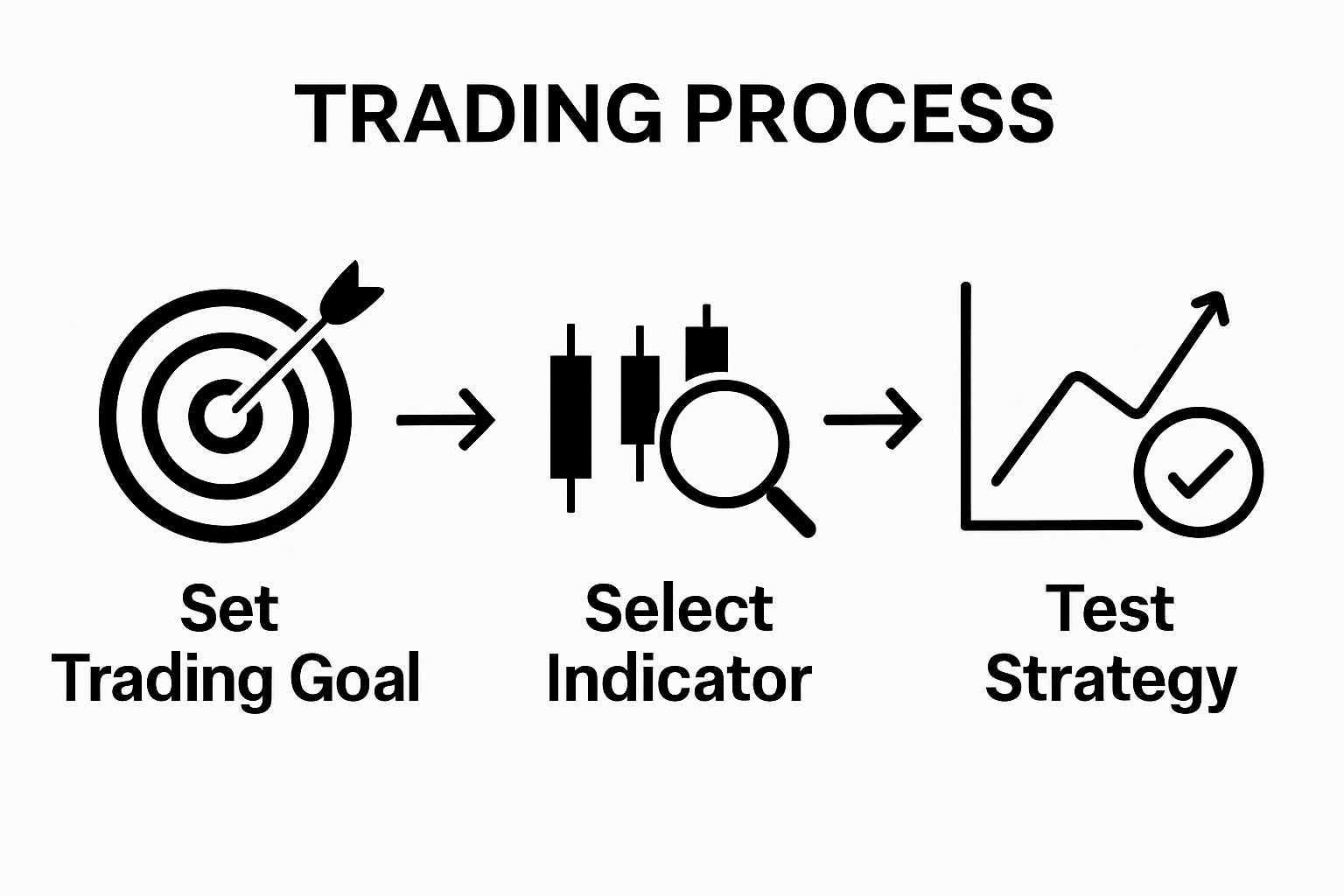
Successful strategy development requires continuous refinement. Plan periodic reviews of your trading system, tracking performance metrics like win rate, risk-reward ratio, and drawdown. Be prepared to adapt your approach based on empirical evidence rather than emotional attachment. Remember, developing trading systems is an iterative process of constant learning and improvement.
Step 2: Select Key Indicators and Tools for Analysis
Selecting the right technical indicators and analytical tools represents the critical engineering phase of developing a robust trading system. Your chosen indicators will serve as the sensory network that interprets market movements, translating complex price actions into actionable trading signals.
Moving averages emerge as fundamental tools in technical analysis, helping traders understand trend direction and potential momentum shifts. Simple and exponential moving averages reveal underlying price trends by smoothing price fluctuations over specific time periods. For instance, a 50-day moving average can help identify medium-term market trends, while a 200-day moving average provides insight into long-term market sentiment.
Momentum indicators like the Relative Strength Index (RSI) and Stochastic Oscillator become essential in assessing market conditions. These tools measure the speed and magnitude of price movements, helping traders identify potential overbought or oversold scenarios. The RSI, ranging from 0 to 100, offers critical signals when it crosses above 70 (potential overbought condition) or below 30 (potential oversold condition), providing traders with nuanced entry and exit points.
Explore advanced trading indicators in our synthetic indices forum to understand how different tools interact within complex trading environments. Volatility indicators like Bollinger Bands help traders understand market volatility by creating dynamic price channels that expand and contract based on market conditions. These bands help identify potential breakout opportunities and assess market uncertainty.
Developing a comprehensive trading system requires combining multiple indicators to create a holistic analytical approach. No single indicator provides a complete market picture. Successful traders develop a synergistic toolkit that cross-validates signals, reducing false positives and improving overall trading accuracy. Your selected indicators should complement each other, providing redundant confirmation of market trends and potential trading opportunities.
Below is a summary table of common technical indicators and tools mentioned, their core purposes, and benefits for building a trading system.
| Indicator/Tool | Core Purpose | Benefit to Trading System |
|---|---|---|
| Moving Averages | Identify trend direction and filter noise | Establishes entry/exit points, confirms trends |
| Relative Strength Index (RSI) | Detect overbought/oversold conditions | Improves entry/exit timing, reduces bad trades |
| Stochastic Oscillator | Measures momentum and market reversals | Highlights potential market turning points |
| Bollinger Bands | Assess market volatility | Identifies breakout potential, aids risk control |
| Backtesting Platforms | Simulate and assess strategy on past data | Validates strategy viability without risk |
| Python/MQL | Code and automate trading systems | Increases precision, enables algorithmic trades |
Remember that indicator selection is not a one-time event but an ongoing process of refinement. Continuously backtest and evaluate your chosen indicators against historical market data, adjusting your approach based on empirical performance metrics. The most effective trading systems evolve through consistent analysis, adaptation, and a commitment to understanding market dynamics.
Step 3: Build and Code Your Trading System
Building and coding your trading system transforms theoretical strategies into executable algorithms that can analyze markets and execute trades autonomously. This critical phase requires precision, technical expertise, and a methodical approach to translating your trading strategy into functional computer code.
Programming languages like Python and MetaTrader’s MQL emerge as preferred tools for developing trading systems due to their robust financial libraries and data manipulation capabilities. Python offers extensive scientific computing packages such as NumPy and Pandas, which facilitate complex mathematical calculations and time series analysis essential for trading logic implementation.
Start by creating modular code segments that correspond to specific trading strategy components. Develop distinct functions for entry signals, exit conditions, position sizing, and risk management rules. Each module should be independently testable and configurable, allowing flexibility in strategy refinement. Your code must include comprehensive error handling mechanisms to manage unexpected market conditions and prevent catastrophic trading errors.
Explore advanced cryptocurrency trading strategies to understand how different algorithmic approaches can be implemented. Implement robust backtesting frameworks that simulate your strategy against historical market data. This process helps validate your system’s performance, revealing potential weaknesses and optimization opportunities before deploying real capital.
Risk management becomes paramount during system development. Incorporate position sizing algorithms that dynamically adjust trade volumes based on account equity, volatility indicators, and predefined risk tolerance levels. Your code should automatically calculate maximum drawdown potential, implement stop-loss mechanisms, and prevent over-leveraging.
Critical verification steps include comprehensive debugging, performance metrics analysis, and stress testing under various market scenarios.
Professional traders often develop multiple variations of their trading system, comparing their performance across different market conditions. Remember that a trading system is a living entity requiring continuous monitoring, refinement, and adaptation to evolving market dynamics. Successful algorithmic trading demands patience, technical skill, and a commitment to ongoing system improvement.
Step 4: Test Your Trading System with Historical Data
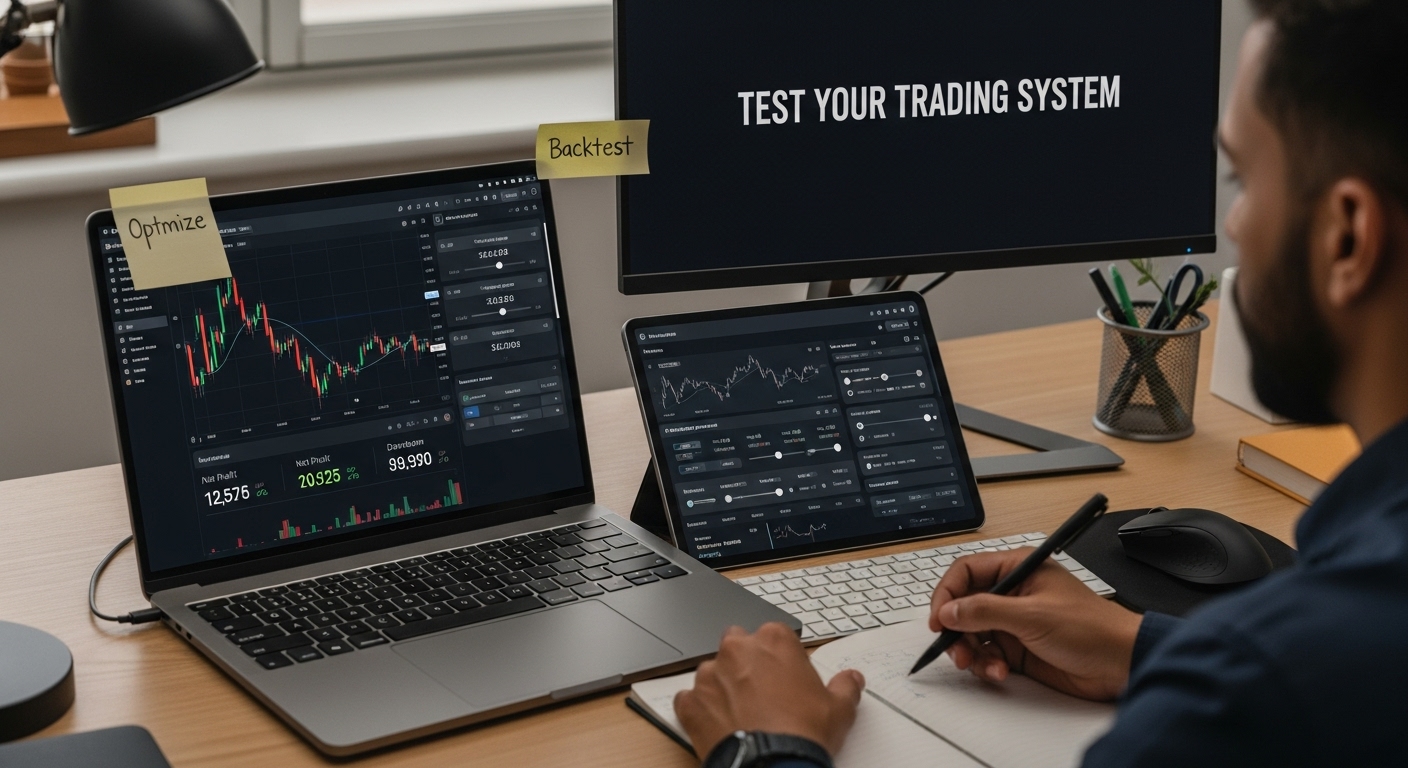
Testing your trading system against historical market data represents a crucial validation process that separates robust strategies from speculative guesswork. This step transforms your theoretical trading approach into a statistically measurable and potentially profitable methodology by rigorously examining its performance across different market conditions.
Backtesting provides the scientific foundation for evaluating trading systems, allowing traders to simulate strategy performance using past market data without risking actual capital. Select comprehensive historical datasets covering multiple market cycles – including bull markets, bear markets, and periods of high volatility. Your chosen timeframe should ideally span at least three to five years to ensure a representative sample of market behaviors.
Utilize professional backtesting platforms that offer granular performance metrics. Look for tools that can calculate critical indicators like net profit, maximum drawdown, Sharpe ratio, win rate, and risk-adjusted return. These metrics reveal the true potential and inherent risks of your trading strategy. Pay special attention to transaction costs and slippage, which can significantly impact real-world performance compared to theoretical backtesting results.
Explore advanced boom and crash trading strategies to understand complex market dynamics during backtesting. Implement walk-forward optimization techniques that divide your historical data into training and validation segments. This approach helps prevent overfitting – a common pitfall where strategies appear successful on historical data but fail in live trading conditions.
Critical verification involves comparing your system’s performance across different market instruments and timeframes. A truly robust trading system should demonstrate consistent performance and adaptability. Traders should look for strategies that maintain positive expectancy across various market conditions, with drawdown periods that remain within acceptable risk parameters.
Remember that backtesting is not a guarantee of future performance but a sophisticated risk management tool. Successful traders continuously refine their systems, understanding that market dynamics evolve. Approach backtesting with scientific skepticism, always preparing for the possibility that your initial strategy might require significant modifications or complete redesign based on empirical evidence.
Step 5: Optimize and Refine Your System for Performance
Optimization represents the critical refinement phase where trading systems transform from theoretical models into high-performance algorithmic strategies. This step demands a meticulous, data-driven approach that systematically enhances your system’s efficiency while maintaining its core strategic principles.
Parameter optimization becomes the cornerstone of system improvement, requiring traders to conduct sensitivity analysis on key variables like stop-loss thresholds, entry/exit conditions, and position sizing rules. Implement advanced optimization techniques such as genetic algorithms and machine learning approaches that can automatically test thousands of parameter combinations, identifying the most statistically robust configurations.
Utilize walk-forward optimization techniques that dynamically segment historical data into training and validation windows. This approach prevents overfitting by ensuring your trading system demonstrates consistent performance across different market periods. Traders should aim for stable performance metrics including consistent positive expectancy, manageable maximum drawdown, and reliable risk-adjusted returns.
Explore advanced volatility index trading strategies to understand complex optimization methodologies. Focus on refining your system’s core components incrementally, making small, measurable adjustments rather than dramatic wholesale changes. Track key performance indicators meticulously, including win rate, average trade profit, total net profit, and Sharpe ratio to quantify optimization impact.
Risk management remains paramount during optimization. Implement strict rules that limit parameter adjustments to prevent curve-fitting – a dangerous practice where strategies are excessively tailored to historical data. Professional traders recognize that over-optimization can create strategies that perform brilliantly in backtests but catastrophically in live markets.
Successful optimization requires emotional discipline and statistical rigor. Approach system refinement as an ongoing process of incremental improvement, maintaining a scientific mindset that values empirical evidence over emotional attachment. Remember that a truly robust trading system adapts continuously, reflecting the dynamic nature of financial markets.
Step 6: Implement Your Trading System with Real Capital
Implementing your trading system with real capital marks the ultimate test of your strategic development, transforming theoretical models into actual market performance. This critical transition demands a calculated, risk-managed approach that protects your investment while validating your system’s effectiveness.
Start with a conservative capital allocation strategy, dedicating only a small percentage of your total trading capital to the initial live implementation. Professional traders typically recommend risking no more than 1-2% of total account value per trade, ensuring that a series of unsuccessful trades will not decimate your investment. Begin with a simulated trading account or a micro-lot account that allows real market interaction with minimal financial exposure.
Carefully monitor your system’s live performance, comparing actual trade execution against your backtested results. Pay close attention to execution speed, slippage, and transaction costs, which can significantly differ from theoretical models. Real-world trading introduces variables like market liquidity, broker spreads, and instantaneous price movements that backtests cannot perfectly simulate.
Learn about advanced boom and crash trading strategies to understand nuanced market entry techniques. Implement rigorous trade journaling practices, documenting every trade’s entry conditions, exit rationale, emotional state, and performance metrics. This comprehensive record-keeping allows for continuous system refinement and helps traders understand the psychological aspects of their algorithmic approach.
Recognize that initial live trading serves as an extended validation phase. Expect and plan for performance variations between backtested and live results. Successful traders maintain emotional discipline, avoiding impulsive system modifications based on short-term performance fluctuations. Instead, collect statistically significant data over multiple market cycles before considering substantial strategy adjustments.
The transition to live trading represents more than a technical challenge – it is a psychological journey that tests a trader’s commitment to systematic methodology. Remain patient, maintain strict risk management protocols, and view each trade as a learning opportunity that contributes to your long-term trading expertise.
Turn Your Trading System into Real Profits with FrankFX
You have just learned that developing a successful trading system is an ongoing journey filled with challenges such as risk management, backtesting accuracy, and staying disciplined during live trading. If you are serious about achieving consistent results and mastering every stage from strategy design to live implementation, you do not have to do it alone.
The following table summarizes each major step in developing a trading system, outlining its objective and key activity for quick reference.
| Step | Objective | Key Activity |
|---|---|---|
| 1. Define Goals and Strategy | Establish direction and boundaries | Set financial goals, trading plan, instruments |
| 2. Select Indicators and Tools | Build analytical foundation | Choose technical indicators and backtesting tools |
| 3. Build and Code the System | Create executable trading algorithms | Program strategy logic and risk management |
| 4. Test with Historical Data | Validate system with real-world scenarios | Backtest against past data, analyze results |
| 5. Optimize and Refine | Enhance and adapt for maximum performance | Adjust parameters, prevent overfitting |
| 6. Implement with Real Capital | Execute in live market with real money | Start small, monitor, and make improvements |
| FrankFX is your partner in turning theory into practice. Our platform provides the resources and guidance to help you refine your system, manage risk, and gain confidence with expert support. |
Why wait when market opportunities are moving right now? Join the FrankFX community and get live trading sessions, daily signals, and direct mentorship. You can start exploring our advanced trading tools and calculators today or access exclusive mentorship and trading signals designed to elevate your performance. Take the next step toward trading success—visit FrankFX and see how your strategy can perform with real-time support and proven resources.
Frequently Asked Questions
What are the initial steps to develop a trading system?
Developing a trading system begins with defining your trading goals and strategy. Assess your motivations, risk tolerance, and available resources to create a personalized trading plan.
How can I select the right technical indicators for my trading system?
Selecting the right indicators involves understanding market movements. Core indicators like moving averages, RSI, and Stochastic Oscillator can help you identify trends and market conditions. Use multiple tools to create a robust analytical approach.
What is the significance of backtesting a trading system?
Backtesting is crucial as it evaluates your trading strategy against historical data, helping to identify its potential performance without risking real capital. Comprehensive datasets and performance metrics reveal the strengths and weaknesses of your system.
How can I optimize my trading system for better performance?
Optimizing your trading system involves parameter adjustments through techniques like sensitivity analysis and walk-forward optimization. Focus on stable performance metrics and avoid overfitting to ensure your strategy is adaptable to real market conditions.
Recommended
- FRANKFX TRADING ACADEMY | TRADING
- FRANKFX TRADING ACADEMY | TRADING
- FRANKFX TRADING ACADEMY | TRADING
- FRANKFX TRADING ACADEMY | TRADING