Moving averages are a staple in trading because they make trend spotting clearer and less stressful. Astonishingly, research shows that trading with 5 and 10-day moving averages can significantly outperform buy-and-hold strategies during certain market cycles. Most traders believe finding the perfect strategy is only about technical know-how, but the real secret is how you use them and manage emotions—sometimes, discipline matters more than any chart indicator.
Table of Contents
- How Moving Averages Help Identify Trends
- Popular Moving Average Strategies Explained
- Best Settings For Forex, Crypto, And Indices
- Tips To Reduce Common Trading Mistakes
Quick Summary
| Takeaway | Explanation |
|---|---|
| Moving averages smooth price data | They filter out daily fluctuations to reveal clear trends and market direction. |
| Use crossover strategies for signals | Monitor when short-term and long-term moving averages intersect for potential buy or sell signals. |
| Apply market-specific settings | Customize moving average periods based on the asset class to enhance trading effectiveness. |
| Incorporate emotional discipline | Avoid impulsive decisions driven by emotions to enhance overall trading success. |
| Practice robust risk management | Limit risk on trades and diversify investments to minimize potential losses. |
How Moving Averages Help Identify Trends
Trading with moving averages is a powerful technique that transforms raw price data into meaningful trend insights. By smoothing out short-term price fluctuations, moving averages provide traders with a clear visual representation of market direction and momentum.
Understanding Trend Identification Through Smoothing
Moving averages act like a financial lens that filters out market noise and reveals underlying price trends. According to the University of Nebraska-Lincoln Extension, this technique involves averaging near-term prices relative to long-term prices, which helps traders make more informed market timing decisions.
The core principle is simple yet profound. Instead of getting distracted by daily price spikes and dips, moving averages create a consistent line that represents the average price over a specific period. This smoothed line makes it easier to recognize whether an asset is moving upward, downward, or trading sideways.
Trend Detection Strategies
Traders use multiple moving average strategies to identify trends with greater precision. The Association of Chartered Certified Accountants (ACCA) highlights that time series analysis through moving averages helps reveal the underlying direction of market data.
Key trend identification methods include:
- Crossover Signals: When a shorter-term moving average crosses above or below a longer-term moving average, it can indicate a potential trend change.
- Slope Analysis: The angle of the moving average line reveals trend strength. A steeply rising or falling line suggests a strong trend.
- Support and Resistance: Moving averages often act as dynamic support and resistance levels, helping traders predict potential price reversals.
For instance, if a 50-day moving average is trending upward and consistently supports price action, it suggests a bullish market trend. Conversely, a downward-sloping moving average might indicate a bearish market sentiment.
Practical Application in Different Markets
Moving averages are versatile tools applicable across various financial markets. Similar to how PBS demonstrates using moving averages to analyze temperature data, traders use this technique to smooth out market volatility and identify trends in stocks, forex, cryptocurrencies, and indices.
By understanding how moving averages help identify trends, traders can develop more robust trading strategies. The key is to combine moving average analysis with other technical indicators and fundamental research to make well-informed trading decisions.
Popular Moving Average Strategies Explained
Moving average strategies are fundamental tools for traders seeking to capitalize on market trends and make informed trading decisions. These strategies transform complex price data into actionable insights, enabling traders to navigate market volatility with greater confidence.
Simple and Exponential Moving Average Crossover
One of the most widely used moving average strategies is the crossover method. According to research evaluating technical trading models, moving average crossovers provide significant potential for enhancing investment performance and reducing potential losses.
Two primary types of moving averages dominate this strategy:
- Simple Moving Average (SMA): Calculates the average price over a specific period, giving equal weight to all data points.
- Exponential Moving Average (EMA): Assigns more weight to recent price data, making it more responsive to recent market changes.
In a crossover strategy, traders watch for moments when shorter-term and longer-term moving averages intersect. A bullish signal occurs when a shorter-term moving average crosses above a longer-term moving average, suggesting potential upward momentum. Conversely, a bearish signal emerges when the shorter-term moving average crosses below the longer-term average, indicating potential downward price movement.
Here’s a table summarizing the key differences and uses of Simple Moving Average (SMA) and Exponential Moving Average (EMA) in crossover trading strategies for easy comparison:
| Moving Average Type | Calculation Method | Sensitivity to Price Changes | Typical Use Cases |
|---|---|---|---|
| SMA | Averages all prices in selected period equally | Less sensitive | Identifying broad market trends |
| EMA | Gives more weight to recent prices | More sensitive | Catching recent price movements |
MACD and Momentum Indicator Strategies
Research exploring MACD indicator performance reveals the complexity and potential of advanced moving average strategies. The Moving Average Convergence Divergence (MACD) indicator combines multiple moving averages to generate sophisticated trading signals.
The MACD strategy involves:
- Signal Line Crossovers: When the MACD line crosses above or below its signal line, it suggests potential trend changes.
- Histogram Analysis: The MACD histogram displays the difference between the MACD line and signal line, helping traders visualize momentum shifts.
- Divergence Detection: Identifying discrepancies between price movement and MACD can signal potential trend reversals.
Performance and Return Prediction
Academic research on moving average trading rules demonstrates the potential of these strategies in predicting stock index returns. By analyzing past returns and integrating moving averages, traders can develop more nuanced approaches to market analysis.
Key considerations for implementing moving average strategies include:
- Time Horizon Selection: Different moving average periods suit various trading styles, from short-term day trading to long-term investment.
- Market Context: Moving average effectiveness varies across different markets and asset classes.
- Complementary Indicators: Combining moving averages with other technical and fundamental analysis tools enhances strategy reliability.
Successful traders understand that no single strategy guarantees profits. Moving average strategies provide valuable insights, but they should be part of a comprehensive, well-researched trading approach that manages risk and adapts to changing market conditions.
Best Settings for Forex, Crypto, and Indices
Selecting the right moving average settings is crucial for effective trading across different markets. Each financial market presents unique characteristics that require tailored technical analysis approaches.
Forex Market Moving Average Strategies
Research examining ASEAN-5 currencies reveals the complexity of applying moving average strategies in foreign exchange markets. Forex traders typically find success with specific timeframes and moving average combinations.
For forex trading, recommended settings include:
- Short-Term Trading: 5-day and 20-day Simple Moving Averages (SMA) work effectively for capturing quick market movements.
- Medium-Term Analysis: 50-day and 100-day moving averages help identify broader currency trend directions.
- Long-Term Trend Confirmation: 200-day moving average provides comprehensive trend validation across major currency pairs.
Cryptocurrency and Index Trading Approaches
Comparative studies on U.S. stock market indices demonstrate that moving average strategies require nuanced implementation. Cryptocurrency markets, known for higher volatility, demand more adaptive settings.
Crypto and index traders can optimize their strategies by:
- Combining Indicators: Integrating moving averages with momentum indicators like Money Flow Index (MFI) and Relative Strength Index (RSI) improves performance.
- Volatility Consideration: Shorter moving average periods often yield better results in highly volatile markets.
- Volume-Based Adaptations: Incorporating trading volume can enhance moving average signal reliability.
Optimal Period Selection and Performance
Technical trading model research provides critical insights into moving average period selection. The study’s extensive backtesting revealed fascinating performance metrics across different markets.
Key findings include:
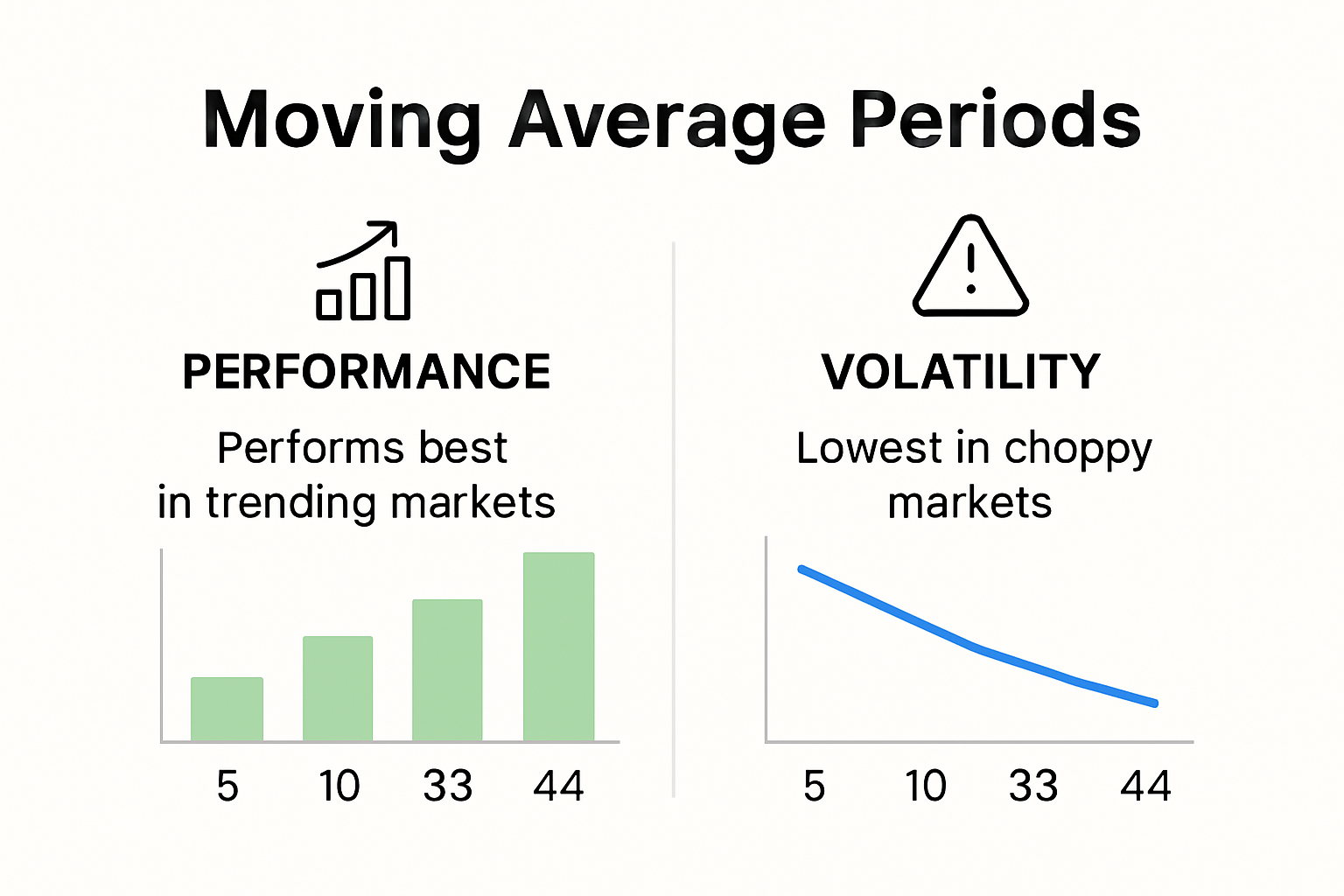
- Performance Periods: 5 and 10-day moving averages demonstrated higher investment performance potential.
- Volatility Reduction: 33 and 44-day periods showed effectiveness in minimizing market volatility.
- Market-Specific Adaptations: Traders must continuously test and adjust moving average settings based on specific market conditions.
Successful traders understand that no universal moving average setting exists. Continuous experimentation, backtesting, and adaptation are essential. While research provides valuable guidelines, individual market analysis and personal trading style remain paramount in developing effective moving average strategies.
Tips to Reduce Common Trading Mistakes
Trading with moving averages requires more than technical knowledge. Successful traders understand that avoiding common pitfalls is as crucial as understanding the technical strategies themselves.
Overcoming Emotional Trading Traps
Traders often fall victim to emotional decision-making, which can severely undermine their moving average strategies. Emotional trading typically manifests through impulsive actions driven by fear, greed, or panic.
The following table organizes common emotional trading mistakes and practical tips to avoid them, providing a quick-reference guide for traders:
| Emotional Trading Mistake | Description | Tip to Avoid |
|---|---|---|
| Revenge Trading | Aggressively trading to recover prior losses | Follow a predetermined plan |
| Confirmation Bias | Interpreting signals only to support own beliefs | Use objective analysis |
| Panic Selling | Quickly exiting positions on minor market movements | Set and stick to stop-losses |
Key emotional trading mistakes include:
- Revenge Trading: Attempting to immediately recover losses by making aggressive, unplanned trades.
- Confirmation Bias: Selectively interpreting moving average signals to confirm pre-existing beliefs.
- Panic Selling: Exiting positions prematurely during minor market fluctuations.
To combat emotional trading, implement strict discipline:
- Develop a predetermined trading plan before entering any position.
- Use stop-loss orders to manage potential losses.
- Practice mindfulness and emotional regulation techniques.
Risk Management Strategies
Effective risk management is the cornerstone of sustainable trading. Moving average strategies can be powerful, but they must be accompanied by robust risk control mechanisms.

Critical risk management principles include:
- Position Sizing: Never risk more than 1-2% of your total trading capital on a single trade.
- Diversification: Spread investments across multiple assets to minimize potential losses.
- Regular Portfolio Review: Continuously assess and adjust your trading strategy based on performance metrics.
Technical Analysis Discipline
Moving averages are powerful tools, but they are not infallible. Traders must avoid over-relying on a single indicator and maintain a holistic approach to market analysis.
Key technical discipline recommendations:
- Multiple Indicator Confirmation: Always cross-reference moving average signals with other technical indicators.
- Market Context Awareness: Understand broader market conditions and economic factors.
- Continuous Learning: Regularly update your knowledge and adapt to changing market dynamics.
Successful traders recognize that moving average strategies are tools, not guarantees. They approach trading as a skill to be continuously refined, understanding that consistent performance requires discipline, emotional control, and a commitment to ongoing education.
Remember, the most sophisticated moving average strategy can be rendered ineffective by poor risk management and emotional decision-making. Your ability to maintain composure, follow a structured plan, and learn from both successes and failures will ultimately determine your trading success.
Frequently Asked Questions
What are moving averages in trading?
Moving averages are statistical calculations that smooth out price data by creating a constantly updated average price. Traders use them to identify trends and potential reversal points in financial markets.
How do I use moving averages to identify trends?
You can use moving averages to identify trends by observing their direction (upward, downward, or sideways) and looking for crossover signals where short-term averages intersect with long-term averages, indicating potential changes in market momentum.
What are the best moving average periods for forex trading?
For forex trading, popular moving average settings include 5-day and 20-day Simple Moving Averages for short-term trends, and 50-day and 200-day moving averages for longer-term trend analysis.
How can I avoid emotional trading mistakes?
To avoid emotional trading mistakes, establish a predetermined trading plan, use stop-loss orders to manage risk, and practice mindfulness techniques to manage emotions during trading.
Trade Smarter With Moving Average Strategies and Real-Time Support
Struggling to turn moving average signals into reliable profits? The article highlights how emotional trading and poor risk management can undo even the best technical strategies. Maybe your biggest challenge is finding hands-on mentorship or timely trade ideas that align with the trend analysis covered above. You do not have to tackle these hurdles alone. At FrankFX, we give you direct access to everything you need to transform moving average concepts into real-world results.
Dive into live trading sessions, get proven daily signals, and benefit from expert mentorship tailored for forex and index traders. Want to enhance your technical skills and discipline? Explore our free tools and advanced analysis classes to see how other traders convert insights into action. Start improving your trading strategy today by joining our supportive community at FrankFX. Your edge in the market is waiting—take the next step now.
Recommended
- 5 Statistical Methods For Forecasting Quantitative Time Series | Bista INC
- How to Bet on MLB in 2025: Guide for Smart Bettors – Betco