Forex trading might sound like a secret code at first. It is the world’s most traded market, with over $6 trillion moving through it every single day. Most people think you need years of experience to understand it, but the truth is that just a few simple terms and concepts can give you a real head start.
Table of Contents
- Defining Basic Forex Trading Terms And Concepts
- Exploring Currency Pairs And Their Importance
- Understanding Market Orders, Limit Orders, And Stop Loss
- The Role Of Leverage, Margin, And Risk In Forex Trading
- Technical Analysis Terms: Indicators And Chart Patterns
Quick Summary
| Takeaway | Explanation |
|---|---|
| Understand Currency Pairs | Currency pairs represent the value relationship between two currencies; knowing their structure aids trading decisions. |
| Utilize Different Order Types | Different orders like market, limit, and stop-loss help manage trades and risks effectively. |
| Master Leverage and Margin | Understand how leverage amplifies both gains and risks to make informed trading decisions and manage exposure. |
| Utilize Technical Indicators | Use indicators like Moving Averages and RSI to analyze market trends and enhance trading strategies. |
| Recognize Chart Patterns | Analyze chart patterns such as Head and Shoulders to predict market behavior and make informed trades. |
Defining Basic Forex Trading Terms and Concepts
Forex trading terminology can seem like a complex language for newcomers, but understanding these fundamental terms is crucial for successful trading. The foreign exchange market operates globally, connecting traders across different time zones and economies.
Understanding Currency Pairs
In forex trading, currencies are always traded in pairs, representing the relative value between two national currencies. A currency pair shows how much of one currency you can exchange for another. For example, in the EUR/USD pair, the euro is the base currency, and the US dollar is the quote currency. If the current rate is 1.20, this means one euro can be exchanged for 1.20 US dollars.
Key characteristics of currency pairs include:
- Major Pairs: Involve the most traded currencies like USD, EUR, JPY, GBP
- Minor Pairs: Exclude the US dollar but include other major global currencies
- Exotic Pairs: Combine a major currency with a currency from an emerging economy
Basic Trading Terminology
Traders must understand several core terms to navigate the forex market effectively. Learn more about forex trading fundamentals with these essential definitions:
- Pip: The smallest price movement in a currency pair, typically representing 0.0001 of the quote currency
- Spread: The difference between the buy and sell price of a currency pair
- Leverage: A mechanism allowing traders to control larger positions with a smaller initial investment
Market Dynamics
Forex trading involves complex interactions between global economic factors. Traders analyze economic indicators, geopolitical events, and central bank policies to predict currency movements. Understanding these dynamics helps traders make informed decisions about potential profit opportunities and risk management.
By mastering these basic forex trading terms and concepts, you’ll build a strong foundation for more advanced trading strategies and analysis.
This table organizes and clearly defines essential forex trading terms introduced in the article for quick and easy reference.
| Term | Definition |
|---|---|
| Currency Pair | Represents the value relationship between two national currencies in a trade |
| Base Currency | The first currency in a currency pair (e.g., EUR in EUR/USD) |
| Quote Currency | The second currency in a currency pair (e.g., USD in EUR/USD) |
| Pip | The smallest price movement in a currency pair, usually 0.0001 of the quote currency |
| Spread | The difference between the buy and sell price of a currency pair |
| Leverage | Mechanism allowing traders to control larger positions with a smaller initial investment |
| Margin | The collateral required to open and maintain leveraged positions |
Exploring Currency Pairs and Their Importance
Currency pairs represent the fundamental building blocks of forex trading, allowing traders to understand and navigate the complex world of international financial markets. Unlike traditional stock trading, forex trading involves simultaneous buying and selling of currencies, creating a dynamic and interconnected global marketplace.
Structure and Mechanics of Currency Pairs
In forex trading, currencies are quoted in pairs, with each pair representing the relative value between two national currencies. The first currency is called the base currency, and the second is the quote currency. When you see EUR/USD at 1.20, this means one euro can be exchanged for 1.20 US dollars.
Currency pairs are categorized into distinct groups
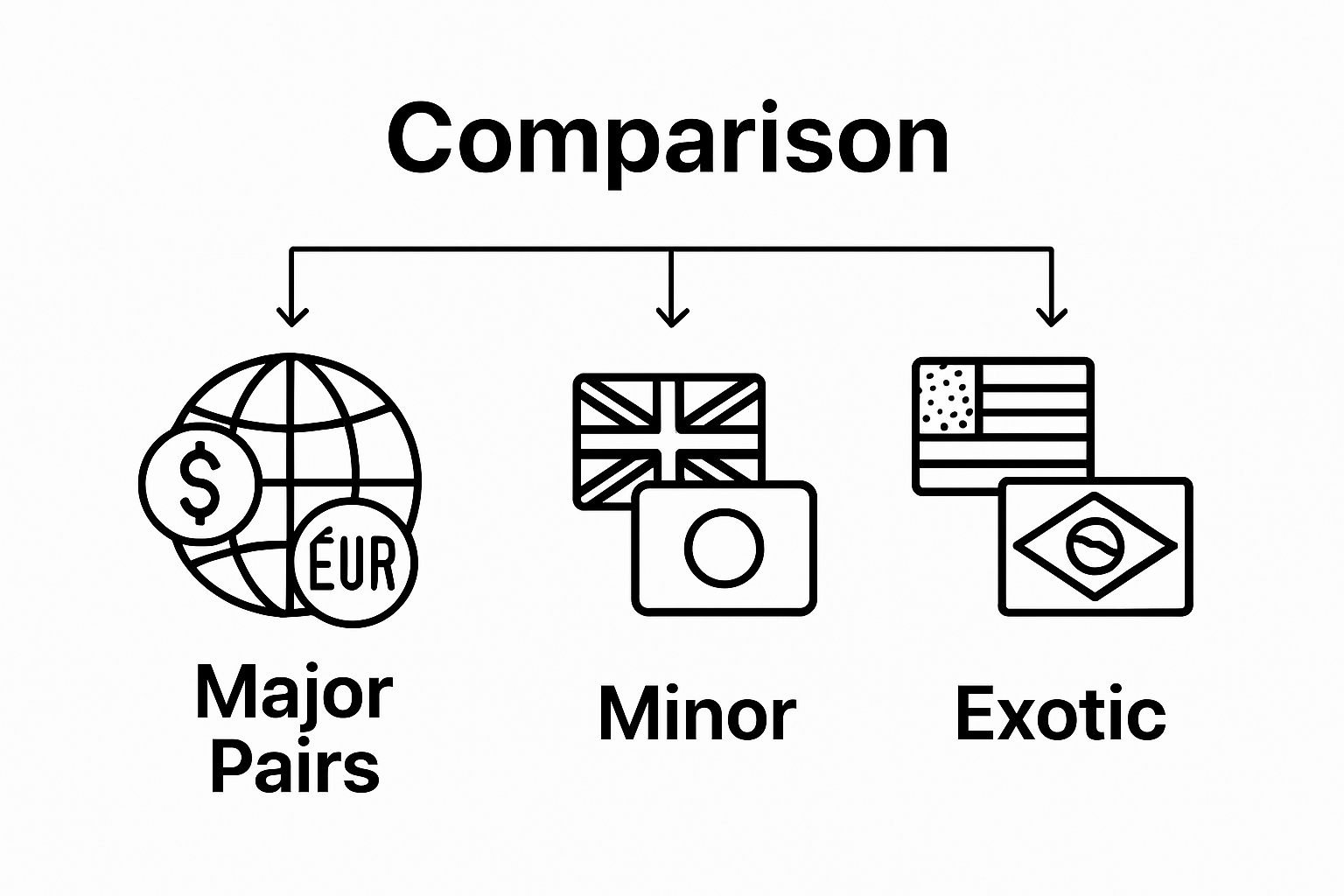 :
:
- Major Pairs: Include most traded global currencies like USD, EUR, JPY, GBP
- Minor Pairs: Exclude US dollar but involve other major currencies
- Exotic Pairs: Combine a major currency with an emerging market currency
Economic Significance of Currency Pairs
Currency pairs reflect complex economic interactions and serve as critical indicators of global economic health. According to research on international financial markets, these pairs provide insights into economic performance, monetary policies, and geopolitical dynamics.
Traders analyze currency pairs to understand:
- Economic Strength: Relative performance of national economies
- Monetary Policy: Central bank decisions and interest rate changes
- Trade Relationships: International economic interactions
Strategic Trading Considerations
Successful forex trading requires deep understanding of how currency pairs interact. Factors like interest rates, inflation, political stability, and global economic trends significantly impact currency valuations. Explore advanced trading strategies to develop a nuanced approach to currency pair analysis.
By comprehending the intricate dynamics of currency pairs, traders can make more informed decisions, manage risks effectively, and potentially capitalize on global economic movements.
The following table compares the key characteristics of major, minor, and exotic currency pairs discussed in the article.
| Currency Pair Type | Involves USD | Examples | Typical Liquidity | Economic Significance |
|---|---|---|---|---|
| Major Pairs | Yes | EUR/USD, GBP/USD | High | Most traded, global economic impact |
| Minor Pairs | No | EUR/GBP, GBP/JPY | Moderate | Regional economic relevance |
| Exotic Pairs | Sometimes | USD/TRY, EUR/SEK | Low | Emerging market significance |
Understanding Market Orders, Limit Orders, and Stop Loss
Forex trading involves sophisticated order types that help traders manage risk, execute trades efficiently, and protect their investment strategies. Understanding these different order types is crucial for navigating the complex forex market with confidence and precision.
Types of Market Orders
Market orders are the most straightforward type of trade execution in forex trading. A market order instructs a broker to buy or sell a currency pair immediately at the current market price. According to the SEC’s investor guidance, these orders guarantee execution but do not guarantee a specific price.
Key characteristics of market orders include:
- Immediate Execution: Trades are completed at the current market rate
- Guaranteed Fill: The order will be executed quickly
- Price Variability: Final price may differ slightly from the displayed rate
Advanced Order Types
Limit orders and stop-loss orders provide traders with more sophisticated risk management tools. A limit order allows traders to specify the exact price at which they want to buy or sell a currency pair. This helps control potential entry and exit points more precisely.
Stop-loss orders serve as a critical risk management strategy:
- Automatic Protection: Triggers a sale when the market moves against your position
- Predetermined Exit: Sets a maximum loss threshold
- Emotional Discipline: Removes human emotional decision making from trading
Strategic Order Management
Successful forex traders combine different order types to create comprehensive trading strategies. Explore advanced trading techniques to understand how these order types can be strategically implemented.
By mastering market orders, limit orders, and stop-loss mechanisms, traders can develop more disciplined approaches to managing risk and potentially improving overall trading performance. The ability to choose the right order type at the right moment can significantly impact trading outcomes.
The Role of Leverage, Margin, and Risk in Forex Trading
Forex trading introduces complex financial mechanisms that can amplify potential gains and losses. Leverage, margin, and risk management are interconnected concepts that define a trader’s potential success and financial exposure in the global currency markets.
Understanding Leverage
Leverage allows traders to control larger trading positions with a relatively small amount of capital. When a broker offers 100:1 leverage, it means traders can control $100,000 in currency with just $1,000 of their own money. According to SEC investor guidance, this strategy comes with significant risks.
Key leverage characteristics include:
- Amplified Potential Returns: Enables trading larger positions
- Increased Risk Exposure: Potential for substantial losses
- Capital Efficiency: Allows traders to maximize trading potential
Margin and Risk Management
Margin represents the collateral a trader must provide to open and maintain leveraged positions. It acts as a security deposit that protects brokers against potential trading losses. Effective risk management involves understanding margin requirements and maintaining appropriate account balances.
Critical risk management strategies involve:
- Position Sizing: Limiting individual trade exposure
- Stop Loss Orders: Preventing catastrophic losses
- Diversification: Spreading risk across multiple currency pairs
Strategic Risk Mitigation
Successful forex traders develop comprehensive risk management strategies that balance potential gains with potential losses. Explore advanced volatility trading techniques to understand how professional traders manage complex market risks.
By comprehending the intricate relationship between leverage, margin, and risk, traders can make more informed decisions. The key is not to eliminate risk entirely but to understand, measure, and manage it effectively.
Technical Analysis Terms: Indicators and Chart Patterns
Technical analysis provides forex traders with powerful tools for interpreting market movements and predicting potential price trends. By understanding indicators and chart patterns, traders can make more informed decisions based on historical price data and statistical probabilities.
Essential Technical Indicators
Technical indicators are mathematical calculations based on price, volume, or open interest that help traders assess market conditions. According to research from New York University, these tools help traders identify potential trend directions and market momentum.
Key technical indicators include:
- Moving Averages: Track average price over specific time periods
- Relative Strength Index (RSI): Measures momentum and potential trend reversals
- Bollinger Bands: Indicate market volatility and potential price breakouts
Chart Pattern Recognition
Chart patterns represent visual representations of price movements that suggest potential future market behavior. These graphical representations help traders identify potential trend continuations or reversals by recognizing specific geometric shapes and price formations.
Significant chart patterns traders analyze:
- Head and Shoulders: Indicates potential trend reversal
- Cup and Handle: Suggests potential bullish continuation
- Double Top/Bottom: Signals potential trend change
Strategic Pattern Analysis
Successful technical analysis requires more than pattern recognition. Traders must combine multiple indicators and patterns to develop comprehensive trading strategies. Explore advanced trading techniques to understand how professional traders integrate these analytical tools.
By mastering technical analysis terms, indicators, and chart patterns, traders can develop a more nuanced understanding of market dynamics. The key is to view these tools as probabilistic guides rather than guaranteed predictions.

Ready to Make Forex Trading Terminology Work for You?
You’ve just taken the first step to demystify forex trading by understanding basic terms like currency pairs, leverage, and stop loss. But learning terminology is only part of your journey. Many traders struggle to apply these concepts or feel overwhelmed when shifting from theory to live markets. If you recognize phrases like ‘pip’, ‘spread’, or ‘market order’ but still doubt your confidence in real trades or risk management, you’re not alone. FrankFX is here to bridge that gap and turn knowledge into action.
Transform your understanding into real trading results with support designed for you. Join FrankFX to access hands-on mentorship, daily trading signals, and powerful automated tools. Dive deeper with forum discussions packed with practical strategies or boost your analysis skills in our specialized trading technique section. Don’t let confusion about forex terms hold you back. Sign up now so you can trade smarter and reach your financial goals faster.
Frequently Asked Questions
What is a currency pair in forex trading?
A currency pair represents the value of one currency relative to another, indicating how much of the quote currency is needed to purchase one unit of the base currency.
What does the term ‘pip’ mean in forex trading?
A pip, or ‘percentage in point,’ is the smallest price movement in a currency pair, usually representing 0.0001 of the quote currency.
How does leverage work in forex trading?
Leverage allows traders to control larger positions than their actual capital by borrowing funds from their broker, enabling potential higher returns, but it also increases the risk of significant losses.
What are the different types of orders used in forex trading?
In forex trading, key order types include market orders, which execute immediately at the current price; limit orders, which execute at a specific price; and stop-loss orders, which help to automatically close a trade to prevent large losses.
Recommended
- FRANKFX TRADING ACADEMY | TRADING
- FRANKFX TRADING ACADEMY | TRADING
- FRANKFX TRADING ACADEMY | TRADING
- FRANKFX TRADING ACADEMY | TRADING