Trading signals sound like secret codes for investors, sending out exact moments to buy or sell in fast moving markets. Most people assume these alerts are just guesses or gimmicks. The reality is very different and actually pretty high tech. Around 70 percent of professional traders now use AI powered algorithms to generate these signals, which means there is some serious science behind each tip.
Table of Contents
- Defining Trading Signals: Key Concepts And Types
- The Importance Of Trading Signals In Market Strategy
- How Trading Signals Are Generated And Analyzed
- Integrating Trading Signals Into Your Trading Plan
- Evaluating The Effectiveness Of Trading Signals
Quick Summary
| Takeaway | Explanation |
|---|---|
| Trading signals guide buying and selling decisions. | They provide actionable recommendations based on market analysis to help traders make informed choices. |
| Combine technical and fundamental analysis for signals. | Each analytical approach provides unique insights, enhancing signal quality for better trading strategies. |
| Incorporate clear risk management with signals. | Using established entry and exit points helps traders define potential losses and gains effectively. |
| Use backtesting to evaluate signal performance. | This helps determine reliability by assessing how signals have performed in various market conditions over time. |
| Continuously learn to refine signal integration. | Adapting strategies based on market developments and past performance leads to more effective trading outcomes. |
Defining Trading Signals: Key Concepts and Types
Trading signals represent strategic communication tools that guide traders in making informed investment decisions across various financial markets. These signals are essentially actionable recommendations indicating precise moments to buy or sell specific financial instruments like stocks, forex, cryptocurrencies, or indices.
What Exactly Are Trading Signals?
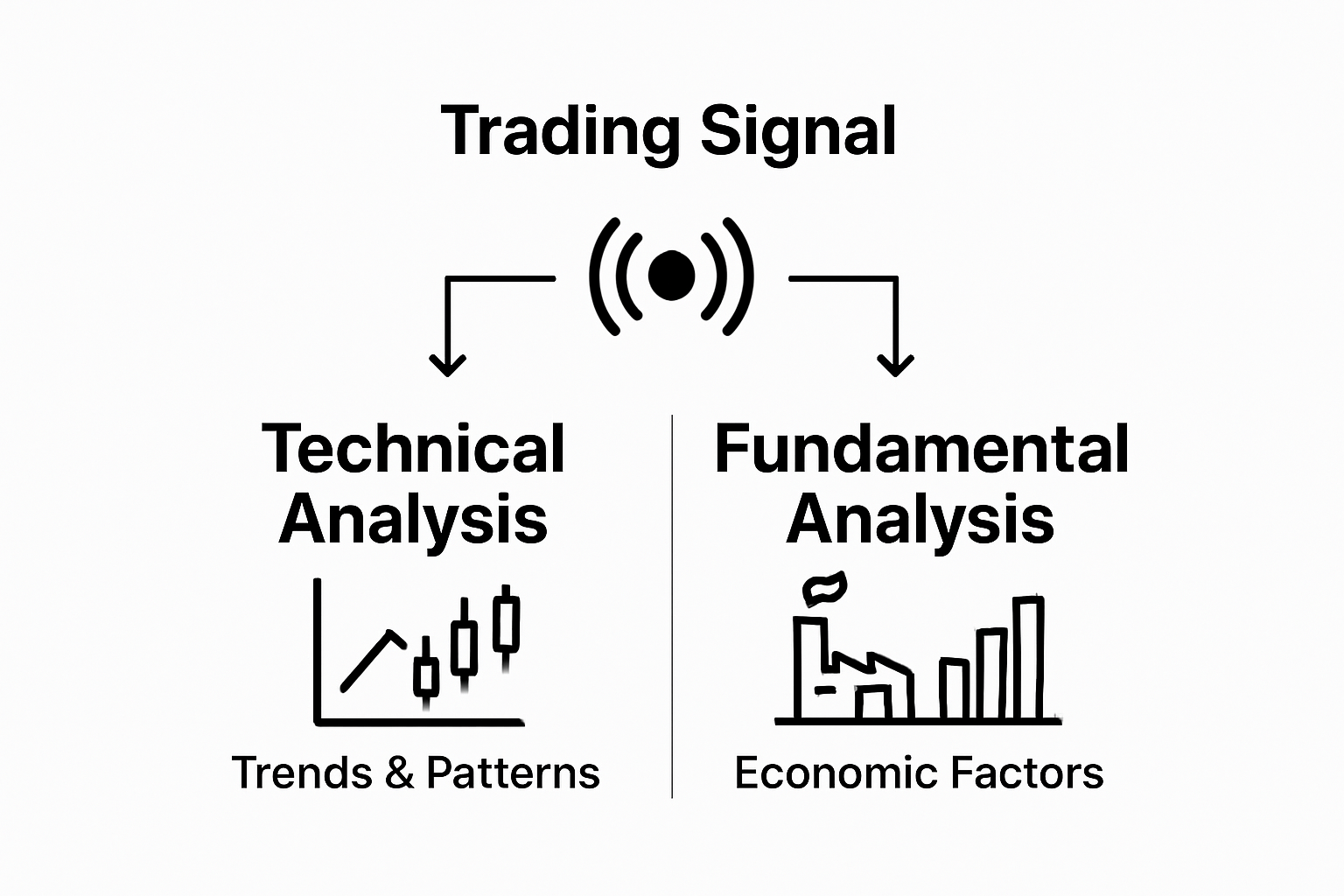
At their core, trading signals are professional recommendations generated through comprehensive market analysis. They emerge from two primary methodological approaches: technical analysis and fundamental analysis. Technical analysis relies on statistical trends, price movements, and chart patterns, while fundamental analysis examines economic indicators, company performance, and broader market conditions.
Signal Generation Mechanisms
Trading signals can be generated through multiple sophisticated mechanisms:
- Algorithmic Signals: Computer programs using complex mathematical models to predict market movements
- Expert Trader Signals: Recommendations crafted by experienced professional traders based on their market insights
- Automated Trading Systems: Software that generates signals using predefined rules and advanced computational techniques
Understanding Signal Components
A comprehensive trading signal typically includes several critical elements:
- Entry point (precise price level for executing the trade)
- Stop loss (maximum acceptable risk threshold)
- Take profit target (predetermined price level for closing the trade)
- Potential risk reward ratio
By understanding these nuanced components, traders can transform raw signals into strategic trading decisions.
To help clarify the differences between key methods for generating trading signals, here is a comparison of the main signal generation mechanisms discussed in the article.
| Signal Generation Mechanism | Description | Key Features |
|---|---|---|
| Algorithmic Signals | Computer programs using mathematical models to predict market movements | Automation, complex modeling, data-driven |
| Expert Trader Signals | Recommendations from experienced professional traders based on their market insights | Human expertise, discretionary analysis |
| Automated Trading Systems | Software that generates signals using predefined rules and computational techniques | Rules-based, systematic, fast execution |
This table outlines the typical components included in a comprehensive trading signal and their respective purposes, making it easier to understand what information each element conveys to traders.
| Signal Component | Purpose |
|---|---|
| Entry Point | Indicates the precise price level for executing the trade |
| Stop Loss | Sets the maximum acceptable risk threshold to limit losses |
| Take Profit Target | Predetermined price level for closing the trade with a gain |
| Risk-Reward Ratio | Shows the balance between potential risk and expected return for each trade |
When exploring trading signals, discover advanced technical analysis strategies that can enhance your understanding of signal interpretation and implementation.
The Importance of Trading Signals in Market Strategy
Trading signals have transformed how modern traders approach financial markets, offering strategic insights that can significantly enhance investment decision making. These powerful tools provide traders with a systematic method to navigate complex market environments, reduce emotional trading, and optimize potential returns.
Strategic Risk Management
One of the most critical advantages of trading signals is their ability to implement disciplined risk management strategies. By providing predefined entry and exit points, signals help traders establish clear parameters for potential losses and gains. Learn how to minimize trading risks through professional signal interpretation techniques. This approach allows traders to:
- Maintain consistent trading discipline
- Minimize emotional decision making
- Establish predetermined risk thresholds
- Create systematic investment approaches

Performance Optimization Techniques
Trading signals serve as sophisticated analytical tools that transform raw market data into actionable recommendations. According to research from the Public Library of Science, technical trading rules can be optimized to enhance market performance when parameters are carefully calibrated. Professional traders leverage these signals to:
- Identify potential market trends
- Validate investment opportunities
- Reduce time spent on manual market analysis
- Make data driven trading decisions
Advanced Trading Intelligence
Modern trading signals represent a convergence of technological innovation and financial expertise. They integrate complex algorithms, machine learning, and expert trader insights to generate precise market recommendations. These intelligent systems analyze multiple market variables simultaneously, providing traders with comprehensive strategic perspectives that would be challenging to obtain through manual research.
By understanding and effectively utilizing trading signals, investors can develop more robust, systematic approaches to financial markets. The key is not just receiving signals but interpreting them with a nuanced understanding of market dynamics and personal investment goals.
How Trading Signals Are Generated and Analyzed
Trading signal generation represents a complex intersection of mathematical algorithms, technological innovation, and financial market expertise. These sophisticated systems transform raw market data into actionable trading recommendations through multiple advanced analytical techniques.
Mathematical Modeling and Signal Extraction
The core of trading signal generation lies in advanced mathematical modeling. According to research from ACM Digital Library, the trading process involves intricate stages including data cleaning, pre-trade analysis, signal generation, and execution. Sophisticated algorithms analyze multiple variables simultaneously
:
- Historical price movements
- Market volatility indicators
- Volume trading patterns
- Economic indicator correlations
- Comparative asset performance metrics
Machine Learning and Pattern Recognition
Modern trading signals leverage machine learning techniques to identify complex market patterns that human traders might overlook. Explore advanced technical analysis strategies that demonstrate how computational models can predict market behaviors. These intelligent systems continuously learn and adapt by:
- Analyzing historical trading data
- Identifying statistically significant market trends
- Developing predictive models based on complex pattern recognition
- Adjusting algorithmic parameters in real time
Signal Validation and Risk Assessment
Before a trading signal becomes actionable, it undergoes rigorous validation processes. Advanced computational models assess potential signals across multiple dimensions, evaluating not just potential profitability but also associated risk levels. Professional signal generation systems incorporate:
- Multiple cross referencing techniques
- Statistical significance testing
- Risk reward ratio calculations
- Contextual market condition analysis
By integrating cutting edge technologies like artificial intelligence and advanced statistical modeling, trading signal generation has evolved from simple trend following to a sophisticated, data driven approach that provides traders with nuanced market insights.
Integrating Trading Signals into Your Trading Plan
Successful trading requires more than just receiving signals. It demands strategic integration, disciplined execution, and continuous refinement of your trading approach. Trading signals serve as sophisticated navigation tools that can significantly enhance investment decision making when incorporated thoughtfully into a comprehensive trading strategy.
Developing a Signal Compatible Trading Framework
Creating a robust trading plan that effectively incorporates signals involves establishing clear parameters and systematic processes. According to research from the National Bureau of Economic Research, systematic signal integration helps mitigate cognitive biases and supports more rational trading decisions. Traders should focus on:
- Defining clear entry and exit criteria
- Establishing precise risk management protocols
- Creating consistent signal evaluation metrics
- Developing predetermined response strategies
Risk Management and Signal Filtering
Not all trading signals are created equal. Intelligent signal filtering becomes crucial in maintaining a disciplined trading approach. Explore professional signal verification techniques to enhance your trading strategy. Effective signal integration requires:
- Cross referencing multiple signal sources
- Implementing probability based validation
- Assessing signal reliability through historical performance
- Considering broader market context
Continuous Learning and Signal Optimization
Trading signal integration is an evolving process that demands ongoing education and strategy refinement. Successful traders treat signals as dynamic tools requiring constant assessment and adjustment. Key optimization strategies include:
- Maintaining detailed trading journals
- Regularly backtesting signal performance
- Adapting strategies based on empirical evidence
- Staying informed about market developments
By approaching trading signals as sophisticated analytical tools rather than absolute instructions, traders can develop more nuanced, adaptive investment strategies that balance technological insights with personal market understanding.
Evaluating the Effectiveness of Trading Signals
Evaluating trading signals requires a systematic approach that goes beyond surface level performance metrics. Traders must develop comprehensive assessment frameworks that analyze multiple dimensions of signal reliability, consistency, and potential profitability.
Performance Measurement Techniques
Measuring trading signal effectiveness involves sophisticated statistical analysis and empirical verification. According to research from PubMed, technical indicators like the Relative Strength Index (RSI) demonstrate varying performance across different market conditions. Critical performance evaluation metrics include:
- Win rate percentage
- Average profit per trade
- Maximum drawdown levels
- Risk adjusted return calculations
- Consistency of signal generation
Statistical Validation Strategies
Rigorous statistical validation becomes crucial in determining signal reliability. Explore advanced signal verification resources to enhance your analytical capabilities. Professional traders employ multiple validation techniques:
- Backtesting across different market periods
- Monte Carlo simulation analysis
- Cross validation with alternative indicators
- Comparative performance benchmarking
- Assessing statistical significance of results
Long Term Signal Reliability Assessment
Effective signal evaluation transcends short term performance, focusing on sustained reliability and adaptability. Comprehensive assessment involves:
- Analyzing signal performance across multiple market cycles
- Examining adaptation capabilities during market volatility
- Monitoring signal generation consistency
- Identifying potential systematic biases
- Understanding underlying algorithmic logic
By approaching signal evaluation as a continuous, data driven process, traders can develop more nuanced strategies that balance technological insights with critical analytical thinking.
Transform Signals Into Real Trading Success With FrankFX
Struggling to turn confusing trading signals into clear, confident trades? Many traders get lost trying to interpret technical and fundamental recommendations, missing vital entry points or failing to manage risk. If you want to move beyond theory and apply proven strategies, FrankFX bridges the gap with hands-on education, professional signals, and automated tools.
Unlock premium trading resources designed to handle the pain points outlined in “Understanding What Are Trading Signals and Their Importance.” With FrankFX, you can access:
- Real-time signals for forex, crypto, and indices
- Daily analysis and live trading sessions for practical learning
- Professional mentorship and a thriving trader community
Don’t let confusing signals slow your progress. Start now with FrankFX to empower your decisions, improve your strategy, and experience greater trading confidence today.
Frequently Asked Questions
What are trading signals?
Trading signals are professional recommendations generated by analyzing market data that indicate opportune moments to buy or sell financial instruments like stocks, forex, or cryptocurrencies.
How are trading signals generated?
Trading signals can be generated through various methods, including algorithmic trading, expert trader recommendations, and automated trading systems that use predefined rules and complex mathematical models.
What components are included in a trading signal?
A comprehensive trading signal typically includes an entry point, stop loss level, take profit target, and a risk-to-reward ratio, all of which help traders make informed decisions.
Why are trading signals important for traders?
Trading signals help implement disciplined risk management, optimize trading performance, and reduce emotional decision-making, allowing traders to navigate complex markets more effectively.
Recommended
- Technical Analysis for Beginners
- Free Forex Signal
- FREE BOOM AND CRASH SIGNAL
- How to Read Forex Charts