Day trading grabs headlines with stories of lightning-fast trades and big wins but the real action happens beneath the surface. Day trading volumes have surged by 55 percent in recent years and the stakes keep climbing. Most people think it’s all about picking the right stock for an instant payoff but the truth is the real challenge is mastering your emotions and risk in a world where every second counts.
Table of Contents
- What Is Day Trading And Why Is It Important?
- Key Concepts In Day Trading: Tools And Techniques Explained
- Understanding Market Dynamics: How Price Movements Occur
- Risk Management In Day Trading: Why It Matters
- Psychology Of Day Trading: The Impact On Decisions
Quick Summary
| Takeaway | Explanation |
|---|---|
| Day trading demands rapid decision-making skills | Traders must make fast choices based on real-time market analysis and price movements to succeed. |
| Implement strict risk management techniques | Setting stop-loss limits and position sizing helps mitigate potential losses and protect capital. |
| Emotional control is crucial for success | Traders must manage emotions like fear and greed to make objective decisions under market pressure. |
| Master technical analysis methods | Utilizing indicators like moving averages and RSI enables traders to interpret price trends effectively. |
| Stay informed about market dynamics | Understanding factors like supply and demand shifts helps traders predict price movements accurately. |
What is Day Trading and Why is it Important?
Day trading represents a high-intensity financial strategy where traders buy and sell financial instruments within the same trading day, aiming to capitalize on short-term price movements. Unlike traditional investment approaches that hold assets for weeks or months, day traders complete all their transactions before the market closes, minimizing overnight risk exposure.
Understanding the Core Mechanics
At its fundamental level, day trading involves making rapid trading decisions based on technical analysis, market sentiment, and real-time price fluctuations. Traders utilize sophisticated tools and platforms to execute multiple trades within hours, often leveraging small price changes to generate profits. Read more about advanced trading strategies that can complement day trading techniques.
Successful day traders typically focus on markets with high liquidity and volatility, such as:
- Foreign exchange (forex) markets
- Stock indices
- Cryptocurrency markets
- Futures contracts
Strategic Importance in Modern Trading
Day trading has gained significant popularity due to its potential for generating quick returns and providing traders with an active, engaging approach to financial markets. According to Bloomberg Market Analysis, day trading volumes have increased by 55% in recent years, demonstrating growing interest in this dynamic trading method.
The importance of day trading extends beyond immediate profit potential. It requires traders to develop critical financial skills such as:
- Rapid decision-making under pressure
- Advanced risk management techniques
- Deep understanding of market psychology
- Technical analysis proficiency
While day trading offers exciting opportunities, it also demands substantial knowledge, discipline, and emotional control. Traders must be prepared to manage potential losses and understand that consistent success requires continuous learning and strategic adaptation.
The following table summarizes some of the most important technical and psychological challenges faced by day traders and the strategies used to address them.
| Challenge | Description | Common Strategies Used |
|---|---|---|
| Rapid Decision-Making | Need to act on market data within seconds | Real-time data analysis, automation |
| Emotional Control | Managing fear, greed, and stress | Mindfulness, trading journals, discipline |
| Managing Risk | Protecting against large losses | Stop-loss orders, position sizing |
| Interpreting Market Signals | Identifying trends and reversals from noisy data | Technical analysis, indicators |
| Overcoming Cognitive Biases | Avoiding mental errors like confirmation or recency bias | Predefined rules, regular review |
| Handling Volatility | Navigating unpredictable price swings | Risk limits, volatility filters |
| Maintaining Consistent Profits | Achieving steady results in fast-changing markets | Strategic adaptation, ongoing learning |
Key Concepts in Day Trading: Tools and Techniques Explained
Day trading requires a sophisticated arsenal of tools, techniques, and strategic approaches that transform raw market data into actionable trading opportunities. Successful traders understand that mastering these fundamental concepts separates professional traders from casual investors.
Technical Analysis and Market Indicators
Technical analysis forms the backbone of day trading strategies, enabling traders to interpret price movements and predict potential market trends. Traders utilize various sophisticated indicators to make informed decisions, such as moving averages, relative strength index (RSI), and Bollinger Bands.
Learn more about technical analysis strategies that can enhance your trading precision.
Key market indicators that day traders frequently monitor include:
- Volume-based indicators
- Price momentum signals
- Trend identification tools
- Volatility measurement metrics
Risk Management Techniques
Risk management represents the critical foundation of sustainable day trading. According to Professional Traders Association, successful traders consistently implement robust risk mitigation strategies that protect their capital and limit potential losses.
Essential risk management principles encompass:
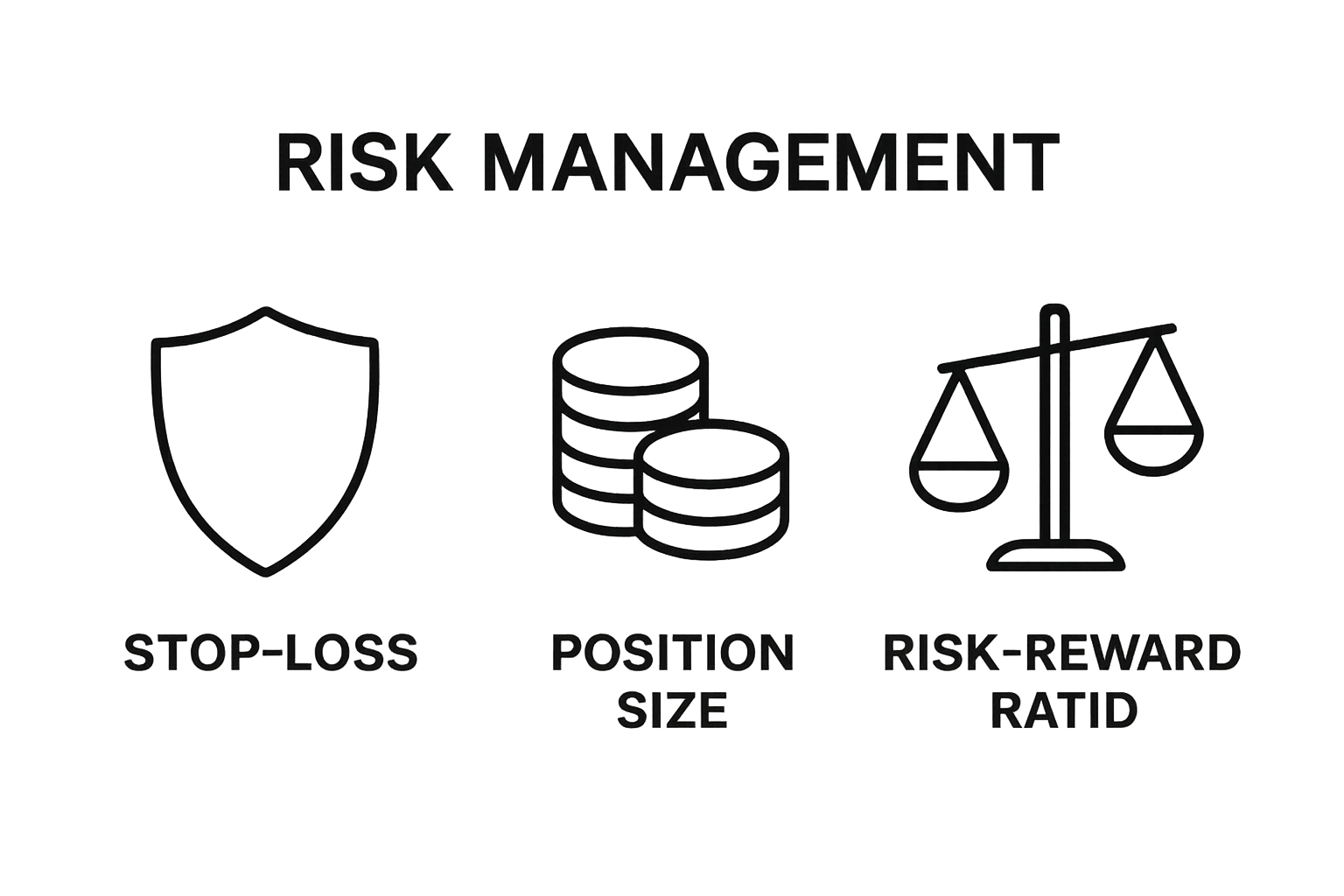
- Setting precise stop-loss parameters
- Calculating optimal position sizes
- Maintaining consistent risk-reward ratios
- Diversifying trading instruments
Traders who prioritize disciplined risk management can navigate market uncertainties more effectively, transforming potential challenges into calculated opportunities. The ability to control emotional responses and adhere to predetermined trading rules distinguishes professional day traders from impulsive investors.
This table outlines key market indicators and risk management techniques mentioned in the article, providing quick reference to their purpose and application in day trading.
| Tool/Technique | Purpose/Role in Day Trading | Application Example |
|---|---|---|
| Moving Averages | Identify trend direction | Spot bullish/bearish conditions |
| Relative Strength Index (RSI) | Measure momentum and overbought/oversold | Detect trend reversals or entries |
| Bollinger Bands | Assess volatility and price range | Identify breakouts or consolidations |
| Stop-Loss Orders | Limit maximum loss on a trade | Automatically close trades if losses exceed preset value |
| Position Sizing | Manage trade exposure based on account size | Allocate portions of portfolio per trade |
| Risk-Reward Ratio | Balance potential gains versus losses | Require favorable trade setups |
| Diversification | Reduce risk by trading multiple instruments | Spread capital across forex, stocks, etc. |
Understanding Market Dynamics: How Price Movements Occur
Market dynamics represent the complex interactions between various economic factors that drive financial instrument prices. Understanding these intricate mechanisms allows day traders to predict and capitalize on potential price fluctuations with greater precision and confidence.
Supply and Demand Fundamentals
At the core of market price movements lies the fundamental economic principle of supply and demand. Prices shift based on the relative balance between market participants wanting to buy or sell a specific financial instrument. Learn more about common volatility trading terminologies that help traders understand these complex interactions.
Key factors influencing market supply and demand include:
- Macroeconomic news releases
- Geopolitical events
- Corporate earnings reports
- Institutional investor sentiment
Information Processing and Market Efficiency
According to research from the Journal of Financial Economics, markets continuously process and integrate new information, which directly impacts price movements. This phenomenon demonstrates how quickly financial markets react to emerging data, creating opportunities for agile day traders.
Traders must understand that market efficiency occurs through several critical mechanisms:
- Rapid information transmission
- Collective investor decision making
- Algorithmic trading responses
- Continuous price discovery
The interaction between human traders and algorithmic systems creates a dynamic environment where prices constantly adjust to reflect the most current available information.

Risk Management in Day Trading: Why It Matters
Risk management represents the critical foundation of sustainable trading strategies, serving as the primary defense mechanism against potential financial losses. In the volatile world of day trading, understanding and implementing robust risk management techniques can mean the difference between long-term success and catastrophic failure.
Understanding Trading Risk Exposure
Traders must recognize that every trade carries inherent financial risk. Calculated risk-taking becomes the cornerstone of professional trading, requiring traders to develop sophisticated strategies that limit potential losses while maintaining opportunities for meaningful gains. Explore essential risk management strategies that can transform your trading approach.
Key components of comprehensive risk assessment include:
- Identifying potential market vulnerabilities
- Calculating maximum acceptable loss per trade
- Analyzing historical market volatility
- Evaluating personal risk tolerance
Psychological and Financial Safeguards
According to the U.S. Securities and Exchange Commission, day trading involves extremely high financial risks that require disciplined psychological management. Successful traders implement stringent protective measures to shield both their financial capital and emotional well-being.
Critical risk mitigation strategies encompass:
- Setting predetermined stop-loss parameters
- Diversifying trading instruments
- Using position sizing techniques
- Maintaining a consistent trading plan
Professional traders understand that risk management transcends mere numerical calculations. It represents a comprehensive approach that integrates financial discipline, emotional intelligence, and strategic decision-making. By treating risk management as a fundamental skill rather than an optional strategy, traders can navigate market uncertainties with greater confidence and resilience.
Psychology of Day Trading: The Impact on Decisions
Day trading represents a high-stakes psychological arena where emotional intelligence and mental discipline determine success far more than technical knowledge. The intricate relationship between a trader’s mental state and financial performance creates a complex landscape of cognitive challenges and potential pitfalls.
Emotional Triggers and Decision Making
Emotional regulation becomes the cornerstone of effective trading strategies. Traders must develop an extraordinary ability to separate personal feelings from objective market analysis. Learn more about developing a trader’s mindset to enhance your psychological resilience.
Common emotional triggers that disrupt rational trading include:
- Fear of missing out (FOMO)
- Panic during market volatility
- Overconfidence after consecutive wins
- Attachment to losing positions
Cognitive Biases in Trading
According to research published in the National Library of Medicine, traders frequently encounter cognitive biases that systematically deviate from rational decision-making. These psychological patterns can significantly undermine trading performance if left unchecked.
Fundamental cognitive biases traders must recognize:
- Confirmation bias
- Loss aversion syndrome
- Anchoring bias
- Recency bias
Successful day traders transform psychological challenges into strategic advantages by developing robust mental frameworks. They understand that trading is not just about market analysis but about maintaining unwavering emotional control under intense pressure. By treating psychological management as a critical skill, traders can consistently make objective decisions that align with their long-term financial goals.
Below is a table categorizing some of the most common emotional triggers and cognitive biases that can influence day trading decisions, together with their typical effects on trading outcomes.
| Psychological Factor | Type | Typical Effect on Trading Decisions |
|---|---|---|
| Fear of Missing Out (FOMO) | Emotion | Impulsive market entry, chasing trades |
| Panic | Emotion | Premature exits, abandoning strategies |
| Overconfidence | Emotion | Overtrading, taking excessive risk |
| Attachment to Losses | Emotion | Unwillingness to close losing positions |
| Confirmation Bias | Cognitive | Ignoring evidence contradicting prior beliefs |
| Loss Aversion | Cognitive | Holding losses too long, selling winners too early |
| Anchoring Bias | Cognitive | Fixation on entry price, ignoring new information |
| Recency Bias | Cognitive | Overweighting recent events, poor trend analysis |
Ready to Turn Day Trading Fundamentals Into Real Results?
You have just learned how crucial risk management, technical analysis, and emotional control are for day trading success. But knowing what to do is only part of the journey. Most traders struggle to apply these fundamentals while the markets move quickly and emotions run high. This is where many promising traders fall behind and miss out on real trading opportunities.

Take your next step with FrankFX. Unlock exclusive mentorship, daily trading signals, and advanced analysis classes designed to help you apply everything covered in this article. Explore our free forex calculators, signals, and robots to reinforce your strategies and gain confidence with each trade. Act now to get personalized guidance and join a thriving community committed to trading success. Your growth starts today.
Frequently Asked Questions
What is day trading?
Day trading is a financial strategy where traders buy and sell financial instruments within the same trading day, aiming to profit from short-term price movements.
What skills are essential for successful day trading?
Successful day traders need skills such as rapid decision-making, advanced risk management, understanding market psychology, and proficiency in technical analysis.
How do day traders manage risk?
Day traders manage risk through techniques such as setting stop-loss parameters, calculating optimal position sizes, maintaining consistent risk-reward ratios, and diversifying trading instruments.
Why is emotional control important in day trading?
Emotional control is crucial in day trading because it helps traders avoid impulsive decisions driven by fear or excitement, allowing them to make objective, rational trading choices.
Recommended
- Swing Trading for Beginners: Simple Strategies and Tips 2025
- Top Swing Trading Strategies for All Market Types 2025
- Common Volatility Trading Terminologies | FRANKFX TRADING ACADEMY
- What Is Fundamental Analysis? A Simple Guide for Traders 2025