Everyone wants a trading plan that actually works and lasts. Professional traders often risk just 1 to 2 percent of their capital on a single trade to protect themselves from big losses. Sounds safe, right? Most people assume trading success is about picking the perfect stock at the right moment. The real secret is much less glamorous: it all starts with setting clear goals, understanding your risk, and treating your strategy as a living document you update over time.
Table of Contents
- Step 1: Define Your Trading Goals And Objectives
- Step 2: Identify Your Risk Tolerance And Capital Allocation
- Step 3: Create Your Entry And Exit Strategies
- Step 4: Develop Your Trade Management Rules
- Step 5: Test And Refine Your Trading Plan
- Step 6: Review And Adjust Your Plan Regularly
Quick Summary
| Key Point | Explanation |
|---|---|
| 1. Define measurable trading goals | Clear goals serve as a compass, guiding your decisions and maintaining discipline in trading. |
| 2. Assess risk tolerance and capital allocation | Understand your ability to withstand losses and allocate capital wisely for sustainable trading. |
| 3. Establish entry and exit strategies | Develop systematic rules for trade entries and exits to manage risks and evaluate market opportunities. |
| 4. Implement rigorous trade management rules | Set protocols for position sizing and trade management to protect capital in volatile markets. |
| 5. Regularly review and adjust your plan | Continuous evaluation helps adapt strategies to changing market conditions for long-term success. |
Step 1: Define your trading goals and objectives
Defining clear and measurable trading goals is the fundamental cornerstone of a successful trading strategy. Without well-defined objectives, traders risk wandering aimlessly in financial markets, making inconsistent and emotionally driven decisions that can quickly erode capital. Your trading goals serve as a strategic compass, guiding every decision and helping you maintain discipline in high-pressure market environments.
Begin by conducting an honest self-assessment of your financial situation, risk tolerance, and long-term investment aspirations. Are you seeking consistent monthly income, capital preservation, or aggressive wealth accumulation? Each goal requires a different approach and risk management strategy. For instance, a trader focused on monthly income might prioritize low-risk, consistent strategies, while an aggressive wealth builder might be more comfortable with higher-risk, potentially higher-reward approaches.
Consider creating a comprehensive goal framework that includes both quantitative and qualitative objectives. Quantitative goals might include specific profit targets, such as achieving a 10% monthly return or growing your trading account by 25% annually. Qualitative goals could involve developing emotional discipline, improving technical analysis skills, or reducing impulsive trading behaviors. Learn more about developing a robust trading mindset to support your goal-setting process.
To validate your goals, implement a rigorous verification process. Create a detailed trading journal documenting your objectives, track your progress systematically, and conduct monthly reviews. This approach allows you to assess whether your current strategies align with your initial goals and make necessary adjustments. Remember that trading goals are not static; they should evolve with your skill development, market changes, and personal financial circumstances.
Here is a checklist table summarizing the key verification criteria to consider when defining your trading goals and objectives.
| Criteria | Description |
|---|---|
| Specific, measurable profit targets | Set clear, numeric goals for profits to track your trading performance. |
| Clear risk management parameters | Define how much risk is acceptable for each trade and overall. |
| Defined timeframes for goal achievement | Establish when you expect to reach your trading objectives. |
| Mechanisms for periodic performance evaluation | Create a system to regularly review and adjust your goals. |
Key verification criteria for your trading goals should include:
- Specific, measurable profit targets
- Clear risk management parameters
- Defined timeframes for goal achievement
- Mechanisms for periodic performance evaluation
By establishing a clear, structured approach to defining your trading objectives, you transform trading from a speculative activity into a methodical, purposeful endeavor.
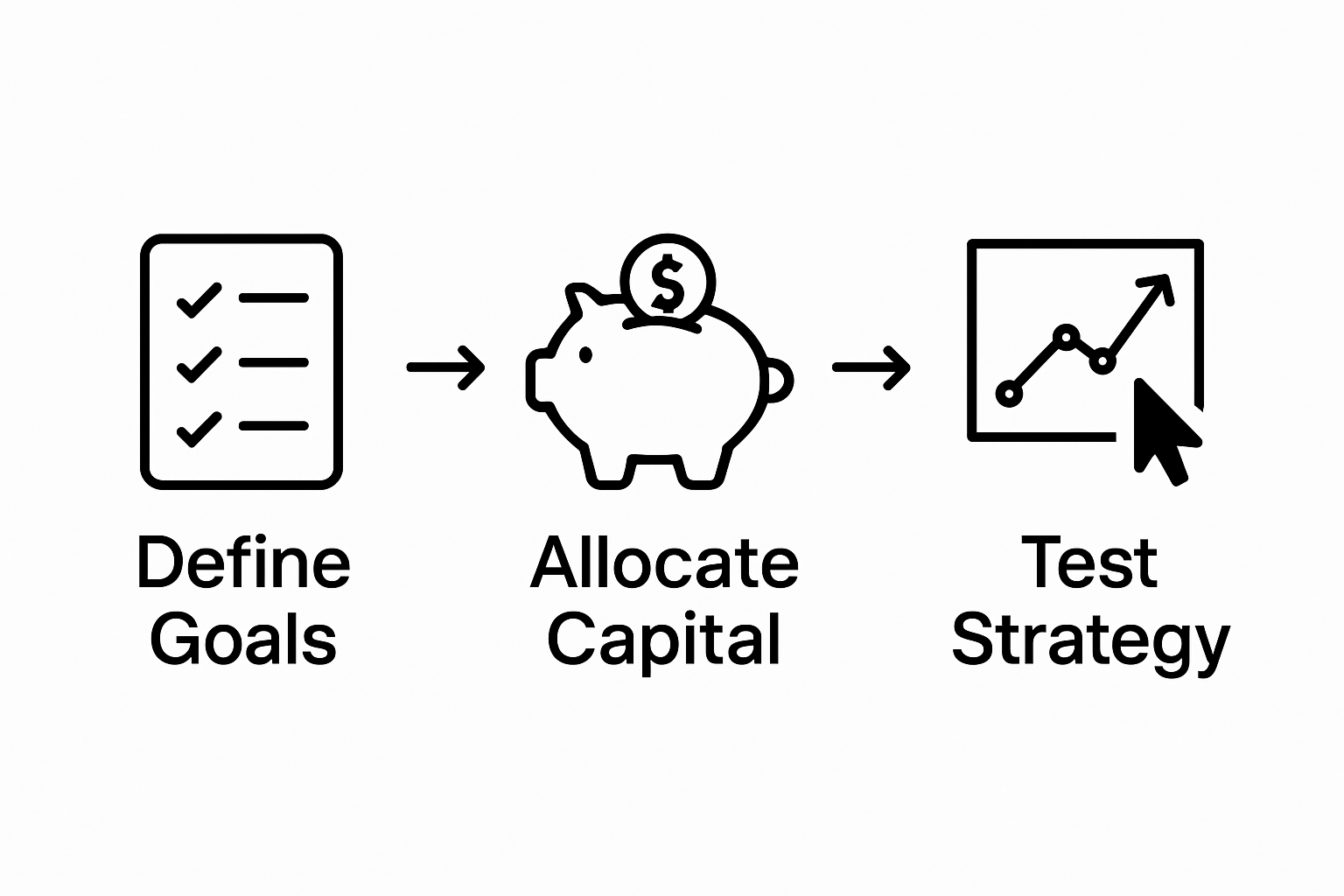
Step 2: Identify your risk tolerance and capital allocation
Risk tolerance and capital allocation form the critical financial backbone of your trading strategy, determining how resilient and sustainable your trading approach will be. This step requires deep introspection and strategic planning, transforming your trading from a random activity into a calculated financial endeavor. Understanding your personal risk threshold is more than a mathematical exercise – it is a psychological and financial self-discovery process.
Begin by conducting a comprehensive personal financial assessment that goes beyond surface-level numbers. Evaluate your current financial situation, including total available capital, monthly expenses, emergency savings, and additional income streams. Your risk tolerance isn’t just about how much money you can afford to lose, but also about your emotional capacity to withstand market volatility without making impulsive decisions. Explore advanced trading psychology techniques to develop a more nuanced understanding of your financial decision-making patterns.
Professional traders recommend allocating no more than 1-2% of your total trading capital per individual trade, which provides a buffer against significant losses while allowing for consistent market engagement. This approach transforms risk management from a theoretical concept into a practical trading discipline. Consider creating multiple trading accounts with different risk profiles: one for conservative, low-risk strategies and another for more aggressive, high-potential trades. This segmentation allows you to experiment and learn while protecting your core capital.
To verify your risk tolerance and capital allocation strategy, implement a rigorous self-assessment process. Document your trading decisions, track emotional responses during trades, and analyze your performance objectively. Your verification should include:
Below is a checklist table summarizing key verification steps to help you confirm your risk tolerance and capital allocation strategy.
| Verification Step | Description |
|---|---|
| Review trading performance vs. risk parameters | Compare actual trade results to your predefined risk limits and targets. |
| Assess emotional state during wins and losses | Reflect on how you feel and react in both successful and losing trades. |
| Periodically recalibrate risk allocation | Adjust your risk and capital distribution as markets and finances change. |
- Comprehensive review of trading performance against predefined risk parameters
- Emotional state assessment during winning and losing trades
- Periodic recalibration of risk allocation based on market conditions and personal financial changes
Remember that risk tolerance is not static. As your trading skills improve and your financial situation evolves, your approach to risk and capital allocation will naturally transform. Embrace this dynamic process with patience, self-awareness, and a commitment to continuous learning.
Step 3: Create your entry and exit strategies
Entry and exit strategies are the strategic heartbeat of your trading plan, transforming potential market chaos into a structured, disciplined approach. Successful trading is not about predicting market movements with absolute certainty, but about creating a systematic method for identifying high-probability trading opportunities and managing potential outcomes. Your entry and exit strategies will serve as precise navigation tools, guiding you through complex market landscapes with clarity and purpose.
Developing robust entry strategies requires a comprehensive understanding of technical and fundamental analysis indicators. Focus on creating a multi-dimensional approach that combines price action, volume analysis, trend indicators, and potential market catalysts. Learn more about advanced breakout trading techniques to enhance your strategy development. Consider implementing specific trigger conditions such as moving average crossovers, support and resistance levels, or momentum indicators that signal potential trade opportunities. For instance, a trader might establish an entry rule that only executes trades when a short-term moving average crosses above a long-term moving average, combined with relative strength index (RSI) confirmation.
Exit strategies are equally critical and often more challenging to define. Professional traders recommend establishing both profit-taking and stop-loss mechanisms before entering any trade. A well-crafted exit strategy protects your capital during adverse market movements and ensures you capture profits during favorable conditions.
This table outlines common entry and exit strategy components and their roles, helping you organize your approach for systematic trade execution.
| Component | Role in Entry/Exit Strategies |
|---|---|
| Technical indicators | Signal when to enter or exit trades based on pricing trends. |
| Price action & volume analysis | Assess market sentiment and potential direction for entries/exits. |
| Stop-loss rules | Limit potential losses by defining exit points for losing trades. |
| Profit targets | Predetermine points to exit and lock in profits. |
| Trailing stops | Adjust stop-loss levels to secure gains as trades move in your favor. |

To validate your entry and exit strategies, implement a comprehensive verification process that goes beyond simple performance metrics. Document and analyze each trade meticulously, tracking not just financial outcomes but also the alignment of actual trades with your predefined rules. Your verification should include:
- Detailed trade journal recording entry and exit conditions
- Performance analysis comparing actual results against strategy parameters
- Periodic review and refinement of strategy rules based on empirical evidence
Remember that successful trading strategies are living documents. Continuous learning, adaptation, and disciplined execution are the true markers of long-term trading success.
Step 4: Develop your trade management rules
Trade management rules are the strategic guardrails that transform potential market chaos into a disciplined, systematic approach to trading. These rules are not merely suggestions, but fundamental protocols that protect your capital and ensure consistent decision-making across varying market conditions. Developing comprehensive trade management rules requires a holistic understanding of your trading psychology, risk tolerance, and market dynamics.
Begin by establishing clear, unambiguous rules for position sizing, which directly impacts your overall portfolio risk. Professional traders recommend never risking more than 1-2% of your total trading capital on a single trade. This approach provides a robust mechanism for preserving capital during inevitable market fluctuations. Explore advanced forex order types to enhance your trade management strategy and provide additional layers of precision in your execution.
Your trade management framework should include precise guidelines for scenario-based decision-making. Create explicit protocols for managing trades under different market conditions, including specific actions for trending markets, range-bound scenarios, and periods of high volatility. This might involve predetermined rules for scaling into positions, using trailing stop-loss mechanisms, or implementing partial profit-taking strategies. For instance, you might establish a rule to automatically reduce position size by 50% once a trade reaches a predetermined profit level, thereby protecting initial gains while maintaining potential for further upside.
To validate your trade management rules, implement a rigorous self-assessment and documentation process. Your verification should extend beyond simple financial metrics and include a comprehensive analysis of your decision-making consistency. Develop a systematic approach that tracks not just monetary outcomes, but also your adherence to predefined trading protocols.
Key verification criteria for your trade management rules should include:
- Detailed trade journal documenting every decision against established rules
- Performance analysis measuring rule compliance and financial outcomes
- Quarterly review and refinement of trade management protocols
Remember that effective trade management is a dynamic process. Your rules should evolve with your trading experience, market conditions, and personal financial objectives. Approach this step with patience, precision, and a commitment to continuous improvement.
Step 5: Test and refine your trading plan
Testing and refining your trading plan is the critical metamorphosis that transforms theoretical strategies into robust, executable trading methodologies. This stage is not about proving your initial strategy right, but about systematically identifying and correcting potential weaknesses before risking real capital. Professional traders understand that a trading plan is a living document, constantly evolving through rigorous analysis and empirical evidence.
Begin your testing process by implementing paper trading or backtesting techniques that simulate real market conditions without financial risk. Utilize historical market data to run your strategy through multiple market scenarios, analyzing performance across different timeframes, market conditions, and asset classes. Explore automated trading techniques to enhance your testing methodology and provide objective, data-driven insights into your strategy’s potential effectiveness. Pay special attention to how your strategy performs during challenging market periods, such as high volatility or unexpected economic events.
The refinement process requires a disciplined, systematic approach to analyzing test results. Create a comprehensive performance matrix that evaluates multiple metrics beyond simple profit and loss. Consider factors like maximum drawdown, win rate, risk-reward ratio, and consistency of returns. Look for patterns in your strategy’s performance that might indicate inherent strengths or fundamental weaknesses. For instance, if your strategy consistently underperforms during specific market conditions, you may need to develop additional rules or modify existing parameters to improve adaptability.
To validate the effectiveness of your testing and refinement process, implement a structured verification framework that goes beyond surface-level metrics. Your verification should provide a holistic assessment of your trading plan’s potential and limitations.
Key verification criteria should include:
- Comprehensive performance analysis across multiple market scenarios
- Detailed documentation of strategy modifications and their impacts
- Periodic review process for continuous strategy improvement
Remember that successful trading is a journey of continuous learning and adaptation. Your willingness to objectively analyze, test, and refine your trading plan will ultimately determine your long-term success in the financial markets.
Step 6: Review and adjust your plan regularly
Regular review and adjustment of your trading plan is the critical maintenance process that transforms a static strategy into a dynamic, adaptive approach to market engagement. Your trading plan is a living document, not a carved-in-stone manifesto that remains unchanged regardless of market conditions. Professional traders understand that consistent performance requires continuous evaluation and strategic recalibration.
Establish a structured review schedule that combines both periodic and event-driven assessments. Conduct comprehensive quarterly reviews that analyze your entire trading strategy’s performance, examining metrics beyond simple profit and loss. Look deeply into win rates, risk-reward ratios, drawdown periods, and the effectiveness of your entry and exit strategies. Learn more about volatility index trading dynamics to help contextualize your performance within broader market trends. During these reviews, create a detailed performance journal that documents not just numerical outcomes, but also the emotional and psychological factors influencing your trading decisions.
Develop a systematic approach to strategy adjustment that balances statistical evidence with market adaptability. When reviewing your trading plan, consider both micro and macro factors that might necessitate modifications. Micro factors include individual trade performance, specific strategy component effectiveness, and personal psychological patterns. Macro factors encompass broader market shifts, emerging economic trends, and changes in global financial landscapes. Your adjustment process should be methodical, avoiding knee-jerk reactions while remaining sufficiently flexible to incorporate meaningful insights.
To validate the effectiveness of your review and adjustment process, implement a comprehensive verification framework that goes beyond surface-level metrics. Your verification should provide a holistic assessment of your trading plan’s evolution and responsiveness to changing market conditions.
Key verification criteria should include:
- Documented evidence of strategy modifications and their subsequent impacts
- Comparative analysis of performance before and after adjustments
- Consistent tracking of long-term trading objectives against current strategy
Remember that successful trading is not about achieving perfection, but about maintaining a disciplined, adaptive approach that allows continuous learning and improvement.
Ready to Turn Your Trading Plan Into Real Results?
Building a solid trading plan can feel overwhelming when you face challenges like emotional decision making, inconsistent strategies, and uncertainty with risk management. This article highlights critical steps every trader must follow, from defining goals, setting risk tolerance, creating entry and exit rules, to refining strategies. But applying all these insights alone can be tough, especially when profits and confidence are on the line.
Here is a step overview table summarizing the six essential steps of building an effective trading plan, along with the main focus for each step.
| Step | Focus Area | Key Outcome |
|---|---|---|
| Step 1 | Define trading goals and objectives | Clear, measurable targets and motivations |
| Step 2 | Identify risk tolerance and capital allocation | Sustainable and resilient trading foundation |
| Step 3 | Create entry and exit strategies | Systematic and disciplined market actions |
| Step 4 | Develop trade management rules | Protocols for consistent trade execution |
| Step 5 | Test and refine your trading plan | Proven, empirically validated strategies |
| Step 6 | Review and adjust your plan regularly | Dynamic and adaptive trading methodology |
| Imagine having the right tools, expert mentorship, and live trading signals at your fingertips to move from theory to execution with confidence. |

If you are determined to make your checklist work for you today, now is the best time to upgrade your trading journey. Explore FrankFX’s trading solutions and access daily trade signals, live mentorship, advanced analysis sessions, and a supportive community. Whether you want to master risk management, streamline your trade entries, or automate your strategy, our free resources and VIP memberships are designed to fill the gaps that hold traders back. The smartest traders know success is more than a checklist—it requires the right support system. Take action and join our community of traders who are transforming plans into profits. Visit FrankFX’s homepage now to claim your competitive edge.
Frequently Asked Questions
What are the key components of a trading plan?
A trading plan should include clearly defined trading goals, risk tolerance, entry and exit strategies, trade management rules, and a testing and refinement process to ensure effectiveness.
How do I determine my risk tolerance for trading?
To determine your risk tolerance, conduct a personal financial assessment considering your total available capital, monthly expenses, emergency savings, and your emotional capacity to handle market volatility without making impulsive decisions.
Why is creating entry and exit strategies important in trading?
Entry and exit strategies are essential as they help identify high-probability trading opportunities while managing potential outcomes. They provide structure and discipline to navigate market complexities effectively.
How often should I review and adjust my trading plan?
It’s recommended to conduct comprehensive reviews of your trading plan quarterly, while also making event-driven assessments. This ensures your strategy adapts to changing market conditions and continues to meet your long-term objectives.
Recommended
- Breakout Trading Strategies for Forex, Crypto, and Indices 2025
- 2.4 Impress Your Date with Forex Lingo Buy me a coffee | FRANKFX TRADING ACADEMY
- 2.5 Types of Forex Orders | FRANKFX TRADING ACADEMY
- Automated Trading for Beginners: Easy Steps to Start Now 2025
- 7 Essential Steps for Your Inventory Management Checklist