End of day trading strategies have caught the attention of traders who want to make smart moves without staring at screens all day. Most people assume you need to be glued to the market every second to have a chance at success. But the surprise is these strategies often lead to lower transaction costs and reduce trading time by up to 90 percent compared to intraday methods. The real story is how analyzing the market after the closing bell could unlock better decisions and even more consistent results.
Table of Contents
- What Are End Of Day Trading Strategies?
- Why End Of Day Trading Matters In Different Markets
- How End Of Day Trading Strategies Work
- Key Concepts Behind End Of Day Trading Success
- Real-World Applications Of End Of Day Trading Strategies
Quick Summary
| Takeaway | Explanation |
|---|---|
| End of day trading allows flexible analysis | Traders can focus on comprehensive market performance without constant monitoring, lowering stress and time commitment. |
| Incorporate technical analysis for decision making | Utilize price charts and indicators to pinpoint trading opportunities and manage risks effectively. |
| Practice disciplined risk management | Maintain clear stop-loss parameters and consistent position sizing to protect against market volatility. |
| Emphasize emotional control in trading | Strong psychological discipline helps minimize impulsive decisions, leading to more consistent trading results. |
| Adapt strategies to specific market sectors | Different markets, like forex and stocks, require tailored end of day strategies based on their unique characteristics. |
What are End of Day Trading Strategies?
End of day trading strategies represent a methodical approach where traders analyze and execute trades based on market performance and price movements at the close of each trading day. Unlike high-frequency or intraday trading techniques, this strategy allows traders to make calculated decisions without constant market monitoring.
Understanding the Core Concept
Traders utilizing end of day trading strategies focus on comprehensive market analysis during the final trading hours, making strategic decisions after markets officially close. Research from Pennsylvania State University highlights that technical chart analysis plays a crucial role in these trading approaches, enabling traders to identify potential market trends and patterns.
Key characteristics of end of day trading strategies include:
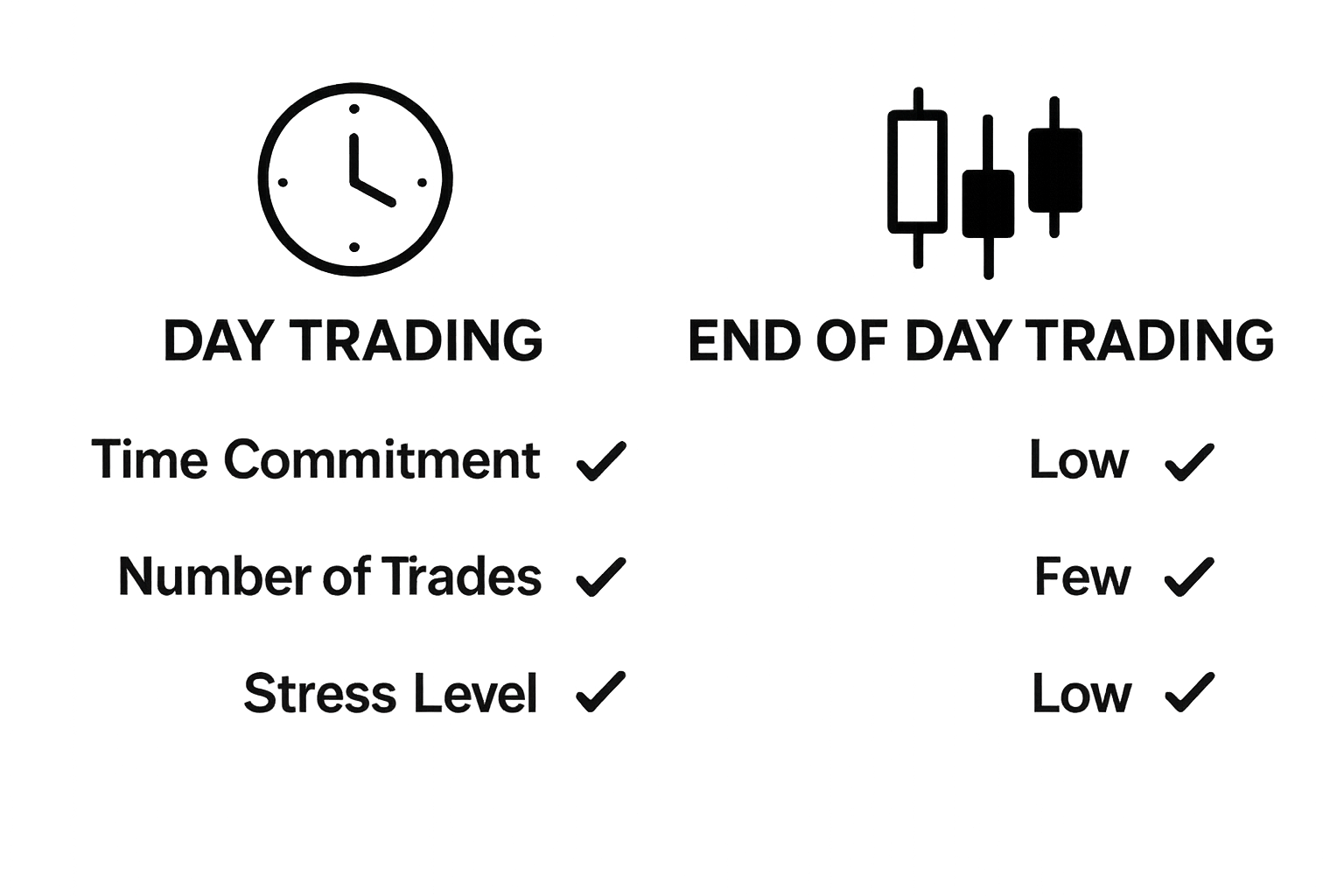
- Reduced time commitment compared to day trading
- Lower transaction costs due to fewer trade executions
- More strategic and calculated decision making
- Opportunity to analyze comprehensive daily market movements
Strategic Considerations
Successful end of day trading requires understanding market dynamics and developing a robust analytical framework. Traders typically review daily price charts, evaluate technical indicators, and assess overall market sentiment to make informed trading decisions. Learn more about advanced trading strategies to complement your end of day trading approach.
Traders must also recognize that while end of day strategies offer more flexibility, they demand disciplined analysis, consistent risk management, and a deep understanding of market indicators. The goal is not just executing trades but making strategic decisions based on comprehensive market intelligence.
To help beginners quickly reference the main features of end of day trading strategies, the table below summarizes their key characteristics and associated benefits.
| Characteristic | Description |
|---|---|
| Reduced Time Commitment | Trades are analyzed and executed after market close, requiring less screen time. |
| Lower Transaction Costs | Fewer trades mean less spent on commissions and transaction fees. |
| Comprehensive Market Analysis | Decisions are based on full-day price and volume data, providing broader insight. |
| Strategic Decision Making | Allows for planning and methodical execution rather than impulsive, reactionary trading. |
| Flexible for Multiple Markets | Adaptable approach suitable for forex, stocks, crypto, commodities, and indices. |
Why End of Day Trading Matters in Different Markets
End of day trading strategies provide significant advantages across various financial markets, offering traders a systematic approach to understanding market dynamics and making informed investment decisions.
Market Complexity and Opportunity
Different markets demonstrate unique characteristics that make end of day trading particularly valuable. Research on global equity markets reveals that market volatility and liquidity often cluster toward trading day closures, creating strategic opportunities for traders across forex, stocks, and cryptocurrency platforms.
Key market segments benefiting from end of day trading include:
- Forex markets with high global interconnectivity
- Stock exchanges with complex daily settlement mechanisms
- Cryptocurrency platforms experiencing significant price fluctuations
- Commodity and index trading environments
Strategic Market Analysis
Traders utilizing end of day strategies gain comprehensive insights by analyzing complete daily market movements. This approach allows for more nuanced decision making compared to rapid, high-frequency trading methods. Explore forex market dynamics to understand how different trading approaches impact investment outcomes.
By reviewing daily price charts, technical indicators, and overall market sentiment, traders can develop robust strategies that minimize emotional trading and maximize potential returns. The end of day approach encourages disciplined analysis, risk management, and a holistic understanding of market trends across diverse financial ecosystems.
How End of Day Trading Strategies Work
End of day trading strategies operate through a systematic process of market analysis, decision making, and strategic execution focused on daily market performance and potential opportunities.
Technical Analysis Framework
Resources from TradingCenter.org emphasize that successful end of day trading requires a comprehensive technical analysis framework. Traders carefully examine multiple technical indicators and price charts to identify potential entry and exit points for their trades.
Critical components of the technical analysis process include:
- Examining daily price movement patterns
- Evaluating moving averages and trend lines
- Analyzing volume and momentum indicators
- Assessing support and resistance levels
Decision Making and Execution
Traders utilizing end of day strategies typically follow a structured approach to making trading decisions. After conducting thorough market analysis during the final trading hours, they carefully evaluate potential trade opportunities based on their predefined strategy and risk tolerance. Learn more about advanced forex order types to enhance your trading execution strategy.
The execution process involves setting precise entry and exit points, managing potential risks, and maintaining a disciplined approach to trading. Successful traders recognize that end of day strategies require patience, consistent analysis, and a deep understanding of market dynamics across different financial instruments.
Key Concepts Behind End of Day Trading Success
Successful end of day trading is not just about technical skills but requires a holistic approach integrating strategic thinking, psychological discipline, and comprehensive market understanding.
Risk Management and Strategic Planning
Advanced trading research highlights that effective risk management is fundamental to trading success. Traders must develop a robust framework that balances potential profits with calculated risk exposure, ensuring long-term sustainability in volatile market environments.
Critical risk management principles include:

- Setting precise stop-loss parameters
- Maintaining consistent position sizing
- Diversifying trading instruments
- Establishing clear risk tolerance levels
Psychological Discipline and Market Awareness
Trading success extends beyond technical analysis and requires strong psychological resilience. Emotional control becomes a critical determinant of consistent performance. Learn more about trading psychology to develop a disciplined approach that minimizes impulsive decision making.
Successful traders recognize that market awareness involves continuous learning, adapting to changing market conditions, and maintaining a strategic perspective that transcends momentary market fluctuations. This approach demands patience, analytical thinking, and a commitment to ongoing skill development.
Real-World Applications of End of Day Trading Strategies
End of day trading strategies demonstrate remarkable versatility across multiple financial markets, offering traders structured approaches to navigating complex investment landscapes and generating consistent returns.
Market Sector Implementation
Research in International Business and Finance reveals that algorithmic traders effectively utilize end of day strategies to provide market liquidity and optimize trading performance. These strategies prove particularly valuable in different market sectors, enabling traders to adapt their approaches based on specific market characteristics.
Key market sectors benefiting from end of day trading include:
- Forex markets with high global interconnectivity
- Stock exchanges with complex settlement mechanisms
- Cryptocurrency platforms experiencing significant volatility
- Commodity and index trading environments
Strategic Decision Making
Traders implement end of day strategies by conducting comprehensive market analysis during closing hours, allowing for methodical evaluation of trading opportunities. Learn more about fundamental forex trading concepts to enhance your understanding of market dynamics.
Successful implementation requires traders to systematically analyze price movements, volume indicators, and market sentiment. By focusing on daily performance rather than rapid intraday fluctuations, traders can develop more robust and sustainable trading approaches that minimize emotional decision making and maximize strategic potential.
The following table helps clarify how end of day trading approaches differ from intraday trading strategies, focusing on time commitment, decision-making, and overall experience for traders.
| Aspect | End of Day Trading | Intraday Trading |
|---|---|---|
| Time Commitment | Low: Analyze and trade after close | High: Monitor markets throughout the day |
| Decision Frequency | 1-2 decisions per day | Many rapid decisions daily |
| Stress Level | Lower due to structured timing | Higher due to constant market movement |
| Transaction Costs | Lower due to fewer trades | Higher with frequent trades |
| Analytical Approach | Strategic, uses full day data | Reactive, uses short-term trends |
Ready to Master End of Day Trading With Real Results?
If you are finding it tough to turn daily market analysis into smarter trades, you are not alone. Many beginners struggle with making consistent decisions and staying disciplined about entries and exits. The right tools and expert strategies can be the difference between missing out and building real momentum in your trading.

Stop second-guessing your end of day trades. At FrankFX, you gain access to live daily signals, in-depth mentorship, and automated tools built for exact strategies discussed in this guide. Boost your learning curve with our free resources and take the next step by exploring our forex trading solutions. Start today so you are not left behind as market opportunities close. Visit FrankFX right now and join a community built to help you trade smarter, every single day.
Frequently Asked Questions
What is end of day trading?
End of day trading involves analyzing and executing trades based on market performance and price movements at the close of each trading day. Traders make informed decisions just before the market closes rather than monitoring it constantly throughout the day.
What are the advantages of using end of day trading strategies?
End of day trading strategies offer several advantages, including reduced time commitment, lower transaction costs due to fewer trades, and the ability to make more strategic and calculated decisions based on comprehensive market analysis.
How do I start using end of day trading strategies?
To begin using end of day trading, you should familiarize yourself with technical analysis, evaluate daily price charts and indicators, and develop a structured decision-making framework. Implementing consistent risk management practices is also crucial for success.
What should I consider when developing an end of day trading strategy?
When developing your end of day trading strategy, focus on key components such as risk management principles, psychological discipline, and a structured approach to evaluating market dynamics. It’s essential to analyze price movements, volume indicators, and overall market sentiment to maximize your trading potential.
Recommended
- Swing Trading for Beginners: Simple Strategies and Tips 2025
- The Different Types of Volatility index Trading Strategies | FRANKFX TRADING ACADEMY
- The Different Types of Boom and Crash Trading Strategies | FRANKFX TRADING ACADEMY
- Automated Trading for Beginners: Easy Steps to Start Now 2025