Every second, trillions of dollars switch hands in the forex market and the entire system runs on one thing currency pairs. Now, it sounds simple. But did you know that major pairs like EUR/USD and USD/JPY make up nearly 80 percent of all forex trades worldwide? Most people focus on the big names and assume minor or exotic pairs are just for experts. That belief could be holding you back because sometimes the highest rewards and biggest lessons are found where few traders dare to look.
Table of Contents
- Understanding Currency Pairs In Forex Trading
- Major, Minor, And Exotic Currency Pairs
- How To Read And Analyze Currency Quotes
- Choosing The Best Currency Pairs To Trade
Quick Summary
| Takeaway | Explanation |
|---|---|
| Understand currency pairs’ structure | Currency pairs show the value relationship between two currencies, vital for forex trading. Knowing the base and quote currencies is essential. |
| Prioritize major currency pairs for stability | Major pairs like EUR/USD and USD/JPY offer high liquidity and lower risks, making them suitable for most traders. |
| Be cautious with exotic currency pairs | Exotic pairs can provide high potential returns but come with wider spreads and higher volatility, necessitating robust risk management. |
| Master currency quote analysis | Accurate interpretation of bid/ask prices and the spread helps traders identify profitable opportunities and manage transaction costs effectively. |
| Select currency pairs based on your strategy | Choose pairs based on liquidity, market predictability, and complexity to align with your trading skills and goals. |
Understanding Currency Pairs in Forex Trading
Forex trading revolves around the strategic exchange of currencies in interconnected global markets. At its core, currency pairs represent the fundamental mechanism through which traders conduct international monetary transactions. Learn more about trading strategies to navigate these complex financial landscapes effectively.
What Are Currency Pairs?
Currency pairs represent the relative value between two national currencies traded on the foreign exchange market. According to Investopedia, the forex market is the largest and most liquid financial marketplace globally, with an average daily trading volume of $7.5 trillion as of April 2022. These pairs are typically written as abbreviations representing specific currencies, such as USD/EUR or GBP/JPY.
In every currency pair, the first listed currency is the base currency, while the second is the quote currency. The exchange rate indicates how much of the quote currency is needed to purchase one unit of the base currency. For instance, if the USD/CAD rate is 1.25, it means one US dollar can be exchanged for 1.25 Canadian dollars.
Types of Currency Pairs
Traders typically categorize currency pairs into three primary groups: major pairs, minor pairs, and exotic pairs. Major pairs involve the most frequently traded currencies worldwide and include combinations like EUR/USD, USD/JPY, and GBP/USD. These pairs generally offer high liquidity and lower transaction costs.
Minor pairs exclude the US dollar but involve other significant global currencies. Examples include EUR/GBP and AUD/CAD. These pairs often demonstrate more volatility compared to major pairs, presenting unique trading opportunities for experienced investors.
Exotic pairs combine a major currency with a currency from a developing or smaller economy. These pairs, such as USD/THB (US dollar to Thai baht) or EUR/TRY (euro to Turkish lira), typically feature higher spreads and increased price fluctuations. Traders approaching exotic pairs require comprehensive market understanding and robust risk management strategies.
Understanding currency pairs requires continuous learning and market analysis. The intricate relationships between global economies, geopolitical events, and monetary policies directly influence currency valuations. Successful forex traders develop keen insights into these complex interactions, enabling them to make informed trading decisions.
As the forex market continues evolving, staying updated on global economic trends and technological advancements becomes crucial. Traders must remain adaptable, leveraging sophisticated tools and maintaining a deep understanding of currency pair dynamics to navigate this dynamic financial ecosystem effectively.
Major, Minor, and Exotic Currency Pairs
Currency pairs form the backbone of forex trading, with distinct categories that offer traders varied opportunities and challenges. Discover the nuances of currency trading to develop a comprehensive understanding of global financial markets.
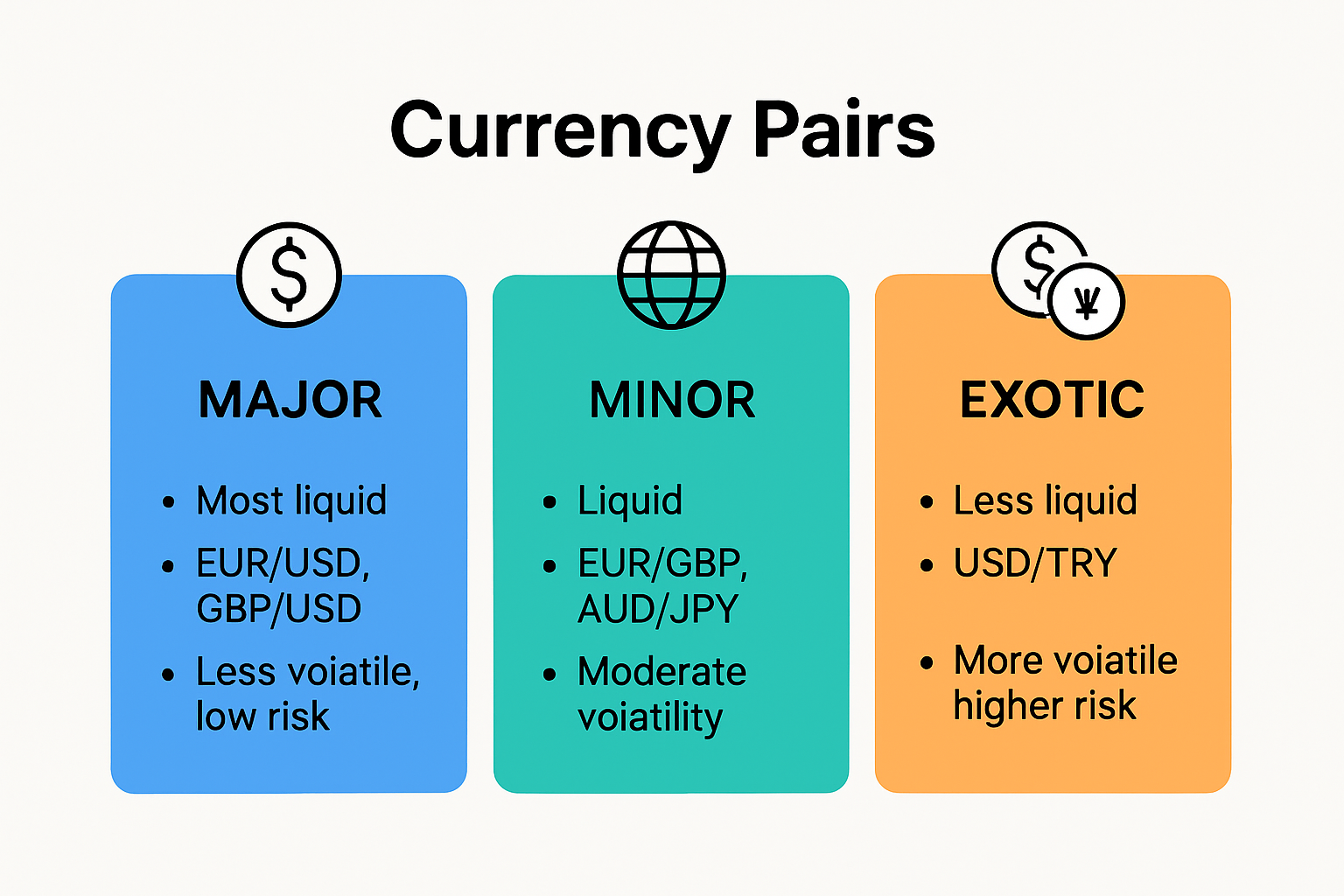
To clarify the differences among major, minor, and exotic currency pairs, here’s a comparison table summarizing their main features:
| Category | Description | Examples | Liquidity | Volatility |
|---|---|---|---|---|
| Major Pairs | Most traded, always include USD, high liquidity and stability | EUR/USD, USD/JPY, GBP/USD, USD/CHF | Very High | Low to Medium |
| Minor Pairs | Exclude USD, include other major currencies, higher volatility | EUR/GBP, AUD/CAD, EUR/AUD | Medium | Medium to High |
| Exotic Pairs | Pair major currency with currency from emerging/smaller economy | USD/THB, EUR/TRY, USD/SEK | Low | High |
Major Currency Pairs: The Global Trading Powerhouses
Major currency pairs represent the most traded and liquid segments of the forex market. According to Investopedia, these pairs invariably include the US dollar and account for approximately 80% of global forex trading volume. The most prominent major pairs include EUR/USD, USD/JPY, GBP/USD, and USD/CHF.
Traders gravitate towards major pairs due to their exceptional characteristics. They offer tight spreads, meaning lower transaction costs, and demonstrate high predictability driven by substantial economic data and transparent market information. The stability of major economies underpinning these currencies provides traders with more reliable trading signals and reduced volatility compared to other currency categories.
Minor Currency Pairs: Global Trading Beyond the Dollar
Minor currency pairs, alternatively known as cross-currency pairs, exclude the US dollar from direct transactions. These pairs involve other significant global currencies like the euro, British pound, and Japanese yen. Examples include EUR/GBP, EUR/CAD, and AUD/NZD.
According to Wikipedia, minor pairs tend to exhibit higher volatility compared to major pairs. This increased price movement presents both opportunities and risks for traders. The complexity of minor pairs demands a more nuanced understanding of individual economies, geopolitical dynamics, and monetary policies.
Exotic Currency Pairs: High Risk, High Potential
Exotic currency pairs combine a major currency with a currency from an emerging or smaller economy. These pairs, such as USD/THB (US dollar to Thai baht) or EUR/TRY (euro to Turkish lira), represent the most challenging trading segment. Characterized by wider spreads and more pronounced price fluctuations, exotic pairs require sophisticated risk management strategies.
Traders approaching exotic pairs must possess deep market knowledge and robust analytical skills. The currencies involved often reflect complex economic conditions, political instabilities, and less transparent market mechanisms. While potentially offering significant profit margins, exotic pairs demand exceptional discipline and comprehensive research.
Successful forex trading transcends simple currency exchange. It requires continuous learning, adaptability, and a holistic understanding of global economic interconnections. Traders must develop nuanced strategies that account for the unique characteristics of each currency pair category.
As global financial landscapes evolve, staying informed about emerging market trends, technological advancements, and geopolitical shifts becomes paramount. The ability to navigate different currency pair types with strategic insight distinguishes exceptional traders from average market participants.
How to Read and Analyze Currency Quotes
Reading and analyzing currency quotes is a fundamental skill for forex traders, requiring precision and strategic understanding. Learn essential trading techniques to navigate the complex world of currency exchange effectively.
Understanding Basic Currency Quote Structure
Currency quotes represent the relative value between two currencies and provide critical information for traders. According to Lumen Learning, every currency quote consists of two primary components: the base currency and the quote currency.
In a typical quote like EUR/USD 1.0850, the first currency (EUR) is the base currency, while the second (USD) is the quote currency. The number 1.0850 indicates how many US dollars are required to purchase one euro. For instance, if the quote increases to 1.0900, it means the euro has strengthened relative to the US dollar, requiring more dollars to buy the same amount of euros.
Interpreting Bid and Ask Prices
Forex quotes include two critical prices: the bid price and the ask price. According to Wikipedia, the bid price represents the maximum price buyers are willing to pay, while the ask price is the minimum price sellers will accept.
The difference between these prices is called the spread. A narrower spread typically indicates higher liquidity and lower transaction costs. Professional traders carefully analyze these price differences to identify potential trading opportunities. For example, if the EUR/USD bid price is 1.0845 and the ask price is 1.0850, the spread is 0.0005 or 5 pips.
Below is a summary table clarifying the main elements found in a typical currency quote and what they represent, for quick reference:
| Element | Definition | Example in EUR/USD 1.0850 |
|---|---|---|
| Base Currency | The first currency in the pair (being bought) | EUR |
| Quote Currency | The second currency in the pair (used to buy the base) | USD |
| Rate | Amount of quote currency needed for one unit of the base | 1.0850 |
| Bid Price | Maximum price a buyer is willing to pay for the base | 1.0845 |
| Ask Price | Minimum price a seller is willing to accept for the base | 1.0850 |
| Spread | Difference between ask and bid prices | 0.0005 (5 pips) |
Advanced Quote Analysis Techniques
Successful currency quote analysis extends beyond basic price reading. Traders must consider multiple factors that influence exchange rates, including economic indicators, geopolitical events, and monetary policies. Understanding these complex interactions requires continuous learning and sophisticated analytical skills.
Economic indicators like inflation rates, employment data, and central bank decisions significantly impact currency valuations. Traders who develop comprehensive strategies for interpreting these signals can make more informed trading decisions. Technical analysis tools, such as moving averages and trend lines, further enhance quote interpretation by providing additional insights into potential price movements.
The ability to read and analyze currency quotes is not just about understanding numbers. It involves developing a holistic view of global economic dynamics. Traders must remain adaptable, continuously updating their knowledge and refining their analytical approaches.
As financial markets become increasingly interconnected, mastering currency quote interpretation becomes crucial. The most successful traders combine technical skills, economic understanding, and strategic thinking to navigate the complex world of forex trading effectively.
Choosing the Best Currency Pairs to Trade
Selecting the right currency pairs is a critical decision that can significantly impact trading success. Explore strategic trading approaches to optimize your forex investment strategy.
Analyzing Market Liquidity and Volatility
Traders must carefully evaluate currency pairs based on their unique market characteristics. According to research from the National Bureau of Economic Research, different trading strategies yield varying results, with carry-trade strategies generating an average annualized payoff of 4.5% and a Sharpe ratio of 0.86.
Liquidity and volatility are paramount considerations when choosing currency pairs. Major pairs like EUR/USD, USD/JPY, and GBP/USD typically offer the most stable trading environments. These pairs demonstrate consistent market activity, tighter spreads, and more predictable price movements. Traders benefit from lower transaction costs and more reliable market signals in these highly liquid pairs.
Complexity and Predictability Factors
Research published in ResearchGate reveals fascinating insights into currency pair complexity. Some currency pairs exhibit significantly different market behaviors. Pairs like EUR/USD, AUD/USD, and USD/CAD demonstrate more structured market patterns, making them attractive to traders seeking more predictable trading opportunities.
In contrast, pairs involving emerging market currencies such as USD/RUB, USD/BRL, and USD/TRY show higher complexity and unpredictability. These pairs can offer substantial profit potential but require advanced analytical skills and comprehensive risk management strategies. Traders must carefully assess their risk tolerance and market expertise before engaging with these more challenging currency combinations.
Strategic Pair Selection Techniques
The Indian Journal of Finance highlights sophisticated approaches to currency pair selection. Advanced traders employ cointegration techniques and comprehensive market analysis to identify optimal trading pairs. This involves examining long-term economic indicators, geopolitical factors, and monetary policies that influence currency valuations.
Successful pair selection extends beyond simple price analysis. Traders must consider multiple factors, including:
- Economic stability of the underlying countries
- Current and projected interest rates
- Political and economic news
- Global market trends
- Individual trading experience and risk management capabilities
The most effective currency pair selection combines technical analysis, fundamental research, and personal trading strengths. Traders should develop a personalized approach that aligns with their individual investment goals, risk tolerance, and market understanding.
As global financial landscapes continue to evolve, adaptability becomes crucial. The most successful traders remain flexible, continuously learning and adjusting their strategies to navigate the complex and dynamic world of forex trading. Mastering currency pair selection is not just about choosing the right pairs, but about developing a comprehensive, nuanced approach to global financial markets.

Frequently Asked Questions
What are currency pairs in forex trading?
Currency pairs represent the value relationship between two currencies traded on the foreign exchange market. The first currency in a pair is known as the base currency, while the second is the quote currency.
What are the different types of currency pairs?
There are three main types of currency pairs: major pairs, minor pairs, and exotic pairs. Major pairs involve the most traded currencies and usually include the US dollar. Minor pairs exclude the US dollar, while exotic pairs combine a major currency with a currency from an emerging economy.
How do I read currency quotes?
Currency quotes consist of two prices: the bid price, which is the maximum price buyers will pay, and the ask price, which is the minimum price sellers will accept. The difference between these two prices is called the spread.
How can I choose the best currency pairs to trade?
When selecting currency pairs, consider factors such as market liquidity, volatility, and the complexity of the pairs. Major pairs typically offer the most stability, while minor and exotic pairs may provide higher potential returns but involve greater risks.
Tired of Guesswork When Trading Currency Pairs?
Understanding major, minor, and exotic currency pairs is essential, but real success depends on turning this knowledge into confident, fast decisions. Traders often struggle with the complexity of currency quote analysis and the unpredictability of the forex market. The pressure to react quickly while interpreting spread, volatility, and shifting trends can lead to missed opportunities or costly mistakes.
What if you could put your strategy on autopilot? Stop relying on manual effort and let automation handle complex analysis for you. Visit Trading with easy and see how our platform helps you automate decisions, streamline your forex trading, and master any currency pair. To discover tools that work with your approach, learn more about buying and selling currency pairs or see our unique strategic trading techniques. Start your journey toward trading success today.
Recommended
- Buying And Selling Currency Pairs – FRANKFX TRADING ACADEMY
- 2.1 Know When to Buy or Sell a Currency Pair – FRANKFX TRADING ACADEMY
- What are the Major Currency Pairs – FRANKFX TRADING ACADEMY
- What is sold foreign exchange? – FRANKFX TRADING ACADEMY
Article generated by BabyLoveGrowth