Pair trading lets you profit in markets that go up or down, but the real surprise is how much edge the right data gives you. Many traders stick to simple correlations and miss the big picture. In fact, cointegration-based strategies have delivered annualized mean returns over 24% in historical simulations. Most people overlook how critical advanced analytics and continuous adaptation are to unlocking this hidden potential.
Table of Contents
- What Is Pair Trading And How It Works
- Popular Pair Trading Strategies Explained
- How To Pick And Analyze Trading Pairs
- Tips To Maximize Profits And Reduce Risks
Quick Summary
| Takeaway | Explanation |
|---|---|
| Utilize statistical analysis | Analyze historical price correlations between securities for effective pair trading. |
| Employ risk management strategies | Implement stop-loss measures and diversify to protect your capital. |
| Select pairs through fundamentals | Focus on sector alignment and fundamental comparability for better pair choices. |
| Leverage machine learning | Use advanced algorithms to identify trading opportunities and refine strategies. |
| Adapt continuously | Regularly reassess positions and strategies based on market conditions and performance. |
What Is Pair Trading and How It Works
Pair trading is a sophisticated market-neutral trading strategy that allows investors to potentially generate returns regardless of overall market conditions. According to Investopedia, this strategy involves simultaneously taking long and short positions in two historically correlated securities.
The Core Mechanics of Pair Trading
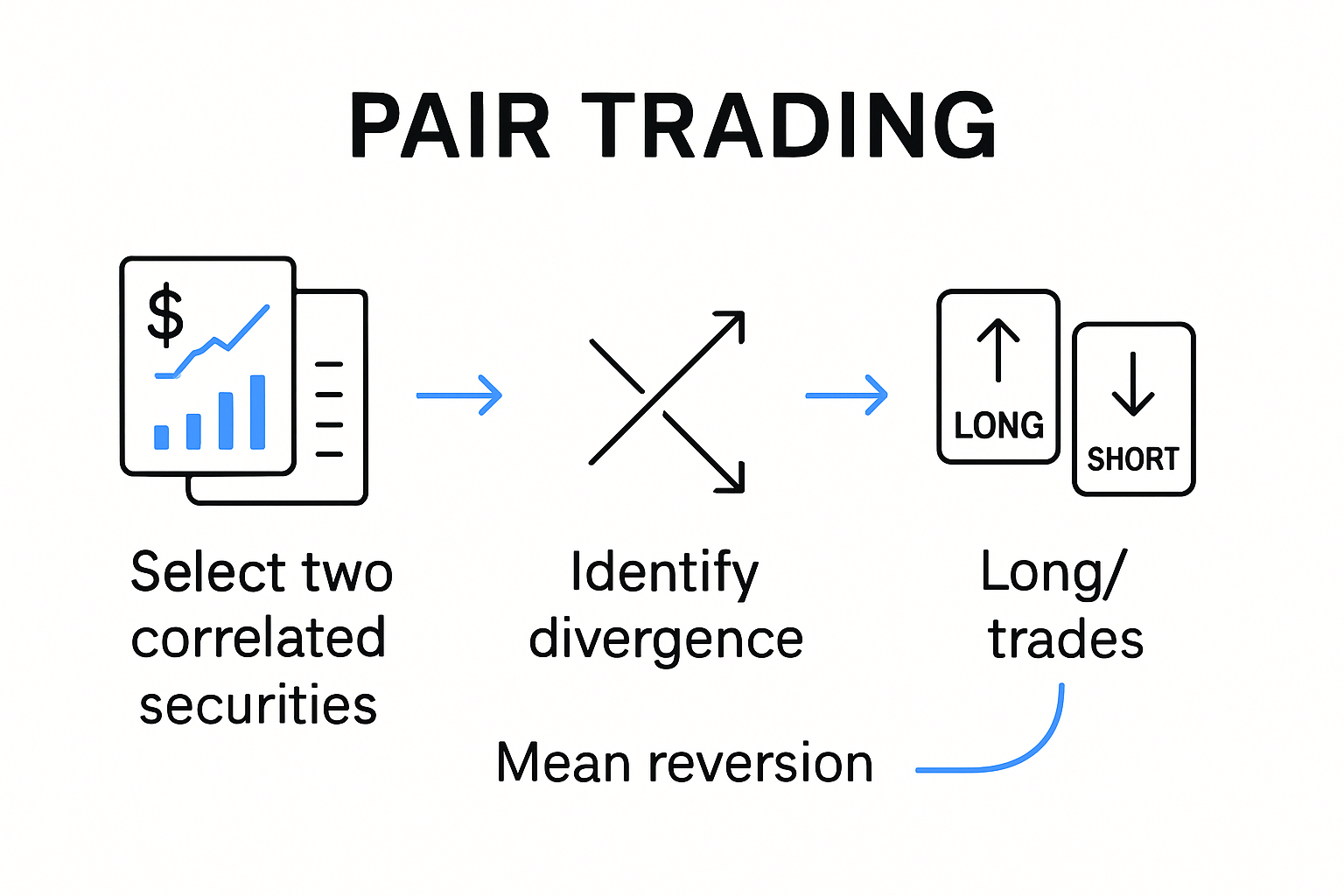
At its fundamental level, pair trading relies on the statistical relationship between two securities. Traders identify stocks or assets that have demonstrated a strong historical correlation in their price movements. The strategy operates on a critical assumption: when these historically linked securities temporarily diverge from their typical price relationship, they will eventually revert to their mean correlation.
Traders executing a pair trade will take opposing positions. If one security appears overvalued, they will short that stock while simultaneously taking a long position in the undervalued companion security. This approach creates a market-neutral position that can potentially generate profits regardless of broader market trends.
Identifying and Executing Pair Trades
Research from Britannica highlights that successful pair trading requires sophisticated statistical analysis and continuous monitoring. Traders must meticulously screen for securities that exhibit strong historical price correlations. These could be stocks within the same industry, competing companies, or even securities with similar market sensitivities.
The execution process involves several critical steps:
- Statistical Screening: Use advanced mathematical tools to identify securities with consistent price correlations
- Correlation Analysis: Examine the historical price relationship between selected securities
- Deviation Detection: Identify moments when the price relationship temporarily breaks down
- Position Establishment: Enter simultaneous long and short positions when significant deviation occurs
Modern pair trading strategies leverage advanced computational tools and algorithms to identify potential trading opportunities. These technologies enable traders to process vast amounts of market data rapidly, detecting subtle price relationship shifts that might represent profitable trading scenarios.
Key advantages of pair trading include reduced market risk, potential for consistent returns, and the ability to generate profits in both bullish and bearish market environments. However, successful implementation requires deep market knowledge, sophisticated analytical skills, and disciplined risk management.
Learn more about advanced trading techniques on our guide to market-neutral strategies.
Pair trading represents a nuanced approach to market participation. While it offers compelling potential returns, traders must understand its complexity and be prepared to continuously adapt their strategies based on evolving market dynamics.
Popular Pair Trading Strategies Explained
Pair trading strategies have evolved significantly, offering traders multiple sophisticated approaches to capitalize on market inefficiencies. Research from Scientific Direct reveals five primary techniques that traders can utilize to develop robust pair trading strategies.
Correlation-Based Pair Trading Strategy
The correlation-based strategy represents the most fundamental approach to pair trading. Traders identify securities that demonstrate historically high price correlation, typically within the same industry or sector. By analyzing statistical relationships, traders can detect potential trading opportunities when the traditional price correlation temporarily breaks down.
Key characteristics of correlation-based strategies include:
- Statistical Screening: Identifying securities with consistent historical price movements
- Correlation Coefficient Analysis: Measuring the strength of price relationships
- Deviation Monitoring: Tracking moments when price correlations diverge
This method requires continuous monitoring and sophisticated statistical tools to effectively screen and track potential trading pairs.

Cointegration-Based Pair Trading Approach
According to advanced financial research, the cointegration-based strategy represents the most sophisticated and potentially profitable pair trading technique. This approach goes beyond simple correlation, examining deeper statistical relationships between securities.
Cointegration strategies involve:
- Advanced Mathematical Modeling: Using complex statistical techniques to identify long-term price relationships
- Spread Normalization: Precisely measuring temporary price deviations
- Dynamic Position Adjustment: Continuously recalibrating trading positions based on evolving market conditions
Researchers have demonstrated that cointegration strategies can potentially generate significant returns, with some studies showing annualized mean returns exceeding 24% in historical market simulations.
Machine Learning and Algorithmic Pair Trading
Modern pair trading increasingly leverages advanced computational techniques. Machine learning algorithms can process vast amounts of market data, identifying subtle price relationship shifts that human traders might miss. These strategies incorporate multiple data points beyond traditional price information, including:
- Company financial characteristics
- Market sentiment indicators
- Macroeconomic variables
- Historical trading patterns
Explore advanced trading techniques with our comprehensive market strategies guide.
Traders must recognize that while these strategies offer compelling potential, successful implementation requires deep market knowledge, continuous learning, and disciplined risk management. Each approach carries unique advantages and challenges, demanding careful analysis and ongoing strategy refinement.
Below is a table comparing the three prominent pair trading strategies discussed above, summarizing their methodologies, strengths, and considerations.
| Strategy Type | Core Methodology | Key Advantages | Key Considerations |
|---|---|---|---|
| Correlation-Based | Uses historical price correlation; enters trades when price deviates from norm | Simple, easy to implement; identifies short-term opportunities | May miss deeper relationships; susceptible to false signals |
| Cointegration-Based | Uses advanced statistical techniques (cointegration) to model long-term equilibrium relationships | Higher potential returns; more robust to noise | Requires advanced skills; computationally intensive |
| Machine Learning & Algorithmic | Utilizes ML and big data to detect complex and subtle relationships | Can process vast data; adapts to changing conditions | Requires technology investment; interpretability risk |
How to Pick and Analyze Trading Pairs
Selecting and analyzing effective trading pairs requires a systematic and data-driven approach that goes beyond simple price correlation. Research from advanced mathematical modeling suggests a comprehensive strategy for identifying and evaluating potential pair trading opportunities.
Fundamental Criteria for Pair Selection
Successful pair trading begins with rigorous security selection. Traders must look beyond surface-level correlations and examine deeper fundamental relationships between potential trading pairs. Key selection criteria include:
- Sector Alignment: Identifying securities within the same industry or with similar market sensitivities
- Historical Price Behavior: Analyzing long-term price movement patterns
- Fundamental Comparability: Examining financial metrics such as revenue, market capitalization, and operational efficiency
- Liquidity Assessment: Ensuring both securities have sufficient trading volume to support the strategy
Traders should create a comprehensive screening process that combines quantitative and qualitative analysis. This approach helps eliminate pairs with superficial or temporary correlations.
Advanced Analytical Techniques
According to cutting-edge research, modern pair trading strategies incorporate sophisticated mathematical techniques to optimize pair selection and trading signals. These advanced methods go beyond traditional correlation analysis, utilizing:
- Time-Varying Volatility Models: Dynamically adjusting strategies based on market volatility
- Stochastic Control Techniques: Implementing mathematical frameworks to maximize expected portfolio returns
- Machine Learning Algorithms: Processing complex market data to identify subtle pair relationships
The most advanced traders leverage computational tools that can simultaneously analyze multiple data points, including historical price movements, financial statements, and broader market indicators.
Practical Implementation Strategies
Emerging research in quantitative trading demonstrates the potential of hierarchical approaches to pair selection. Traders can develop a multi-layered strategy that involves:
- Initial broad-market screening
- Detailed statistical analysis of potential pairs
- Continuous monitoring and dynamic position adjustment
Learn more about advanced trading pair techniques.
Effective pair trading requires a combination of mathematical precision, market insight, and disciplined risk management. Traders must remain adaptable, continuously refining their approach based on changing market conditions and new analytical techniques.
While the potential for consistent returns is compelling, success demands ongoing education, sophisticated analytical skills, and a willingness to embrace complex mathematical modeling techniques. The most successful pair traders view their approach as a dynamic, evolving strategy rather than a static trading method.
Below is a summary checklist table of key criteria for selecting effective trading pairs, helping traders ensure a systematic approach to screening candidates.
| Selection Criterion | Rationale/What to Look For |
|---|---|
| Sector Alignment | Pairs within same industry or with similar sensitivities |
| Historical Price Behavior | Consistent, correlated long-term trends |
| Fundamental Comparability | Similar financials (revenue, market cap, ops) |
| Liquidity Assessment | Sufficient trading volume for both securities |
| Statistical Relationship | Strong historical correlation or cointegration |
Tips to Maximize Profits and Reduce Risks
Pair trading demands strategic approaches to optimize profitability while minimizing potential losses. Research from advanced mathematical modeling suggests that meticulous parameter optimization can lead to consistent trading performance, even in volatile market conditions.
Strategic Risk Management Techniques
Effective risk management is the cornerstone of successful pair trading. Traders must implement comprehensive strategies that protect capital while maximizing potential returns. Key risk mitigation approaches include:
- Position Sizing: Carefully calculating the appropriate investment amount for each trade
- Stop-Loss Implementation: Establishing clear exit points to limit potential losses
- Diversification: Spreading investments across multiple uncorrelated pairs
- Continuous Monitoring: Regularly reassessing pair relationships and market conditions
According to empirical research, the selection of appropriate trading techniques is crucial. Traders must be prepared to adapt their strategies based on changing market dynamics and individual pair behaviors.
Profit Maximization Strategies
Successful pair trading goes beyond simple risk reduction. Traders can enhance their profit potential through sophisticated analytical approaches:
- Advanced Statistical Modeling: Utilizing complex mathematical techniques to identify optimal entry and exit points
- Machine Learning Integration: Leveraging algorithmic tools to process vast amounts of market data
- Dynamic Position Adjustment: Continuously refining trading positions based on real-time market insights
Research on diversification strategies indicates that traders can significantly reduce overall portfolio risk by carefully selecting and managing multiple trading pairs. This approach helps create a more robust and stable trading strategy.
Practical Implementation and Continuous Learning
Maximizing profits while minimizing risks requires a holistic approach to pair trading. Successful traders must:
- Develop a disciplined trading methodology
- Invest in ongoing education and skill development
- Utilize advanced technological tools
- Maintain emotional discipline
Explore advanced trading strategies for long-term success.
The most effective pair traders view their approach as a continuous learning process. They remain adaptable, constantly refining their strategies based on market conditions, new research, and personal performance analysis. While pair trading offers compelling profit potential, success requires a combination of mathematical precision, market insight, and disciplined risk management.
Ultimately, the key to maximizing profits and reducing risks lies in a comprehensive approach that balances sophisticated analytical techniques with practical, real-world implementation. Traders must be prepared to invest time, resources, and continuous effort to develop and maintain a truly effective pair trading strategy.
Frequently Asked Questions
What is pair trading?
Pair trading is a market-neutral trading strategy that involves taking long and short positions in two historically correlated securities to generate returns regardless of overall market conditions.
How do I choose the right pairs for trading?
To choose effective pairs, consider factors such as sector alignment, historical price behavior, fundamental comparability, and liquidity assessment of the securities involved.
What are the most common pair trading strategies?
The most common pair trading strategies include correlation-based strategies, cointegration-based strategies, and machine learning & algorithmic approaches that leverage advanced computational techniques for analysis.
How can I reduce risks in pair trading?
To reduce risks, implement strategic risk management techniques such as position sizing, stop-loss measures, diversification across multiple pairs, and continuous monitoring of market conditions.
Unlock the Power of Automated Pair Trading with FrankFX
Struggling to keep up with the rapid shifts and data-heavy demands of pair trading strategies? Many traders feel overwhelmed when managing advanced strategies like cointegration and machine learning. If you want to simplify the process and gain an advantage with continuous adaptation, real-time analytics, and cutting-edge automation, you are not alone. Discover a smarter path with tools designed to eliminate guesswork and help you turn complex strategies into clear results. Take the next step and explore Synthetic indices Analysis – FRANKFX TRADING ACADEMY to learn how professionals analyze and automate synthetic index trades for consistent performance.

Ready to experience trading made easy? Visit FrankFX Trading Academy now to access modern automation solutions and practical guidance. Transform your pair trading approach and start your success journey with technology that puts you one step ahead. Don’t wait—seize opportunities and build your confidence with tools trusted by serious traders.
Recommended
- 2.1 Know When to Buy or Sell a Currency Pair – FRANKFX TRADING ACADEMY
- A Profitable boom and crash strategy this year – FRANKFX TRADING ACADEMY
- What are the Major Currency Pairs – FRANKFX TRADING ACADEMY
- Forex Broker Reviews – FRANKFX TRADING ACADEMY
Article generated by BabyLoveGrowth