Technical analysis can look complicated at first. The charts, indicators, and patterns sometimes seem endless. But check this out. Over 60 percent of active traders rely on technical analysis as their main decision-making tool. That might sound like a quick path to profits, but most traders fall into the same set of avoidable mistakes—and that is where opportunity hides for those willing to look deeper.
Table of Contents
- Core Principles Of Technical Analysis Explained
- Popular Tools And Indicators For Traders
- Applying Technical Analysis In Forex And Stocks
- Common Mistakes And How To Avoid Them
Quick Summary
| Takeaway | Explanation |
|---|---|
| Understand Market Efficiency | Prices reflect all available information, aiding decision-making. |
| Identify Trends for Trading | Prices follow predictable trends based on investor behavior. |
| Apply Multiple Indicators | Combining indicators enhances market predictions. |
| Mind Psychological Factors | Emotions like fear and greed influence trading decisions. |
| Practice Effective Risk Management | Strict rules protect capital and ensure long-term success. |
 |
Core Principles of Technical Analysis Explained
Technical analysis represents a strategic approach to understanding market movements by examining historical price data and trading volumes. Traders and investors utilize this method to predict future price behaviors based on carefully analyzed patterns and statistical trends.
The Fundamental Assumptions of Market Behavior
At its core, technical analysis rests on three critical assumptions that guide traders’ decision making processes. The CFA Institute outlines these foundational principles with remarkable clarity.
First, markets are considered to be inherently efficient, meaning all available information is already reflected in current price levels. This implies that stock prices instantly incorporate public knowledge, company reports, economic indicators, and market sentiment. Traders assume that current pricing represents the most accurate snapshot of a security’s true value at any given moment.
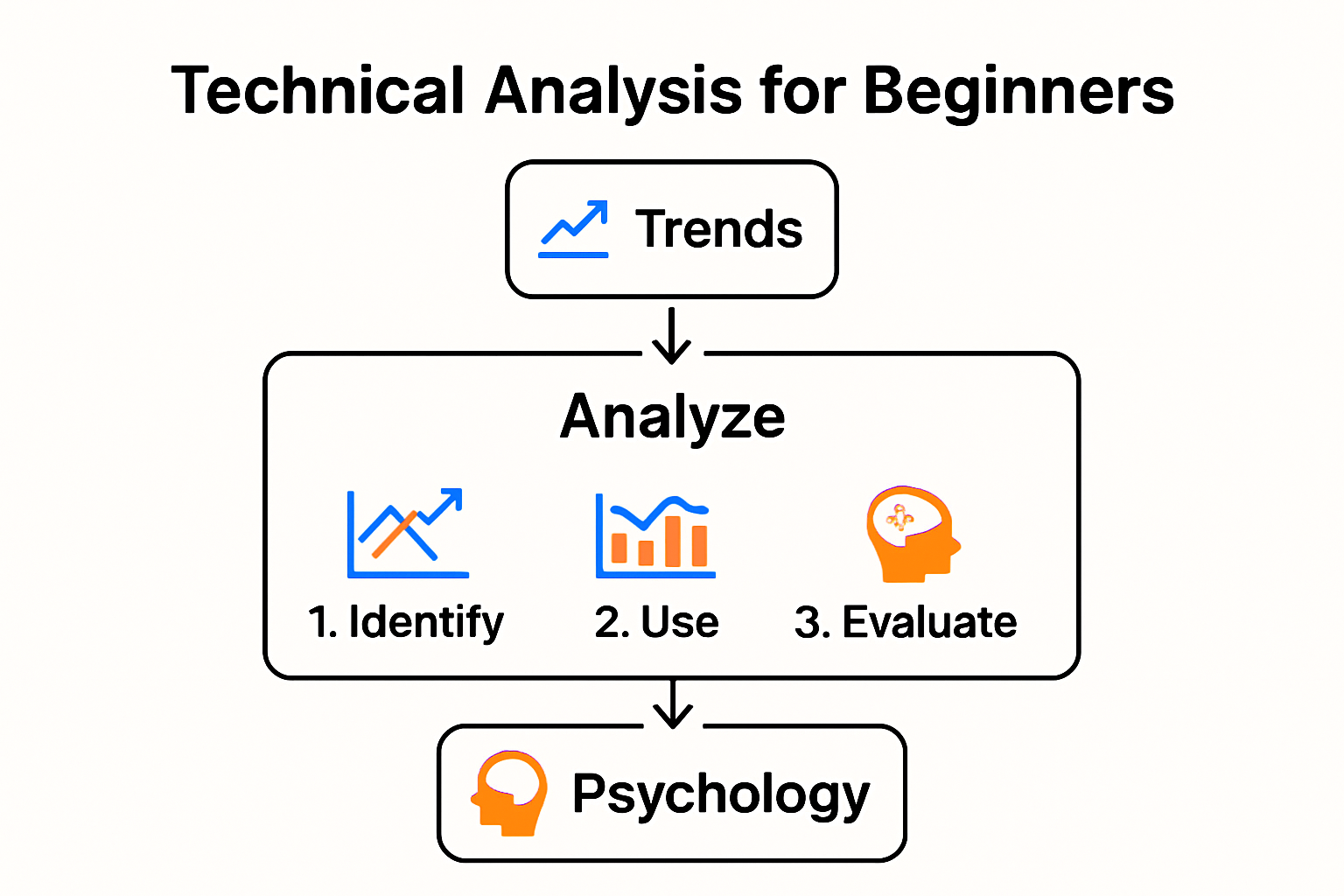
Second, prices tend to move in identifiable trends. Whether short term or long term, these trends represent collective investor behavior and psychological patterns. Technical analysts believe that prices do not move randomly but follow recognizable directional movements that can be anticipated and strategically leveraged.
Third, historical price patterns demonstrate a tendency to repeat. This principle suggests that human psychology remains consistent across market cycles, causing investors to react similarly under comparable circumstances. Wikipedia confirms that investor collective behavior creates predictable patterns which skilled analysts can recognize and interpret.
To clarify the three core assumptions of technical analysis, the following table provides a summary for easy reference:
| Assumption | Description |
|---|---|
| Market Efficiency | All current prices reflect all publicly available information. |
| Existence of Trends | Prices move in identifiable, non-random trends reflecting investor behavior and psychology. |
| Repetitive Price Patterns | Historical price patterns recur due to consistent human psychology across market cycles. |
Key Analytical Tools and Techniques
Technical analysts employ various tools to decode market movements. These include chart patterns, trend lines, moving averages, and momentum indicators. Each tool provides unique insights into potential future price actions by examining past performance.
Chart patterns like head and shoulders, triangles, and double tops offer visual representations of market psychology. Trend lines help traders identify support and resistance levels, showing where prices might potentially reverse or continue their current trajectory. Moving averages smooth out price fluctuations, revealing underlying trends by averaging prices over specific time periods.
Momentum indicators such as Relative Strength Index (RSI) and Moving Average Convergence Divergence (MACD) help traders understand the strength and potential sustainability of current price movements. These tools measure the speed and magnitude of recent price changes, providing crucial insights into potential trend reversals or continuations.

Psychological Foundations of Market Analysis
Beyond mathematical calculations, technical analysis deeply acknowledges the psychological aspects driving market movements. Traders recognize that human emotions like fear, greed, and hope significantly influence investment decisions. By understanding these psychological undercurrents, analysts can better predict potential market reactions.
Self repeating trading strategies emerge from consistent behavioral patterns. Investors tend to react similarly under comparable market conditions, creating predictable cycles of buying and selling that technical analysts can strategically anticipate.
Ultimately, technical analysis transforms complex market data into actionable insights. By combining statistical analysis, pattern recognition, and psychological understanding, traders develop a comprehensive approach to navigating financial markets with increased confidence and strategic precision.
Popular Tools and Indicators for Traders
Technical analysis relies on a diverse array of sophisticated tools and indicators that help traders decode market movements and make informed investment decisions. These analytical instruments transform raw market data into actionable insights, enabling traders to identify potential trends, momentum shifts, and trading opportunities.
Trend-Following Indicators
Investopedia highlights that trend-following indicators are crucial for understanding market direction. Moving averages stand out as one of the most widely used tools in this category. Simple Moving Average (SMA) and Exponential Moving Average (EMA) help traders smooth out price fluctuations and identify underlying market trends.
The Moving Average Convergence Divergence (MACD) represents another powerful trend-following indicator. This tool measures the relationship between two moving averages of a security’s price, providing insights into potential trend changes and momentum. Research from arxiv.org suggests that combining MACD with other momentum indicators can significantly improve trading performance and risk-adjusted returns.
Traders often use trend lines to complement these indicators, drawing visual representations of price movements that help identify potential support and resistance levels. These lines connect significant price points, revealing the market’s directional bias and potential reversal points.
Momentum and Volatility Indicators
Britannica categorizes momentum indicators as essential tools for understanding market strength and potential trend reversals. The Relative Strength Index (RSI) emerges as a key instrument in this category. RSI measures the magnitude of recent price changes to evaluate overbought or oversold conditions, helping traders anticipate potential price corrections.
Volatility indicators provide crucial information about market fluctuations. Bollinger Bands stand out as a premier tool, displaying price volatility through three lines that adjust dynamically based on market conditions. The width of these bands indicates the level of market volatility, with wider bands suggesting increased price uncertainty.
The Average True Range (ATR) offers another perspective on market volatility, measuring price fluctuations and helping traders set appropriate stop-loss and take-profit levels. This indicator is particularly valuable for managing risk in unpredictable market environments.
Volume and Advanced Trading Indicators
Volume indicators provide critical insights into the strength behind price movements. The Money Flow Index (MFI) combines price and volume data to measure buying and selling pressure. High volume during price movements suggests stronger market sentiment and more reliable trend signals.
Learn advanced trading techniques that integrate multiple indicators for comprehensive market analysis. Professional traders often use a combination of these tools to create more robust trading strategies, reducing reliance on any single indicator.
Stochastic oscillators represent another advanced tool, comparing a security’s closing price to its price range over a specific period. These indicators help traders identify potential trend reversals and momentum shifts by highlighting overbought and oversold conditions.
Understanding and effectively utilizing these technical analysis tools requires practice and continuous learning. While no single indicator guarantees success, a comprehensive approach that combines multiple indicators can significantly enhance a trader’s ability to make informed decisions in complex market environments.
To help clarify the differences and purposes of commonly used technical indicators, the following table summarizes key types, examples, and their main uses:
| Indicator Type | Example(s) | Main Purpose |
|---|---|---|
| Trend-Following | SMA, EMA, MACD, Trend Lines | Identify and confirm market direction |
| Momentum | RSI, MACD | Assess strength or weakness of price movements (overbought/oversold) |
| Volatility | Bollinger Bands, ATR | Measure price fluctuation and risk |
| Volume | Money Flow Index (MFI) | Analyze buying/selling pressure behind price moves |
| Oscillators | Stochastic Oscillator | Detect potential trend reversals and momentum shifts |
Applying Technical Analysis in Forex and Stocks
Technical analysis serves as a powerful approach for traders navigating both forex and stock markets, offering strategic insights into price movements and potential trading opportunities. While the fundamental principles remain consistent, the application of technical analysis varies between different financial markets.
Forex Market Technical Analysis Strategies
Forex markets present unique challenges and opportunities for technical analysis. Currency pairs exhibit distinct characteristics that require nuanced analytical approaches. Research from the Securities & Exchange Commission emphasizes the importance of understanding market psychology when applying technical tools to currency trading.
Traders typically focus on several key aspects when applying technical analysis in forex. Trend identification becomes crucial, with traders using moving averages and trend lines to determine overall market direction. Short-term and long-term trends provide critical insights into potential entry and exit points for currency trades.
Volatility indicators play a significant role in forex technical analysis. The Average True Range (ATR) helps traders measure price fluctuations and set appropriate stop-loss levels. This becomes especially important in forex markets, where currency pairs can experience rapid price movements driven by global economic events.
Stock Market Technical Analysis Approaches
A comprehensive review on technical analysis highlights the complexity of applying technical tools to stock markets. Unlike forex, stock markets require deeper fundamental analysis alongside technical indicators.
Chart patterns become particularly important in stock trading. Head and shoulders, double tops, and triangle formations provide visual representations of potential price movements. Traders use these patterns to anticipate trend reversals and make informed trading decisions.
Momentum indicators like Relative Strength Index (RSI) and Moving Average Convergence Divergence (MACD) prove especially valuable in stock markets. Advanced trading techniques often combine multiple indicators to create more robust trading strategies.
Cross-Market Technical Analysis Considerations
Sophisticated traders recognize that technical analysis requires adaptability across different markets. The arxiv.org research suggests that combining multiple momentum indicators can significantly improve trading performance and risk-adjusted returns.
Key considerations for cross-market technical analysis include:
- Understanding unique market characteristics
- Adapting indicator settings to specific market conditions
- Considering broader economic factors that influence price movements
- Maintaining flexible analytical approaches
Risk management remains critical when applying technical analysis. No single indicator guarantees success, and traders must develop comprehensive strategies that incorporate multiple analytical tools.
Successful technical analysis requires continuous learning and adaptation. Markets evolve constantly, and traders must remain flexible, continuously refining their analytical approaches to stay competitive in dynamic financial environments.
Common Mistakes and How to Avoid Them
Technical analysis offers powerful insights for traders, but numerous pitfalls can undermine even the most sophisticated strategies. Understanding and avoiding these common mistakes becomes crucial for maintaining consistent trading performance and protecting investment capital.
Cognitive Biases in Trading Decision Making
LinkedIn research reveals that cognitive biases significantly impact trading decisions. Confirmation bias stands out as a particularly dangerous psychological trap where traders actively seek information that supports their existing beliefs while dismissing contradictory evidence.
Recency bias represents another critical cognitive challenge. Traders often give disproportionate weight to recent market events, assuming that short-term trends will continue indefinitely. This approach can lead to hasty and poorly considered trading decisions that deviate from sound analytical principles.
Overconfidence emerges as a pervasive issue in technical analysis. Nasdaq experts caution that traders frequently believe past market movements were more predictable than they actually were, creating a dangerous illusion of expertise that can result in significant financial losses.
The table below summarizes several common cognitive biases traders face, along with their effects on decision making:
| Cognitive Bias | Description | Potential Effect on Trading |
|---|---|---|
| Confirmation Bias | Seeking evidence that supports existing beliefs, ignoring counter-evidence | Reinforces poor strategies, missed risks |
| Recency Bias | Overweighting recent events over historical patterns | Hasty, short-sighted decisions |
| Overconfidence | Believing one’s analysis is more accurate than it really is | Excessive risk-taking, financial losses |
Indicator and Strategy Misapplication
New Trader U highlights the risks of overrelying on technical indicators. Moving averages, while valuable in trending markets, can become ineffective during volatile or range-bound market conditions. Traders must understand that no single indicator provides a guaranteed prediction of market movements.
Common mistakes in indicator usage include:
- Overcomplicating Analysis: Using too many indicators simultaneously
- Ignoring Market Context: Applying indicators without considering broader economic factors
- Rigid Interpretation: Treating indicator signals as absolute rather than probabilistic
Successful traders learn to combine multiple indicators and maintain flexibility in their analytical approach. They recognize that technical analysis is more art than exact science, requiring continuous adaptation and critical thinking.
Risk Management and Emotional Discipline
Perhaps the most critical mistake traders make involves poor risk management and emotional decision making. Learn advanced risk mitigation strategies to protect your investment capital and maintain consistent performance.
Key risk management principles include:
- Setting strict stop-loss orders
- Never risking more than a small percentage of total capital on a single trade
- Maintaining emotional detachment from individual trading outcomes
- Developing a consistent, rule-based trading strategy
Emotional discipline separates successful traders from unsuccessful ones. Fear and greed can lead to impulsive decisions that deviate from carefully developed trading plans. Professional traders cultivate a systematic approach that prioritizes objective analysis over emotional reactions.
Ultimately, mastering technical analysis requires continuous learning, self-awareness, and a willingness to challenge personal biases. Traders who approach the market with humility, adaptability, and a commitment to ongoing education are most likely to achieve long-term success in the complex world of financial trading.
Frequently Asked Questions
What is technical analysis?
Technical analysis is a method used by traders and investors to evaluate and predict price movements in financial markets by analyzing historical price data and trading volumes.
How do traders use technical analysis?
Traders use technical analysis to identify trends, patterns, and potential price movements. They employ various tools and indicators, such as moving averages and momentum indicators, to make informed trading decisions.
What are some common mistakes in technical analysis?
Common mistakes include over-reliance on a single indicator, ignoring broader market conditions, and allowing cognitive biases, such as confirmation bias and recency bias, to influence trading decisions.
How can I improve my technical analysis skills?
To improve your technical analysis skills, practice using different indicators, stay updated on market trends, study chart patterns, and continuously learn through courses and trading resources.
Turn Your Technical Analysis Skills into Profitable Trading Results
Struggling to move from chart analysis to consistent trading profits? You are not alone. Many traders understand technical indicators and price patterns, yet still face losses due to cognitive biases, emotional trading, and using tools in the wrong market context. If you want to overcome these barriers and make your technical skills work for you, start by exploring proven strategies and expert resources in our Synthetic indices Analysis – FRANKFX TRADING ACADEMY section.
Elevate your trading confidence today. At FRANKFX TRADING ACADEMY, we make trading easy with practical guides and automation tools that help you avoid common mistakes discussed in this guide. Visit now to access strategies tailored to your needs and take your next step toward lasting trading success.
Recommended
- A Profitable boom and crash strategy this year – FRANKFX TRADING ACADEMY
- The Different Types of Forex Analysis To Know – FRANKFX TRADING ACADEMY
- Boom And Crash Indicator Mt5 – FRANKFX TRADING ACADEMY
- How to Read Boom and Crash Chart – FRANKFX TRADING ACADEMY
Article generated by BabyLoveGrowth