Forex trading never slows down. The market stays open 24 hours a day, moving more than $6.6 trillion every single day. You might think constant access means non-stop opportunity, but most hours are actually quiet and unremarkable. The real action only happens when global market sessions overlap, and that makes timing your trades even more powerful than picking the right currency pair.
Table of Contents
- Understanding Forex Market Open Time
- Major Forex Trading Sessions Explained
- Best Times To Trade For Different Markets
- Tips For Beginners And Experienced Traders
Quick Summary
| Takeaway | Explanation |
|---|---|
| Trade during session overlaps for higher liquidity | The London-New York overlap from 8:00 AM to 12:00 PM Eastern is ideal for trading due to increased volatility and tighter spreads. |
| Focus on major currency pairs’ peak times | EUR/USD is most active during the London-New York overlap, while AUD/JPY thrives during the Asian session. |
| Stay aware of economic events for trading impact | Economic announcements can significantly influence currency values, so align trading with key reports, like Non-Farm Payrolls, for better outcomes. |
| Implement strict risk management strategies | Limit risk to 1-2% of your capital per trade to protect against significant losses and sustain trading over the long term. |
| Continuously learn and adapt your strategies | Stay updated with market trends and historical performance to refine trading strategies and maintain an edge in the dynamic forex market. |
Understanding Forex Market Open Time
Forex trading operates as a complex global network where currency markets function across different time zones, creating unique opportunities and challenges for traders worldwide. Understanding forex market open time is crucial for developing a strategic approach to trading that maximizes potential profit windows and minimizes unnecessary risk.
Global Market Sessions and Timing Dynamics
The forex market operates in four primary trading sessions: the Sydney session, Tokyo session, London session, and New York session. These sessions overlap at different times, creating periods of heightened trading activity and liquidity. According to FXCM, each session represents a specific geographical region and has distinct characteristics that impact trading strategies.
Traders must recognize that not all hours are created equal. The most volatile and liquid periods occur during session overlaps, particularly when the London and New York sessions intersect. During these windows, trading volume surges, spreads typically narrow, and price movements become more pronounced. This makes these timeframes especially attractive for traders seeking active market conditions.
Strategic Timing Considerations
Successful forex trading requires more than just understanding when markets are open. Traders need to consider economic calendar events, potential news releases, and the specific currency pairs they intend to trade. The Bank for International Settlements reports that certain currency pairs exhibit dramatically different behaviors depending on the active trading session.
For instance, EUR/USD trades will experience maximum liquidity during the London and New York session overlap, while AUD/JPY might show more interesting movements during the Asian market hours. Professional traders often adjust their strategies to align with these session-specific characteristics, using timing as a critical component of their overall trading approach.
Understanding forex market open time is not just about knowing clock times. It involves comprehending the nuanced interactions between global financial centers, recognizing high-probability trading windows, and developing a disciplined approach that respects market rhythms and volatility patterns. By mastering these temporal dynamics, traders can significantly enhance their potential for successful trading outcomes.
Major Forex Trading Sessions Explained
Forex trading is a global phenomenon that operates across multiple time zones, with distinct trading sessions representing different financial centers worldwide. Understanding these major forex trading sessions is essential for traders seeking to optimize their strategies and capitalize on market dynamics.
The Four Primary Global Trading Sessions
According to Investopedia, the forex market comprises four primary trading sessions: Sydney, Tokyo, London, and New York. Each session represents a major financial hub with unique characteristics that significantly impact global currency trading. The continuous nature of these sessions means that when one market closes, another opens, creating a 24-hour trading environment.
The Sydney session typically kicks off the global trading day, operating from 5:00 PM to 2:00 AM Eastern Time. This session is characterized by relatively lower trading volumes but sets the initial market sentiment for currency pairs involving the Australian and New Zealand dollars. As the Sydney session winds down, the Tokyo session begins, bringing increased activity for Asian currency markets and providing insights into regional economic conditions.
To help traders understand when the forex market is most active, the table below summarizes the four primary global trading sessions, their operating hours (Eastern Time), and notable characteristics for each session.
| Session | Open (ET) | Close (ET) | Key Characteristics |
|---|---|---|---|
| Sydney | 5:00 PM | 2:00 AM | Low volume; sets tone for AUD & NZD pairs |
| Tokyo | 7:00 PM | 4:00 AM | Focus on JPY pairs; increased Asian market activity |
| London | 3:00 AM | 12:00 PM | High volatility; peak EUR, GBP, and CHF trading |
| New York | 8:00 AM | 5:00 PM | Major USD movement; overlaps with London for 4 hours |
Session Overlaps and Market Volatility
The Wikipedia entry on foreign exchange markets highlights the critical importance of session overlaps. These periods represent the most dynamic trading windows, where multiple financial centers are simultaneously active. The most significant overlap occurs between the London and New York sessions, typically from 8:00 AM to 12:00 PM Eastern Time. During these hours, trading volumes surge, liquidity increases, and price movements become more pronounced.
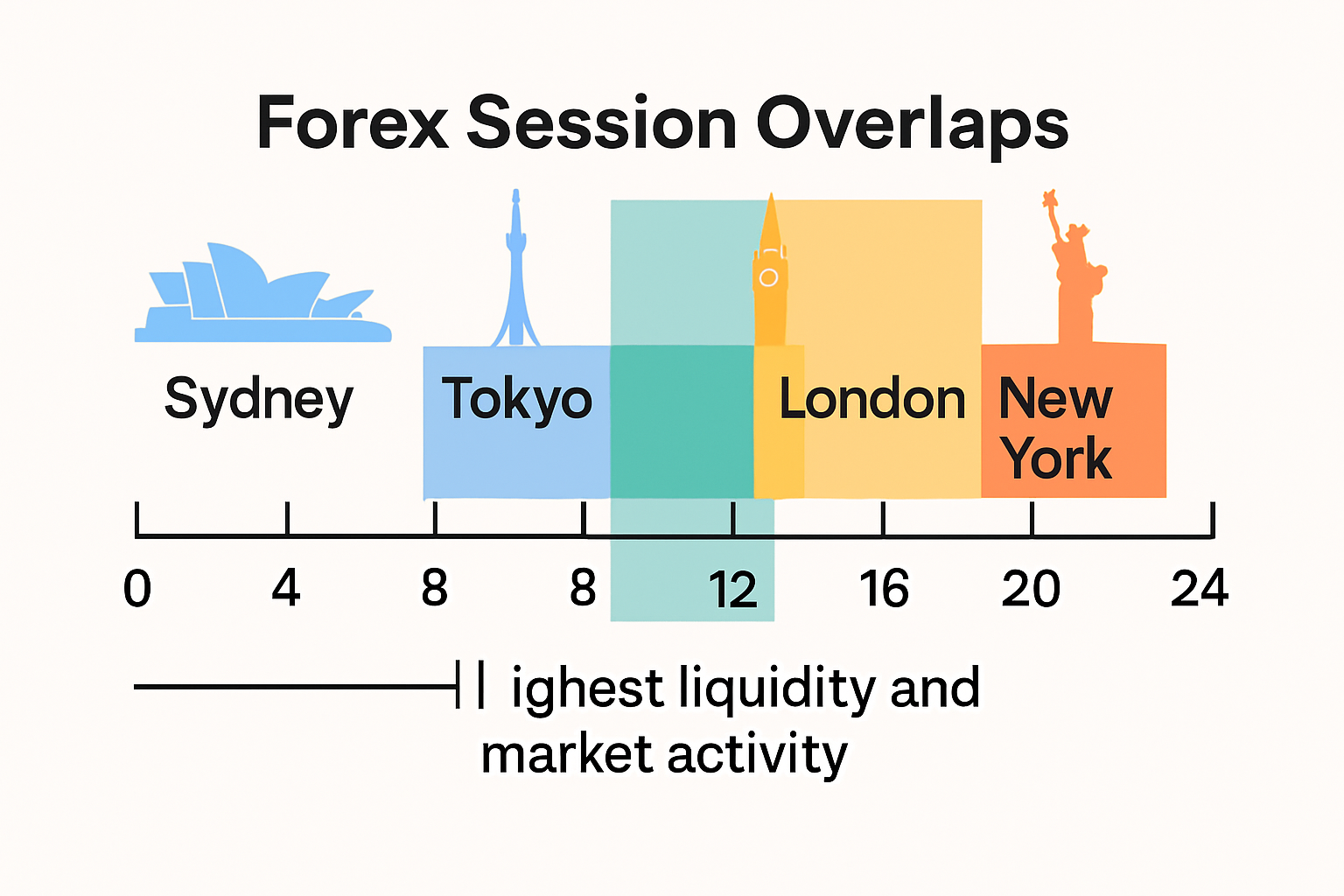
Traders often view these overlap periods as prime opportunities for executing trades. The London-New York overlap is particularly attractive because it combines the substantial liquidity of the European markets with the economic activity of North American traders. Currency pairs like EUR/USD and GBP/USD experience maximum volatility and tightest spreads during these hours, making them especially appealing to both day traders and short-term trading strategies.
Strategic Implications for Forex Traders
Mastering the nuances of forex trading sessions requires more than simply knowing their operational hours. Successful traders develop a deep understanding of each session’s unique characteristics, including typical price movements, liquidity levels, and potential economic announcements. The interplay between these sessions creates a complex ecosystem where timing can be as crucial as technical analysis.
Each trading session brings its own set of opportunities and challenges. The Tokyo session might offer subtle movements in Asian currency pairs, while the London session typically sees significant activity in European markets. The New York session often responds to overnight developments and sets the tone for potential global market trends. By comprehending these distinctions, traders can develop more sophisticated and adaptable trading strategies that leverage the continuous global nature of the forex market.
Best Times to Trade for Different Markets
Successful forex trading demands a nuanced understanding of market timing specific to different currency pairs and trading instruments. Traders who strategically align their activities with optimal market hours can significantly enhance their potential for profitable trades.
Major Currency Pair Trading Windows
According to FXCM, different currency pairs demonstrate distinct trading characteristics based on their associated market sessions. The EUR/USD pair, for example, experiences peak liquidity during the London and New York session overlap, typically between 8:00 AM and 12:00 PM Eastern Time. During these hours, traders can expect tighter spreads and more significant price movements.
AUD/JPY trades show heightened activity during the Asian market hours, when both the Australian and Japanese markets are simultaneously active. Traders focusing on this pair should pay close attention to the Tokyo session, which runs from 7:00 PM to 4:00 AM Eastern Time. The GBP/USD pair demonstrates maximum volatility during the London session, reflecting the United Kingdom’s significant role in global forex markets.
The table below compares major currency pairs, highlighting their most active trading windows and the most influential market sessions for each. This can help traders align their strategies with periods of highest liquidity and volatility.
| Currency Pair | Most Active Trading Window (ET) | Most Influential Session(s) |
|---|---|---|
| EUR/USD | 8:00 AM – 12:00 PM | London/New York Overlap |
| GBP/USD | 3:00 AM – 12:00 PM | London |
| AUD/JPY | 7:00 PM – 4:00 AM | Tokyo/Asian |
Economic Event Considerations
The Bank for International Settlements emphasizes that trading times are not just about market sessions but also critical economic announcements. Major economic indicators like employment reports, interest rate decisions, and GDP announcements can dramatically impact currency valuations. Traders should be particularly cautious and strategic around these events.
For instance, US Non-Farm Payroll reports released on the first Friday of each month can cause substantial market movements. Similarly, European Central Bank monetary policy statements and Federal Reserve announcements create significant trading opportunities. Experienced traders often adjust their strategies to either capitalize on or avoid trading during these high-impact economic events.
Strategic Timing for Different Trading Styles
Trading strategies vary significantly based on a trader’s approach and market timing. Day traders typically seek the most volatile periods with high liquidity, making the London-New York overlap their preferred trading window. Swing traders might prefer slightly less volatile periods where trends can develop more steadily.
Scalpers require extremely liquid markets with minimal spread differences, making the major session overlaps ideal for their rapid trading approach. Long-term position traders, conversely, might be less concerned with specific trading hours and more focused on broader economic trends and fundamental analysis.
Ultimately, successful forex trading requires a comprehensive understanding of market dynamics, session characteristics, and individual trading goals. By carefully selecting trading times that align with specific currency pairs and personal trading strategies, traders can optimize their potential for successful market engagement.
Tips for Beginners and Experienced Traders
Forex trading presents a complex landscape where success depends on strategic knowledge, disciplined approach, and continuous learning. Whether you are a novice or an experienced trader, understanding key principles can significantly enhance your trading performance and minimize potential risks.
Building a Solid Foundation
According to Investopedia, successful forex trading begins with comprehensive market education. Beginners should focus on understanding fundamental market mechanics, including how different trading sessions impact currency movements. Developing a robust educational foundation involves studying market analysis techniques, learning technical indicators, and comprehending economic factors that influence currency valuations.
Experienced traders recommend starting with a demo account to practice trading strategies without financial risk. These simulated environments allow traders to test different approaches, understand market dynamics, and build confidence before committing real capital. Forex.com suggests that traders should spend at least three to six months practicing in a simulated environment to develop consistent trading skills.
Risk Management Strategies
Effective risk management is crucial for traders at all levels. Professional traders typically recommend never risking more than 1-2% of your total trading capital on a single trade. This approach helps protect against significant losses and ensures long-term trading sustainability. Implementing stop-loss orders, diversifying trading positions, and maintaining a disciplined approach to capital allocation are essential strategies.
Advanced traders often use sophisticated risk management techniques like position sizing, correlation analysis, and advanced hedging strategies. These methods help mitigate potential losses and create more stable trading portfolios. Understanding the correlation between different currency pairs and global economic indicators can provide traders with a significant competitive advantage.
Continuous Learning and Adaptation
The forex market is dynamic and constantly evolving. Successful traders must commit to continuous learning and stay updated on global economic trends. This involves regularly reading financial news, analyzing market reports, and understanding geopolitical events that might impact currency movements.
Technology plays a crucial role in modern forex trading. Utilizing advanced charting tools, real-time market analysis platforms, and automated trading systems can help traders make more informed decisions. However, technology should complement, not replace, fundamental market understanding and personal trading judgment.
Experienced traders emphasize the importance of maintaining emotional discipline. Developing a consistent trading psychology that manages fear and greed is often more critical than technical skills. This involves creating a structured trading plan, setting realistic expectations, and maintaining a long-term perspective that focuses on consistent performance rather than short-term gains.
Ultimately, successful forex trading is a journey of continuous improvement. By combining solid educational foundations, disciplined risk management, technological tools, and emotional intelligence, traders can develop strategies that adapt to the ever-changing global financial landscape.
Frequently Asked Questions
What are the best hours to trade in the forex market?
The best hours to trade in the forex market are during session overlaps, particularly the London-New York overlap from 8:00 AM to 12:00 PM Eastern Time, which offers higher liquidity and volatility.
How do different trading sessions impact forex trading?
Different trading sessions, such as Sydney, Tokyo, London, and New York, have unique characteristics that affect market activity. The London session is known for high volatility, while the Tokyo session is more active for JPY pairs.
Which currency pairs are most active during specific trading sessions?
Currency pairs like EUR/USD are most active during the London-New York overlap, while AUD/JPY experiences heightened activity during the Tokyo session. GBP/USD tends to see maximum volatility in the London session.
Why is it important to consider economic events when trading forex?
Economic events, such as employment reports and interest rate announcements, can significantly impact currency valuations. Traders should align their strategies with these events to capitalize on potential market movements.
Trade Smarter: Maximize Your Trading Hours With FrankFX
Trying to catch the best forex trading window can feel overwhelming. This article highlighted how session timing, liquidity, and volatility can make or break your trades. Yet, knowing the best time to trade is just the beginning. Many traders struggle to react quickly to fast market changes or miss out on clear signals during those key overlap hours. The true challenge is having accurate strategies and automated support so you can take action during the highest potential sessions.
With FrankFX, you do not have to guess when or how to trade. Gain instant access to real-time forex signals, daily analysis, and automated tools designed specifically for the session overlaps and volatile windows discussed in the article. Join our VIP mentorship or tap into our free forex calculators and indicators to fine-tune your trading around the clock. Start now and let FrankFX help you master both timing and execution so you never miss your next best trade.