Figuring out the right lot size in forex trading is where plans quickly turn into reality. Most traders have heard that risking just 1-2 percent of your account per trade protects you from big losses, and that sounds simple enough. But the real surprise is this—getting one small input wrong in your calculation can throw your entire risk strategy out the window. Unlocking the full power of lot size calculators means knowing which details truly matter—and why your preparation might be the only thing standing between disciplined gains and reckless losses.
Table of Contents
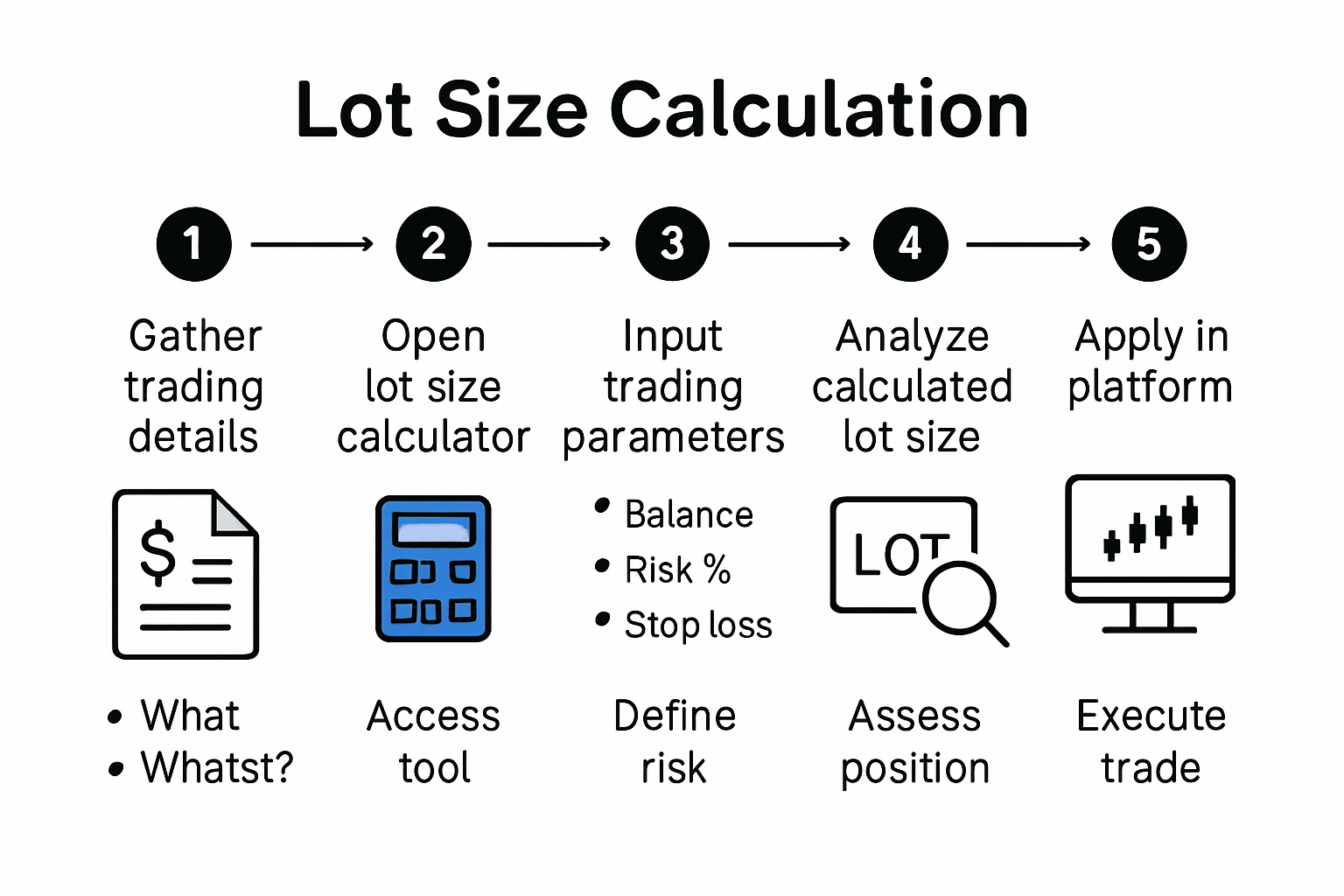
- Step 1: Gather Your Trading Details
- Step 2: Open Up a Lot Size Calculator Tool
- Step 3: Input Your Trading Parameters
- Step 4: Analyze The Calculated Lot Size
- Step 5: Apply The Calculated Lot Size In Your Trades
Quick Summary
| Key Point | Explanation |
|---|---|
| 1. Gather Trading Details First | Ensure you have current account balance and risk tolerance documented before trading. |
| 2. Choose a Reliable Lot Size Calculator | Use online calculators that allow input of key parameters for accurate trade size recommendations. |
| 3. Input Precise Trading Parameters | Enter exact account balance, stop loss distance, and risk percentage into the calculator for accuracy. |
| 4. Analyze Your Calculated Lot Size Carefully | Evaluate the recommended lot size against your risk management strategy and market conditions. |
| 5. Apply Calculated Lot Size Diligently | Execute trades using the precise lot size from your calculations while substituting for market fluctuations if needed. |
Step 1: Gather Your Trading Details
Successful forex trading begins with meticulous preparation, and gathering your trading details is the critical first step in calculating your lot size accurately. Before you start using a lot size calculator, you need to compile several key pieces of information that will determine your precise trading parameters.
Begin by identifying your total trading account balance, which serves as the foundational element for determining risk and position sizing. Your account balance represents the total capital you have available for trading, and it will directly influence how much you can safely invest in each trade. Take time to review your most current account statement and confirm the exact amount, ensuring you’re working with the most recent financial data.
Next, you’ll want to determine your personal risk tolerance, which is a crucial component of responsible trading strategy. This involves deciding what percentage of your total account you’re willing to risk on a single trade. Professional traders typically recommend risking no more than 1-2% of your total account balance per trade. For example, if you have a $10,000 account and choose a 1% risk profile, you would limit your potential loss to $100 per trade.
Your specific trading instrument also plays a significant role in lot size calculation. Different currency pairs and trading instruments have unique characteristics that impact your risk management approach. Some pairs exhibit higher volatility, which might require more conservative lot sizing, while others might provide more stable trading conditions.
Learn the fundamentals of forex trading to understand how these nuanced details interconnect and influence your overall trading strategy. By meticulously gathering these details, you’re setting a strong foundation for precise lot size calculation and risk management.
To verify you’ve completed this step successfully, check that you have clearly documented:
- Your total trading account balance
- Your predetermined risk percentage
- The specific trading instrument you’ll be analyzing
These preparatory steps transform lot size calculation from a guessing game into a strategic, data-driven process that protects your capital and maximizes your trading potential.
To help you stay organized and ensure you’ve completed all necessary preparations before calculating your lot size, use the following checklist table to verify that each key requirement is thoroughly documented.
| Preparation Item | Description | Status (✓/✗) |
|---|---|---|
| Trading Account Balance | Most current total available for trading | |
| Predetermined Risk Percentage | Percentage of account willing to risk per trade (recommended 1-2%) | |
| Selected Trading Instrument (Currency Pair) | Specific currency pair or instrument you plan to trade | |
| Stop Loss Distance in Pips | Number of pips at which you will exit a losing trade | |
| Current Exchange Rate | Market price of the selected currency pair | |
| Trading Platform/Calculator Access | Link or log-in access to reliable lot size calculator |
Step 2: Open Up a Lot Size Calculator Tool
With your trading details prepared, the next crucial step is selecting and accessing a reliable lot size calculator tool that will transform your raw financial data into actionable trading insights. The right calculator becomes your strategic partner in managing risk and optimizing trade potential.
Look for an online lot size calculator that offers comprehensive features and user-friendly interface. Professional trading platforms and specialized forex websites typically provide these tools for free. When choosing your calculator, prioritize platforms that allow you to input multiple parameters such as account balance, risk percentage, stop loss distance, and currency pair details. Some advanced calculators even integrate real-time market data to provide more precise calculations.
Begin by launching your preferred web browser and navigating to a reputable forex trading resource. Most professional trading platforms like MetaTrader, TradingView, and specialized forex websites offer built-in lot size calculators. Pay close attention to the tool’s input fields, ensuring they align with the trading details you meticulously gathered in the previous step. Input accuracy is paramount – even a small miscalculation can significantly impact your trading risk management strategy.
When inputting your data, be methodical and double-check each value. Your lot size calculator will typically require specific information including:
- Total account balance
- Percentage of account willing to risk
- Stop loss distance in pips
- Current currency pair exchange rate
Discover advanced trading strategies that complement precise lot size calculation and enhance your overall trading approach. The calculator transforms complex mathematical computations into a simple, actionable recommendation, taking the guesswork out of position sizing.
To verify you’ve successfully completed this step, confirm that your lot size calculator has generated a clear, specific lot size recommendation based on your input parameters. The result should provide a precise trade size that aligns with your predetermined risk tolerance, helping you maintain disciplined and strategic trading practices.
Step 3: Input Your Trading Parameters
Inputting your trading parameters is the precision point where your trading strategy transforms from theoretical planning to actionable calculation. This critical step requires careful attention to detail and a methodical approach to ensure accurate lot size determination.
Begin by carefully entering your total account balance into the lot size calculator. This figure represents the foundation of your risk management strategy. Use the most current balance from your trading account, avoiding rounded estimates that could introduce calculation errors. Precision matters – even a small discrepancy can meaningfully impact your potential trade risk and position sizing.
Stop loss distance represents another crucial parameter that demands your full concentration. This value represents the number of pips you are willing to risk on a single trade before exiting the position. Measure this distance carefully, considering both your risk tolerance and the specific characteristics of the currency pair you’re trading. Professional traders often recommend setting stop loss levels based on technical analysis indicators like support and resistance levels or average true range measurements.
When entering your risk percentage, be conservative and strategic. Most experienced traders suggest risking no more than 1-2% of your total account balance on any single trade. This approach provides a buffer against potential losses and helps preserve your trading capital during challenging market conditions. Your chosen risk percentage will directly influence the calculated lot size, making it a critical input in the lot size calculation process.
Explore advanced risk management techniques to complement your lot size calculation strategy and enhance your overall trading approach. Understanding how each parameter interacts can significantly improve your trading precision.
Your verification checklist should confirm you have accurately input:
- Exact account balance
- Precise stop loss distance in pips
- Carefully selected risk percentage
- Specific currency pair details
By meticulously entering these parameters, you transform raw financial data into a strategic trading recommendation that aligns perfectly with your risk management goals.
Step 4: Analyze the Calculated Lot Size
Analyzing your calculated lot size transforms mathematical results into a strategic trading decision. This critical evaluation ensures that your trading approach remains disciplined, risk-aware, and aligned with your overall financial objectives.
Understand the lot size recommendation as more than just a number. The calculated figure represents a precise balance between your account risk tolerance and potential market opportunity. Standard lots typically represent 100,000 units of currency, while mini lots represent 10,000 units, and micro lots represent 1,000 units. Your specific calculation will guide you toward the most appropriate lot size for your current trading scenario.
Critically examine how the recommended lot size fits within your broader trading strategy. Professional traders always cross-reference their lot size calculation with current market conditions, considering factors like market volatility, economic news events, and the specific characteristics of the currency pair you’re trading. A mathematically perfect lot size might need slight adjustment based on real-world trading dynamics.
Pay special attention to how the calculated lot size impacts your overall risk exposure. The recommended size should never exceed your predetermined risk percentage, typically 1-2% of your total account balance. If the calculator suggests a lot size that would risk more than your established threshold, it’s a clear signal to recalibrate your trading parameters or potentially avoid the trade altogether.
Discover comprehensive risk management techniques that complement your lot size calculation approach and enhance your trading discipline. Understanding the nuanced relationship between lot size, risk, and market conditions is key to long-term trading success.
To verify you’ve completed this step effectively, confirm that your lot size analysis meets these critical criteria:
- Lot size aligns with your predetermined risk percentage
- Calculation considers current market volatility
- Recommended trade size matches your trading account’s capacity
- The lot size feels comfortable and strategically sound
Remember, a lot size calculator is a tool, not a guarantee. Your informed interpretation and strategic judgment remain the most crucial elements in transforming a mathematical recommendation into a successful trading decision.
Step 5: Apply the Calculated Lot Size in Your Trades
Applying your precisely calculated lot size is the moment where mathematical preparation meets real-world trading execution. This critical step transforms your careful risk management strategy from theoretical planning into practical implementation.
Execute your trade with surgical precision, entering the exact lot size determined by your calculator. Navigate to your trading platform and select the specific order type that matches your trading strategy. Whether you’re placing a market order or a limit order, ensure the lot size input matches the calculated recommendation exactly. Professional traders understand that discipline in this moment separates consistent performers from impulsive traders.
Be prepared to make slight real-time adjustments based on immediate market conditions. While your lot size calculator provides an excellent baseline, market volatility or sudden price movements might necessitate minor modifications. This doesn’t mean abandoning your calculated risk parameters, but rather applying intelligent flexibility. For instance, if significant economic news is imminent, you might choose to reduce your lot size slightly to account for potential increased market uncertainty.
Pay close attention to your trading platform’s specific lot size increments. Different platforms and brokers might have slightly different minimum lot size requirements. Standard lots represent 100,000 units, mini lots 10,000 units, and micro lots 1,000 units. Your calculated recommendation might need minor rounding to fit these standard increments without compromising your risk management strategy.
Explore advanced trading strategies that complement precise lot size application and enhance your overall trading approach. Understanding how to seamlessly integrate calculated risk with market execution is a hallmark of professional trading.
To verify successful lot size application, confirm these critical checkpoints:
- Lot size matches calculator recommendation
- Order type aligns with trading strategy
- Risk percentage remains within predetermined limits
- Platform accepts the specific lot size input
Remember, applying your calculated lot size is more than a mechanical process. It represents a moment of strategic decision-making where preparation, discipline, and market awareness converge to create potential trading success.
For a quick reference, the following table summarizes the main forex lot size calculation steps, highlighting the core action, purpose, and verification checkpoint for each stage of the process.
| Step | Core Action | Purpose | Verification Checkpoint |
|---|---|---|---|
| 1. Gather Trading Details | Compile account balance, risk % and trading instrument | Foundation for risk management | Details fully documented |
| 2. Open Lot Size Calculator Tool | Access reputable online/calculator platform | Convert inputs into actionable lot size recommendations | Lot size generated based on inputs |
| 3. Input Trading Parameters | Enter balance, stop loss, risk %, and pair | Ensure accuracy in calculations | Inputs are precise and reviewed |
| 4. Analyze Calculated Lot Size | Evaluate output versus risk and strategy | Confirm decision matches strategy and risk tolerance | Calculation meets all criteria |
| 5. Apply Lot Size in Trades | Enter exact lot size in trading platform | Execute trades that honor calculated risk | Lot size/order matches calculated recommendation |

Unlock Precision and Confidence in Your Forex Trades with FrankFX
Struggling with uncertainty when sizing your trades or worried about risking too much? As highlighted in our guide on calculating your forex lot size, accurate position sizing is the key to protecting your capital and maximizing your profits. Many traders face the same frustration: lacking the right tools or support to make data-driven decisions, especially when managing account balance, risk percentage, or market volatility.
Why trade alone when you can leverage professional tools and expert guidance? Join the FrankFX community to access powerful resources such as monthly and lifetime VIP memberships where you can benefit from mentorship, live trading sessions, and exclusive analysis. Ready to take the next step? Visit FrankFX now and start transforming your trading with education, free calculators, and actionable signals. Make your next position your smartest move yet.
Frequently Asked Questions
How do I determine my total trading account balance for the lot size calculator?
You can find your total trading account balance by reviewing your most current account statement, ensuring you have the exact amount available for trading. This figure is critical for accurate lot size calculations.
What is a safe percentage of my account to risk on a single trade?
Most professional traders recommend risking no more than 1-2% of your total account balance on a single trade. This conservative approach helps to preserve your capital during volatile market conditions.
How do stop loss distances affect my lot size calculation?
Stop loss distance, measured in pips, indicates how much you’re willing to risk on a trade before exiting. A properly determined stop loss distance helps in accurately calculating the lot size, ensuring it aligns with your risk tolerance and market conditions.
Can market conditions change how I apply my calculated lot size?
Yes, while your lot size calculator provides a solid baseline, market conditions can necessitate real-time adjustments. Factors like high volatility or significant news events may prompt you to slightly modify your lot size while remaining within your risk management parameters.
Recommended
- Forex Trading What Is It? Simple Guide for All Traders 2025
- How to Read Forex Charts: Simple Guide for Traders 2025
- How to Learn Forex Trading for Free: A Step-by-Step Guide 2025
- Technical Analysis Explained: A 2025 Guide for Traders and Investors 2025